
Was LEGO manufactured in Detroit from 1961-64?
___
As the current story goes, all LEGO part production happened in Samsonite's Stratford plant from 1961-64. Parts were then shipped over the border from Canada to Samsonite's nearby Detroit plant, where all sets for the USA were packed and shipped out.
It made sense for the time, and I myself accepted it on merit when compiling information for the archive. But this archive is built on evidence, and any such claim should be auditable and supported. Modern retellings do not cite a source for this idea, so we are left to compile everything ourselves.
So, let's ask a simple question:
Were LEGO parts manufactured in Detroit during 1961-64, or was Stratford the sole producer?
Investigation
The good way to research something, especially history, is to compile more than you think you need and write about it in as extensive detail as the evidence will reasonably allow. It helps you continually engage with ideas both new and old, examine the limitations of sources, as well as potentially signal a much needed audit to long held beliefs.
One way I've realized this is through informed, in-depth coverage of manufacturing plants (i.e. the Loveland Plant). The writing of that article alone corrected several misconceptions that I carried previously, even through my engagement with thousands of sources, and has since led to a much stronger evidentiary base. Since then, I'd recently began the compilation of sources for articles on Samsonite's Detroit and Stratford plants, which would be instrumental in all further research in all Samsonite products.
And it was at that point I ran into an unassuming newspaper clipping from 1962, which states that "Shwayder also has manufacturing plants in Detroit, for metal furniture and for Lego... and in Stratford, Ontario, Canada, where all three Shwayder products [luggage, folding furniture, LEGO] are manufactured."
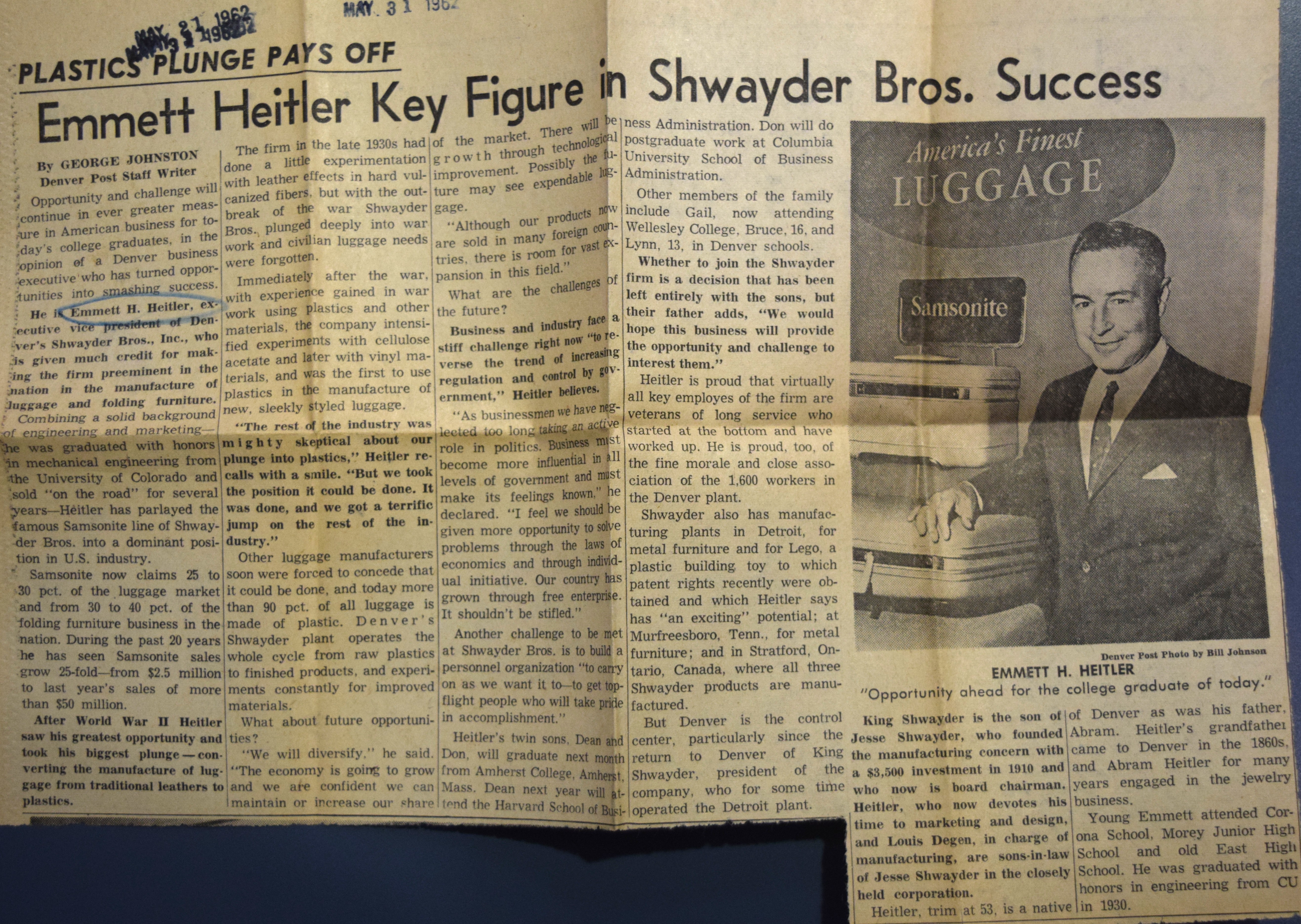
This is significant for a few reasons, but primarily because it treats Detroit and Stratford as two different production environments. It also calls into question logistics, whether or not Stratford could support the production of LEGO for both countries, which we will examine later in the article.
One thing about this site, if you're unfamiliar, is that all claims must have positive, contemporary evidence. Otherwise, they must be signposted as speculation. There is no contemporary source I'm aware of that reports that Canada was responsible for production in both countries.
So, what do the sources say? Well, it's rare for a source to unambiguously give us the answer we're looking for, so we have to see how exactly they speak about the Detroit plant and Stratford to understand the distribution network.
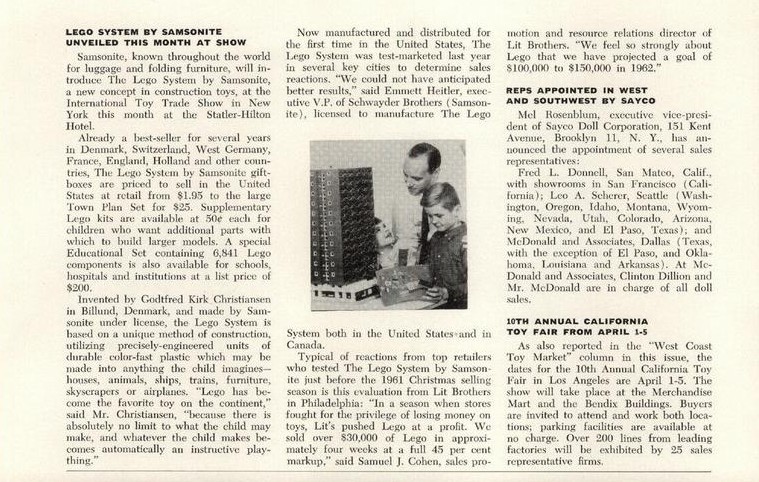
According to a 1962 Playthings article, "Now manufactured and distributed for the first time in the United States... Shwayder Bros. [are] licensed to manufacture The Lego System both in the United States and in Canada."
A 1962 Canadian newspaper makes no mention of a Canadian production in both countries. It explicitly states that LEGO molds are made for both the US and Canada LEGO productions: "Samsonite decided late last year to make the bricks in Canada and secured a license from the Danish firm. It's parent, Shwayder Bros. Inc. also has a license to build in the U.S."
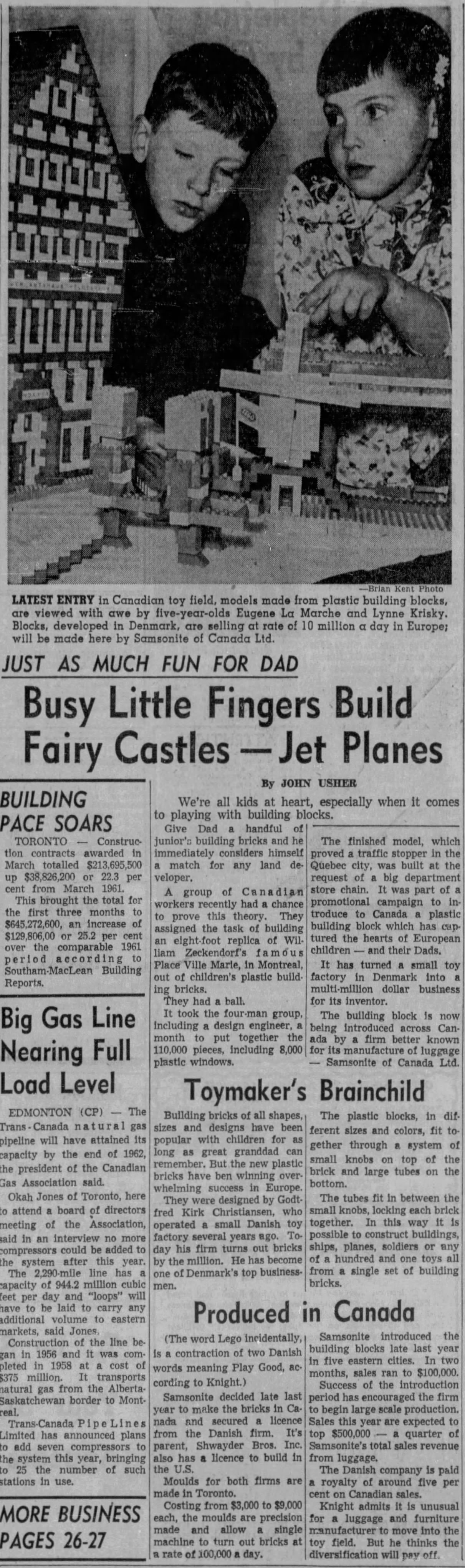
Note this line in particular: "Moulds for both firms are made in Toronto."
A 1962 Norwegian journal also published an article regarding LEGO, which mentions Samsonite. Unfortunately I don't have full access to this one, but it's curious how it speaks to again a separate production structure: "Samsonite has now built two very modern factories, one in Detroit and the other in Stratford near Toronto in Canada. In Detroit, production began with a couple hundred employees, and in Stratford with..."
A December 1st, 1964 newspaper article states: "The Shwayder Brothers closed its Lego plant in Detroit, in preparation to bringing it to Colorado."
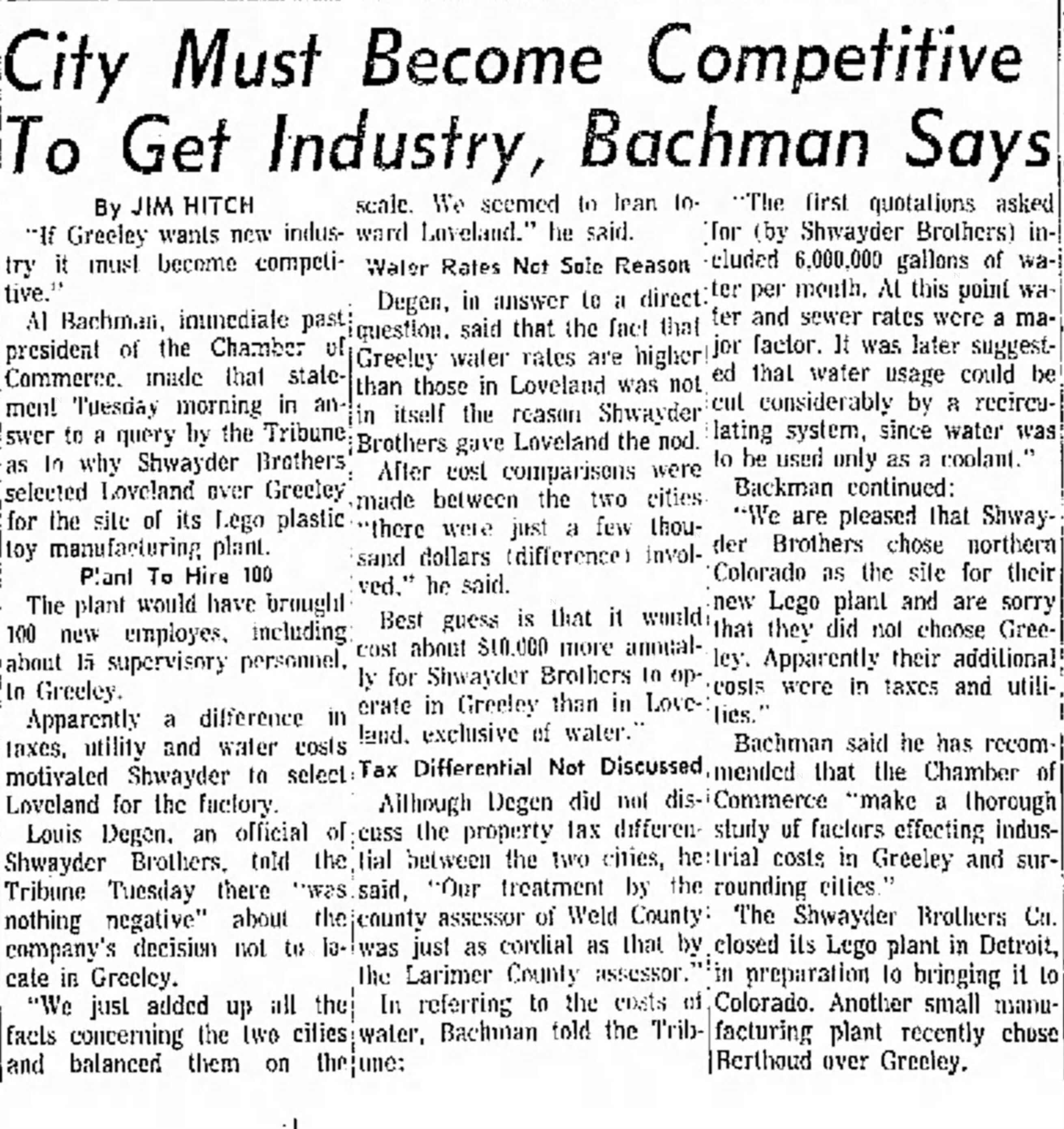
It is important, however, to note that editorially, "production" and "manufacture" have potentially ambiguous meanings and don't necessarily cleanly map to a Detroit production of LEGO elements. Packaging very well falls within production/manufacture. However, when brought together, there is great support that there were two separate productions for both countries.
So ideally, we need a source that explicitly confirms mold use in 1961-62 for LEGO production in Ecrose. We have one quote that vague "molds" were created for Shwayder Bros., but we need a more conclusive quote in order to claim any level of certainty.
In fact, since writing this article, I've found a quote that essentially answers the question itself. According to Modern Plastics, 1962, "the majority of the parts are molded by Shwayder at its Ecrose, Mich., plant, and the company expects to consume approximately 1,300,000 lb of cellulose acetate this year [1962]. Several components are now imported from Europe, but all parts will eventually be produced in this country."
Combined with the information above, as well as what is covered below, a LEGO part production at Ecrose is supported by direct evidence.
Logistical Concerns
Logistics also support a separate conclusion. While not every situation was an ideal circumstance, an important aspect to consider is whether or not the original claim is supported by what each plant was capable of as well as what would be practical.
The Stratford plant was of similar size to the original Loveland plant, 43,000sqft. It was also responsible for luggage and folding furniture production in addition to LEGO. Detroit was much larger, having employed several hundred more employees, and had recently had space opened up with the 1960 opening of Samsonite's Murfreesboro plant.
The point of the Stratford plant, according to Samsonite themselves, was to be able to produce and market products internationally. It was a subsidiary of Samsonite, not a division, and had its own production.
It also was intended to begin exports of Samsonite products according to Samsonite reports. Its production would service other British commonwealth territories, such as Britain and Australia, taking advantage of cheaper export rates through Canada.
The Stratford-only arrangement, if it were true, would've also required the constant shipment of bricks across the Canadian border into the US, which would've required import duties fees. Even at the lowest estimates for 1961-64, with articles claiming over 100,000 bricks could be produced per day, the cost of that arrangement would've very quickly exceeded the cost of the molds. According to the Canadian newspaper linked above, each mold cost several thousand dollars. According to a 1961 Canadian newspaper, the Stratford plant only added 25 jobs to the plant. According to the Norwegian article, as well as other sources about Samsonite's Detroit plant, they had the space and a recently displaced workforce.
While not inherently proof as to what exactly happened, on paper it is obvious the original proposed arrangement would've been extremely messy. Not impossible, but not likely either, especially given contemporaneous accounts.
The Answer
For now, I am very comfortable concluding that Stratford and Detroit had their own separate productions to service each market. And such makes sense, as the opening of Loveland was never touted as the first time LEGO had been produced in the US, it was seen as an operational shift from Detroit to Loveland.