
How did Samsonite offload LEGO inventory after losing the LEGO license?
___
This is one of those fascinating questions that has loomed in the back of my mind for a long time. It's one of those things that isn't privy to documentation, but is important to understanding the wider aftermath.
For context, in 1972 Samsonite lost the license to manufacture/distribute LEGO in the United States. 1972 was the last season of major Samsonite set sales, with Danish LEGO imports beginning almost immediately afterwards.
So the question becomes: how did Samsonite get rid of the LEGO that was left over?
I'd read anecdotes that Samsonite workers sold bags of LEGO parts out of Loveland to locals when it was closing. That very well could have happened, and we have no reason to doubt it. But there are more channels that more account for what was left, as several things have since come to light.
Ad Service Co. of Denver
According to a 1973 newspaper article, Samsonite first tried to sell the remainder of their LEGO inventory to TLG, who did not want them. TLG also did not want to inherit Samsonite's contractual collaborations with Kraft, Del Monte, and Quaker Oats (LIFE). So Samsonite was left to fulfill these things on their own with their remaining inventory.
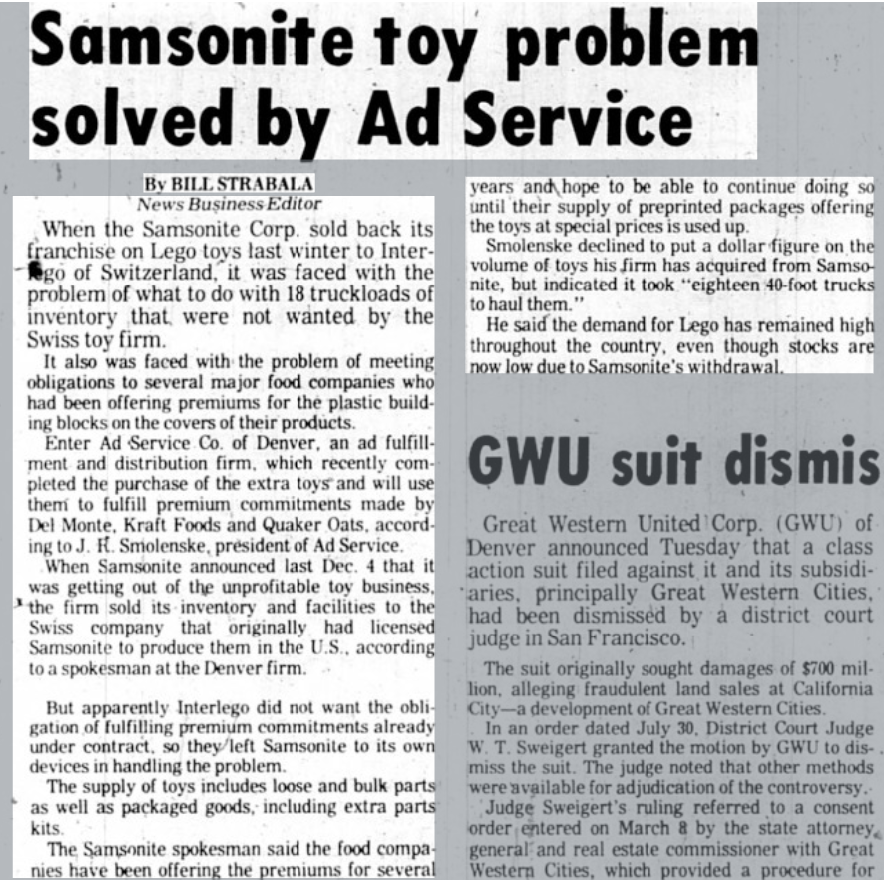
And so, according to the above article, Ad Service Co. of Denver purchased the remainder of LEGO parts from Samsonite, everything from finished sets to loose parts.
Why this company? Well, Samsonite actually began working with Ad Service Co. (ASC) as early as 1971, possibly earlier. This will be covered in detail within Kraft Sets (Late 1971).
So ASC was a significant channel according to the article, responsible for fulfillment of Kraft, LIFE, and Del Monte promotions in late 1973 into 1974.
Between the announcement of the closure of Samsonite Loveland Plant in December of 1972 and early 1973, when Samsonite was negotiation with Gabriel who was purchasing all Samsonite's non-LEGO toys/molds, Samsonite continued production of non-LEGO toys stalling to find a buyer for the Loveland plant and its workforce. The exact date for the permanent closure of the Loveland plant is currently unclear, but given the sale of Samsonite toys in early to mid-1973, the above August 1973 article reporting the sale of all remaining LEGO inventory, as well as an September 1973 article reporting that two of the molding machines had been sold, it is reasonable to assume around August to September of 1973 was when the plant was out of work and closed.
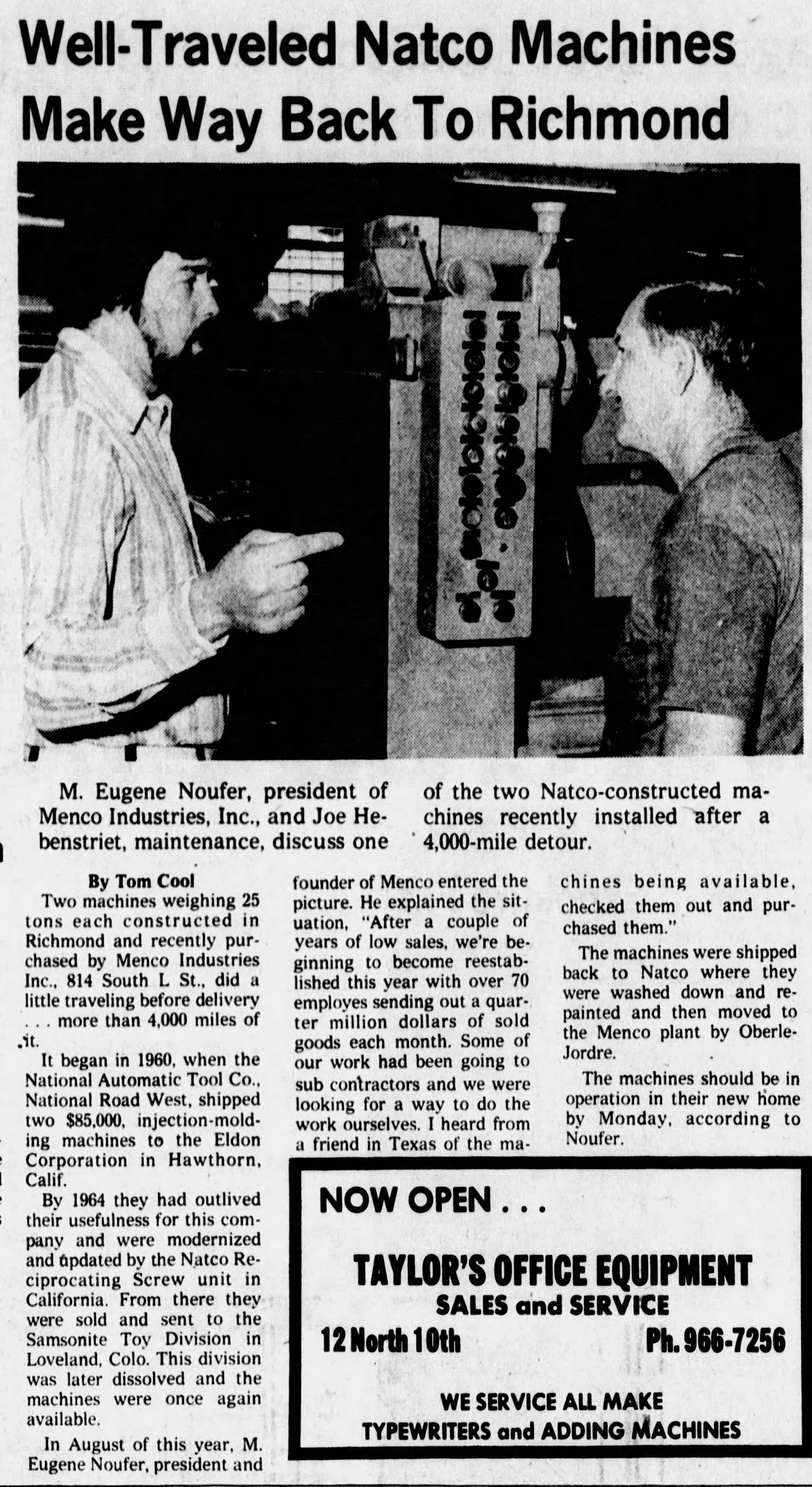
The reason why I give the timeline is to seek a reason why this sale took place at all. It looks like, based on the timing of all these events, that Loveland finished packing of all 1973 LEGO premium fulfillments in mid-1973, but there was little reason to justify the plant staying in operation. And so, ASC took over the inventory and fulfillment.
It's a little unclear what the extent of this inventory was, but we do have a hint in the next section.
Bank Promotion
Beyond the toy premiums, ASC also did local promotions to expel remaining LEGO parts. This is likely where all non-premium packed LEGO sets went. One of such were rewards for opening bank accounts at participating Denver banks in October-November 1973:
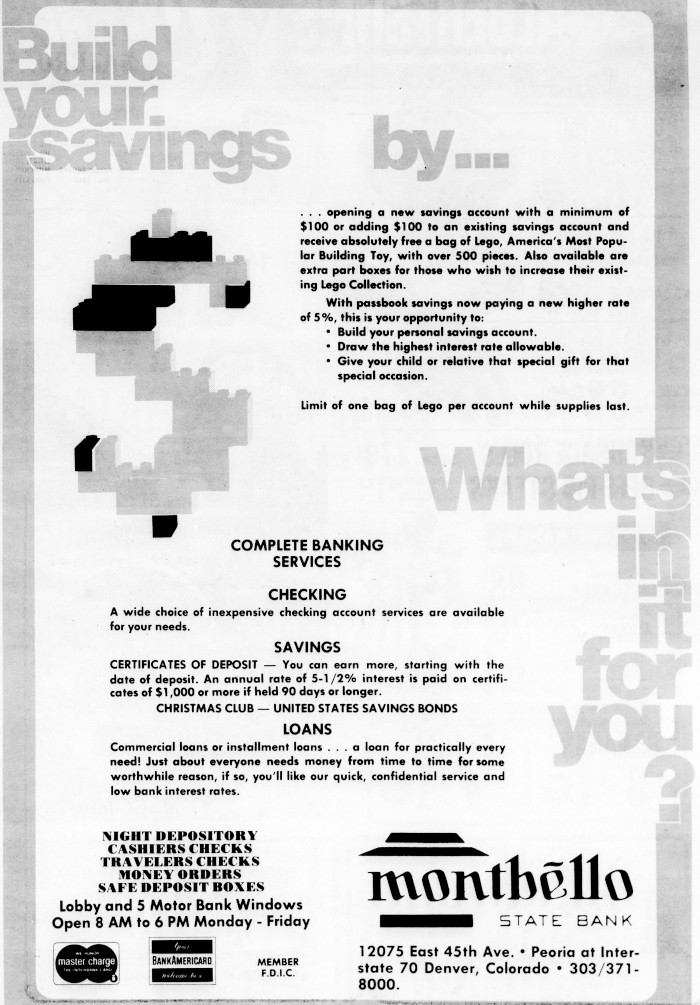
The ad advertises a bag of "over 500 pieces", and extra parts boxes. Because of the duration of this promotion, we can reasonably assume this is where a majority of the loose bulk was directed.
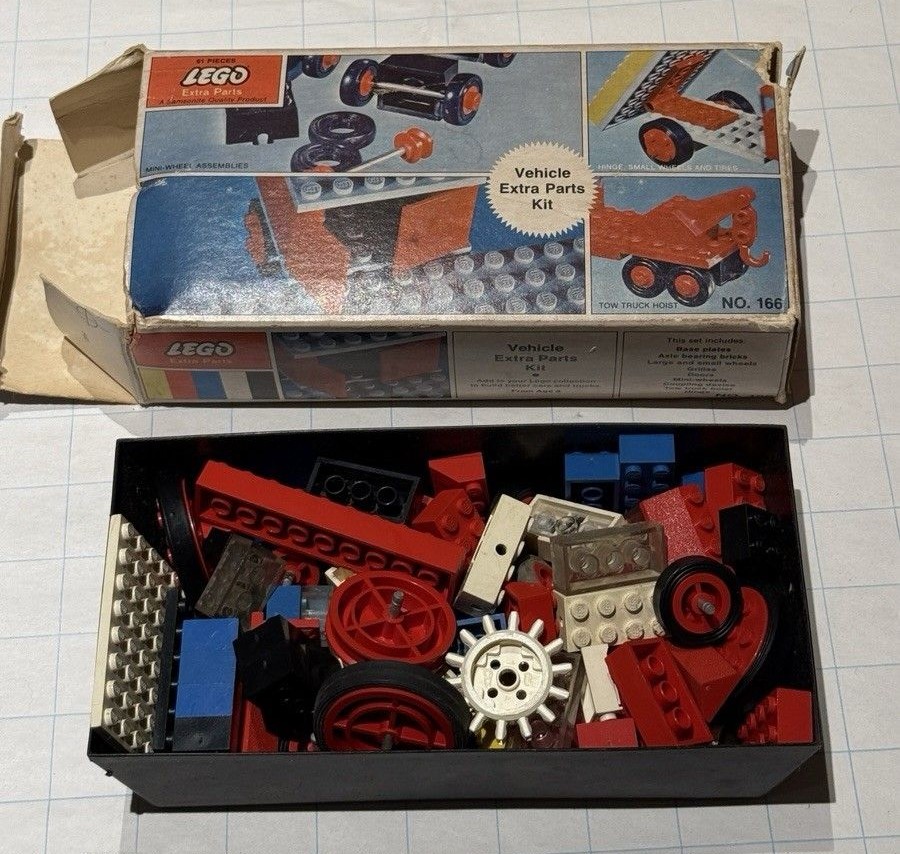
While it can never be tied to this promotion in particular, I did somewhat recently obtain a 166 Extras Parts Kit that contained random 1972-era parts and the uber-rare black tray. I thought nothing of it at the time, but having now having seen the above article and this advert, I believe it could very well be from the 1973 ASC era:
Imagination Sets?
Common thought online has been that the 1972 101, 102, 103, 104, 105 Imagination Sets were created to dump Samsonite's inventory after having lost the US license
I've already written a dedicated article on this subject here: Why did Samsonite lose the USA LEGO license? Essentially, I reason that the Imagination sets were conceptualized independently of and prior to the loss of license, and subsequently was the catalyst for such. It's a fascinating topic on its own.
The inventory dumping idea was originally based around these very large sets that seemingly randomly appeared in 1972—the same year it was known Samsonite lost the LEGO license. So, it was reasoned, the Imagination sets were the means by which Samsonite sold off the remaining amount of their inventory.
If you're familiar with the sets, this will seem apparent. The assortment was incredibly basic, colors were scaled back, etc. However, they're extremely consistent in their assortments/colors, not very similar to the known inventory dumping sets (i.e. the 695 Bulk Assortment Set).
There's much more to the subject, but I won't reiterate it here and my analysis will largely be independent of that context.
Essentially, it's unlikely there was complete inventory dumping going on for two full seasons. Based on reporting, Samsonite still had manufacturing/distribution rights for the entirety of 1972, and had at least distribution rights for 1973 onward for them to sell the remaining inventory.
So, it seems the Imagination sets were at least designed without inventory dumping in mind. It is much more likely for manufacturing to continue with this simplified assortment in 1972, regardless of what one believes the motivation to be. Otherwise, the opposite would be true: the design/manufacture of these consistent assortments to carry out endless inventory dumping of millions of bricks for 1972 into 1973, only for there to still be eighteen truckloads of LEGO sets/pieces left over in August of 1973.
With all that we've gone over, all these channels for which Samsonite's inventory was expelled in 1973-74, I feel the Imagination sets are largely exempt from the explanation as to where Samsonite's inventory went, except in the context of...
Sears 1973 Catalog Sets
This is pretty easy. In addition to the known channels Samsonite used, there is a possibility that Sears was also a channel in which remaining inventory was sold, as it is the only known department store catalog to still be selling Samsonite sets in 1973:
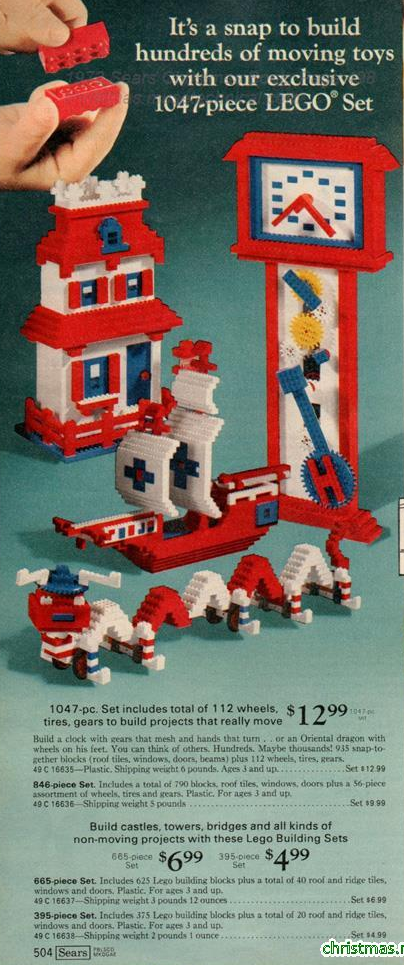
The reason why I call this possible, however, is that we don't really have recourse to verify if this 1973 catalog is extra inventory Sears had from 1972 or new inventory sold to Sears in mid-1973.
It's hard to say.