
The Entire History of LEGO By Samsonite - Historiography
___
While I'd love to do a play by play of exactly what revelations happened when, crediting the earliest efforts to each member that contributed—unfortunately we are far too late to do so. The internet has an incredibly volatile memory in that regard, with message boards, forums, and personal sites that existed in the 2000-2010s are quietly being erased from history, with no archives or means to recover the information shared there.
I'll include some of the most pivotal contributors, but do not treat them as bad faith actors, the task they took on was impossible and admirable. This article is more focused as an exploration of previous research in this field: how progress was made and why some of it was misled.
You may ask: "why are we doing this at all, can we just cover the history of LEGO Samsonite itself?"
Historiography is a fascinating field, in that it's essentially the history of history. It's the study of how those who came before approached recording events, places, people, etc. It seems to be a weird field to utilize, especially in LEGO history of all places, but what you'll find is that each example below is a different cautionary tale, and we can use them to learn and grow as researchers.
That's why this is the first topic in The Entire History of LEGO Samsonite.
What sources were available?
As early as 2005, LEGO Samsonite sets were starting to be documented. As you can see, it was based on extremely limited information and primitive mapping, essentially just recording things as they were found.
Sets were unable to be properly dated, such as the LEGO Samsonite 001 Gears set being assigned a release date of 1971 instead of the true 1965. It's unclear where exactly these early dates came from, whether they were complete guesses or based on something dateable.
Over the next decade, the information above was refined as more sources reached the community. Eric Strand's brickshelf is a wonderful time capsule into exactly what had been collected by the late 2000s to early 2010s in regards to LEGO Samsonite. It's not necessarily everything, but essentially so.
Eric is primarily notable for being the first to scan LEGO Samsonite ephemera and place it in a timeline, even collecting scans of rarer materials from other Samsonite collectors. These efforts were impressive, even given the limited number of sources they were working with. Having scanned some dealer catalogs and order forms, they primarily used those as what they calibrated their information against. Very rarely does a piece of LEGO Samsonite ephemera have a date or year, thus it can only be dated in relation to outside materials.
They had a collection of catalogs from Sears, JCPenney, Eaton's, FAO Schwarz, as well as department stores like Wards or Spiegel. It was not a complete collection, more so whatever scans they could find or make themselves.
Similarly, several magazine ads were available, but often lacking sourcing.
How was research conducted?
Early research was limited in that there was little recourse for verification beyond one's own personal collection. Without such, collectors would search online to see what a set exactly was, and if an answer existed, that was the answer.
Sometimes users would turn to message boards or forums, asking specific questions about the lot they'd purchased or a specific set. Information online was contradictory, incomplete, or the set was entirely missing, so it didn't hurt to ask.
In these forums, several users rose as the defacto experts for anything LEGO Samsonite, as any relevant post would automatically be deferred to them. This is where a lot of progress took place, in that these specialists were interacting with LEGO Samsonite material beyond the surface level and critically thinking about information online and their own sources. The first steps in the right direction.
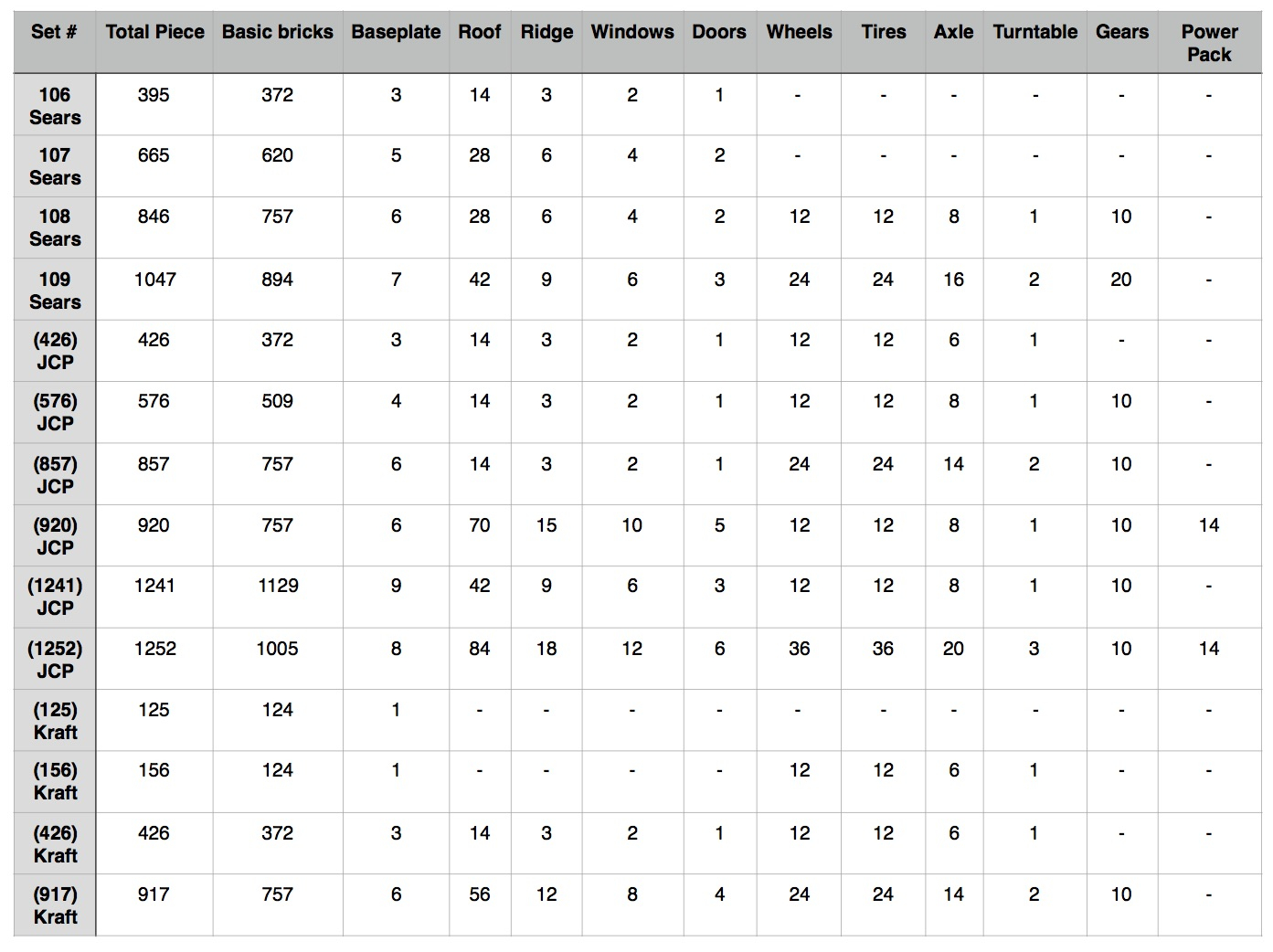
One such example was LusiferSam, who decoded the inventories of 1972 Imagination Sets. His work can be seen below or in this article: Orgin of Imagination Set Inventories:
The forum approach, while it was corrective of what came before and made positive change, relied heavily on the work of a select few in a fundamentally limited format. There was an implicit incentive to supply an answer, as someone passionate in a subject wants to bring what they know to the table, not just shrug their shoulders. We'll get more into why exactly that's problematic in the examples below.
Example: FAO Exclusives
As we've already covered in the Preface, some claims were borne from assumptions based on observations. There was a need to explain a particular pattern, but little evidence to actually do so.
In this particular example, I think there is also an element of telephone at play, wherein I don't believe the original claimant offered the idea so confidently. Regardless, it has made a life of its own, so much so I've coined it as "FAO of the gaps".
Remember that early research relied more on physical sets and pamphlets rather than third party ephemera. As such, collectors were left with several mysterious sets that never appeared in regular LEGO catalogs:
244 Explorer Set
835 Advanced Builder Set
066 Governor Set
080 Ambassador Set
005 Discovery Set
223 Adventure Set
704 Master Discovery Set
326 Suburban Set
630 Diplomat Set
So the issue becomes... when exactly did they release? Why are all these sets missing from normal LEGO catalogs?
Imagine you have a limited number of adverts to work with. You are given the above list of sets, and you need to find where they go.
You have these FAO catalog pages (1968 left and 1970 right), the only known place some of these sets appear in:
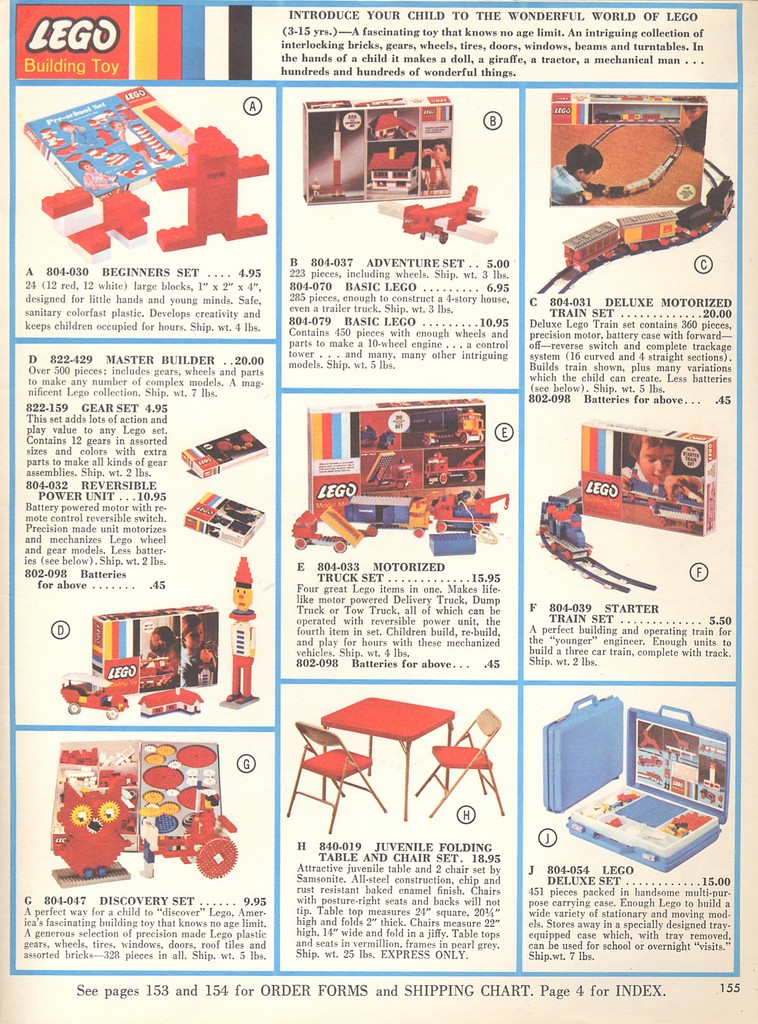
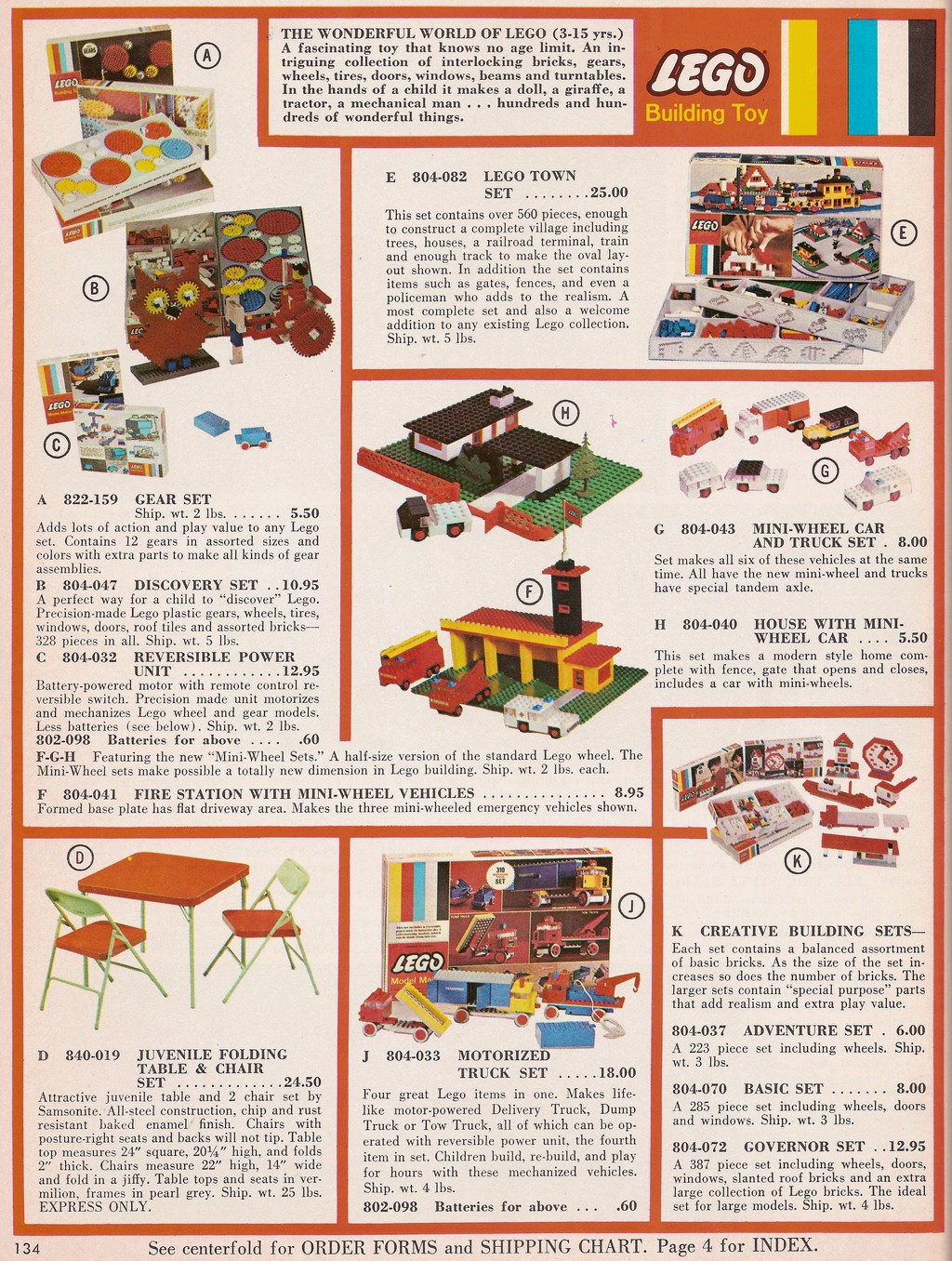
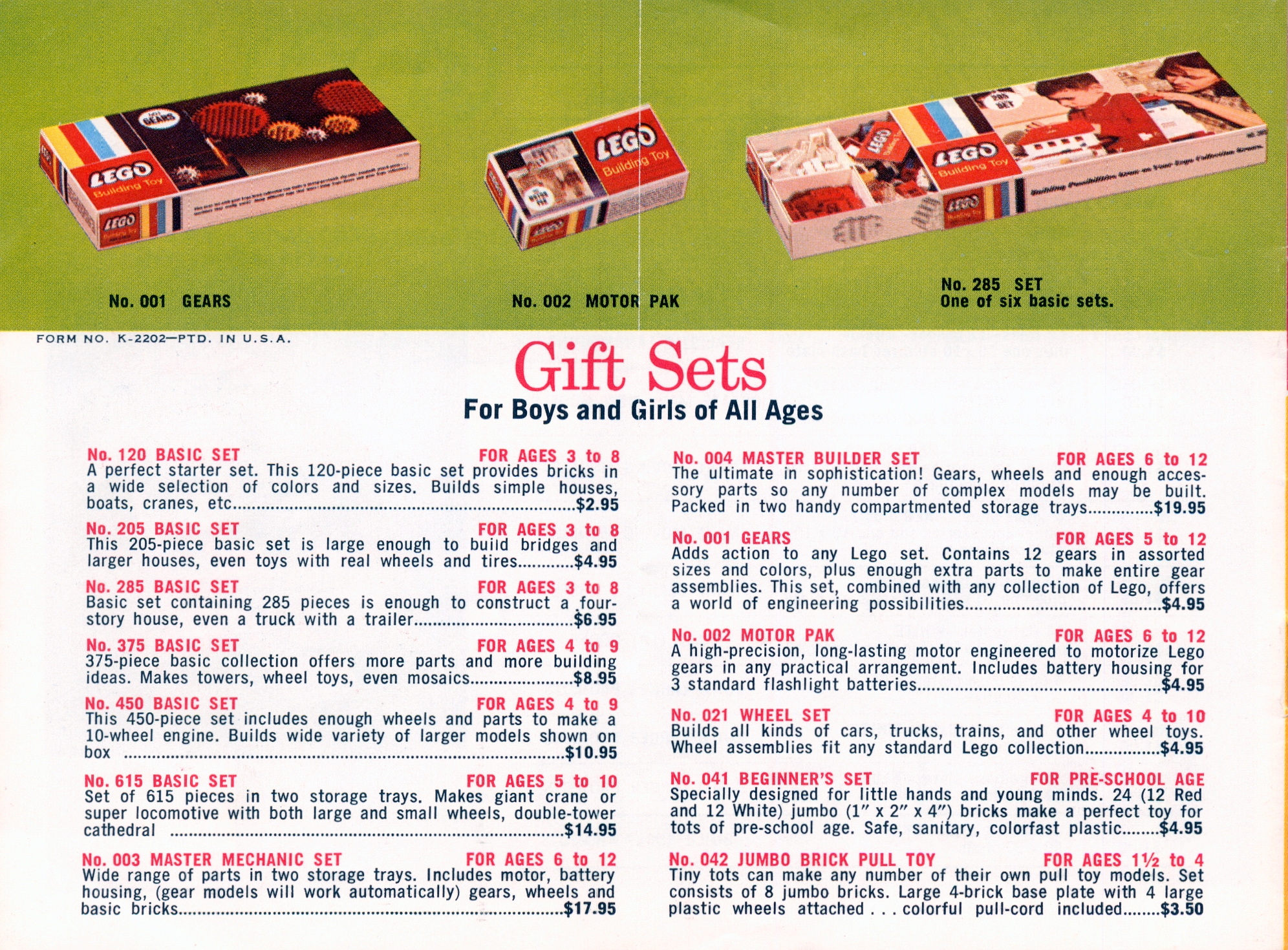
You also have the context that FAO is known for being America's luxury toy store and was well known for having its own exclusive toys. You're also aware that Sears had its own unique exclusives. You also notice the above sets all have names, something that the normal basic sets, the ones that appeared in catalogs, did not carry (only specialty sets had names):
Thinking about it further, the names given to these sets are very regal sounding. "Ambassador", "Diplomat", "Adventure". They sound like a premium product, not a normal LEGO set.
Thus, given all those seemingly related nodes, we conclude all sets above were FAO exclusive.
This is a direct quotation of a post perpetrating FAO of the gaps as late as 2019, wherein it would seem logical on the outside looking in...
"From 1965-72 FAO Schwarz had USA Samsonite LEGO produce about a dozen exclusive LEGO sets, most of which were not sold anywhere else. The largest of the exclusive LEGO sets was the 630 Diplomat Set of 1971-72... The 244 piece Explorer Set, another FAO Schwarz exclusive. Most of the FAO Schwarz sets had a set number that matched the parts count... Most of the FAO Schwarz LEGO Set exclusives had names, such as the 326 Suburban Set, the 223 Adventure Set, the 066 Governors Set, and the 080 Ambassador Set. Here is the 326 FAO Schwarz Suburban set, sold nowhere else... Because FAO Schwarz is a luxury toy store, all the sets had random fancy names... 630 Diplomat, 326 Suburban, 080 Ambassador, 066 Governor, 223 Adventure, 244 Explorer. The name had nothing to do with the function of the set."
...but none of it evidently holds up, as no LEGO sets were FAO exclusive.
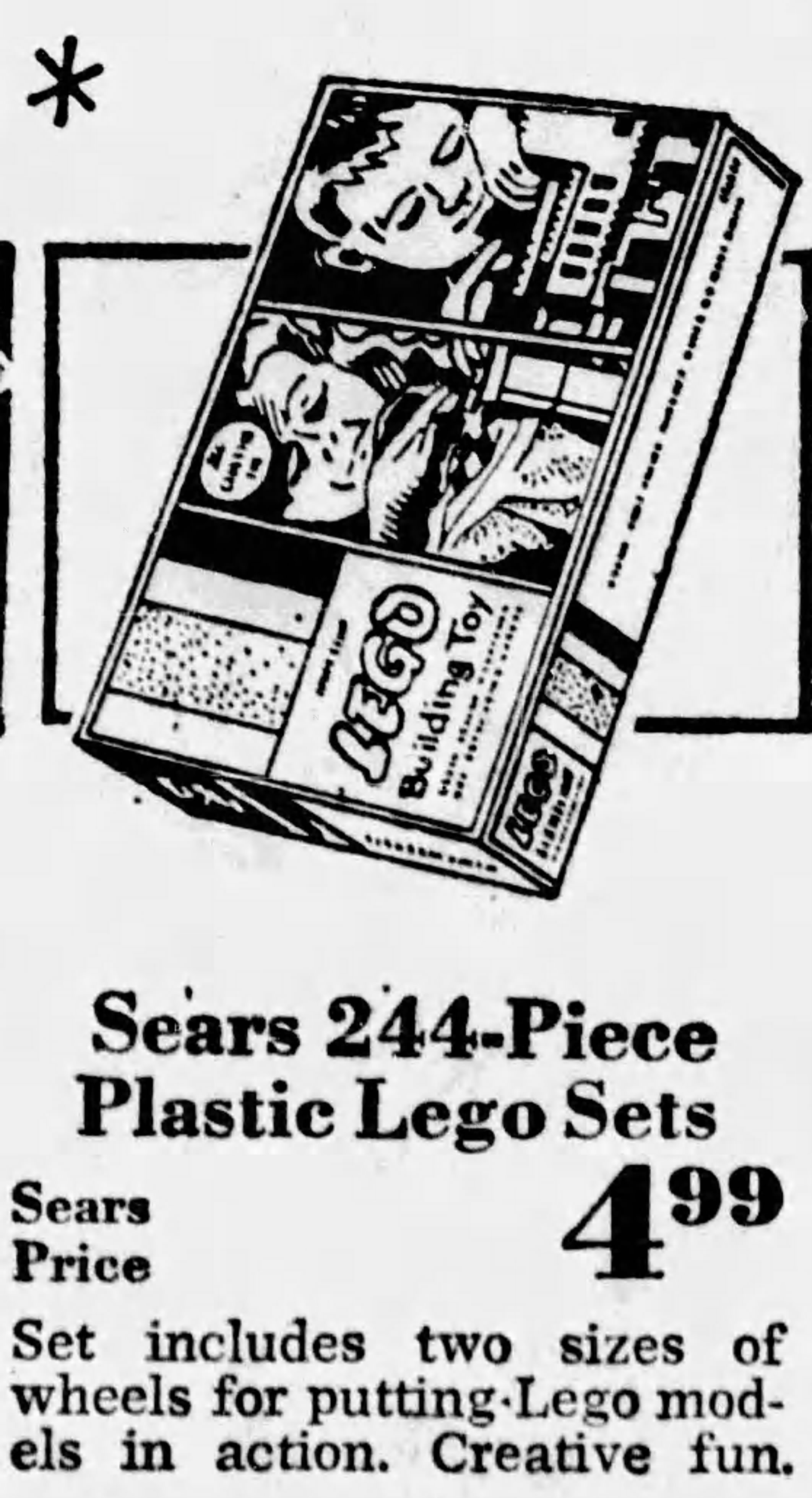
We will go through each example as we get to them in the history. For now, the easiest to demonstrate is the 244 Explorer Set, which was actually a Sears exclusive starting in 1967, as can be seen in all Sears catalogs 1967-71 as well as newspaper ads also from Sears, such as this 1967 newspaper:
The lesson here, as a TLDR, is not to make assumptions and present them as fact, even if the idea is grounded in reality. This is why so many LEGO Samsonite sets have been misunderstood, such as the example below.
695 Bulk Assortment
Some claims originated via an incorrect process of evaluation: taking what was known and fitting the evidence to it. The 695 Bulk Assortment is a notorious example.
I'm not sure exactly where this information originally came from, but it's been a very big talking point since the early 2000s that Samsonite lost the license to produce LEGO around 1971-72 and produced several sets to offload inventory.
This is a direct quote from an early 2010s EuroBricks post:
"...what [Samsonite] was doing was dumping the last of their LEGO plastic pellets and parts inventory before the Aug. 1973 end date for LEGO sales... and they were creating huge boxes of LEGO, some with over 900 parts (in Sear's catalogs, some very large sets had nearly 1300 parts). So they were selling it at bargain prices just to clear out their remaining ABS inventory. Some parts... such as yellow bricks were already nearly depleted by 1972.
Here is another set... the #695 Bulk Assortment Set, a set dating to about 1972-73... no 2 sets have the same contents (as can be seen by the 3 shown examples (2 are MISB). Also notice almost no yellow parts... and have you ever seen such a strange plastic compartment or non-colorful outer box sleeve? Samsonite no longer cared about these things... they just wanted to get rid of the last of the parts they had in inventory... and by the look of it... they had a lot of blue parts left over."
You can very well see how these ideas got mixed together by that last line alone.
But put yourself in their shoes, you know Samsonite loses the LEGO license and you know they put out massive sets to deplete part inventories. You have several examples of these sets titled "Bulk Assortment", and their inventories are immensely varied, looking like this:
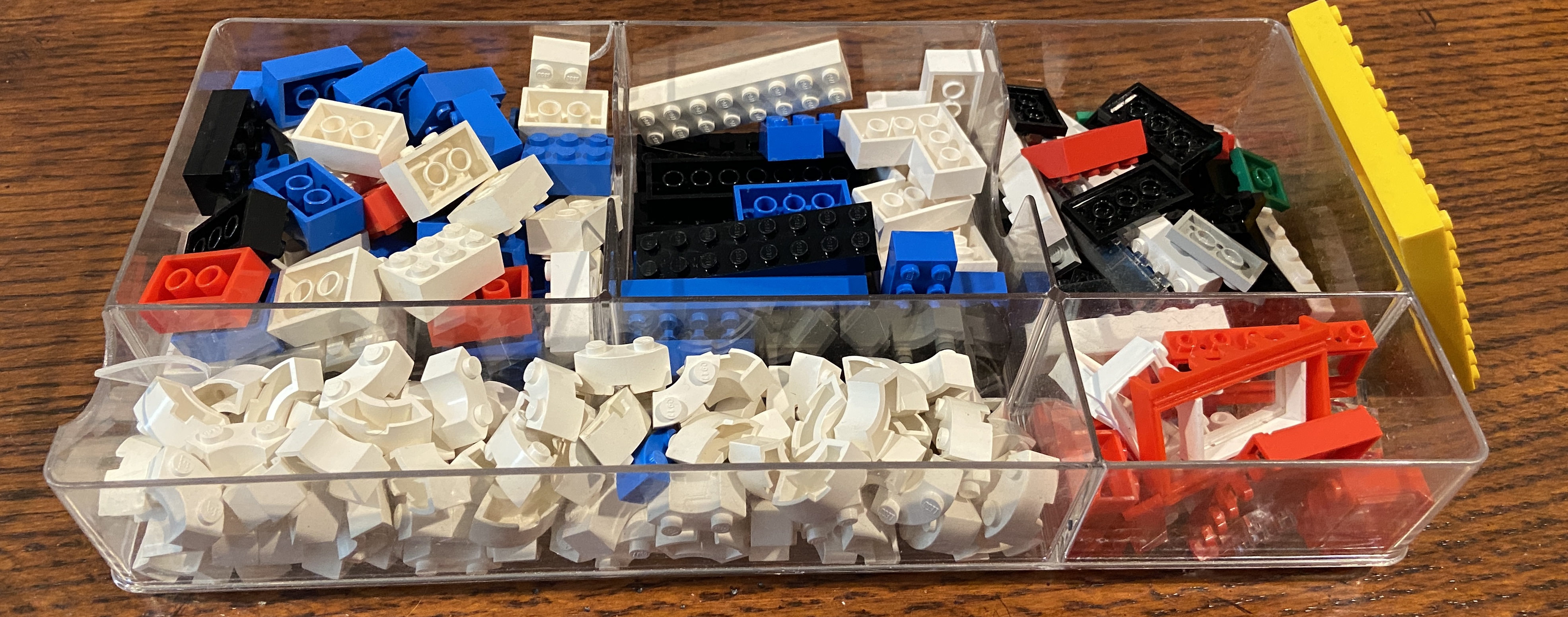
It's reasonable to see as to how the 695 was attributed to the 1972 flush.
How we've overcome that here is that we've looked at the contents of the set itself, with several notable examples that only ever sold in the 1961-65 supplements line including 2x8 and 2x10 black bricks, 4x4 corner bricks in yellow and black, 10x10s in any color other than red, and green plates. Then, cross referencing that with newspapers and the line's structural changes from 1965 to 1966, it's very clear to see what happened.
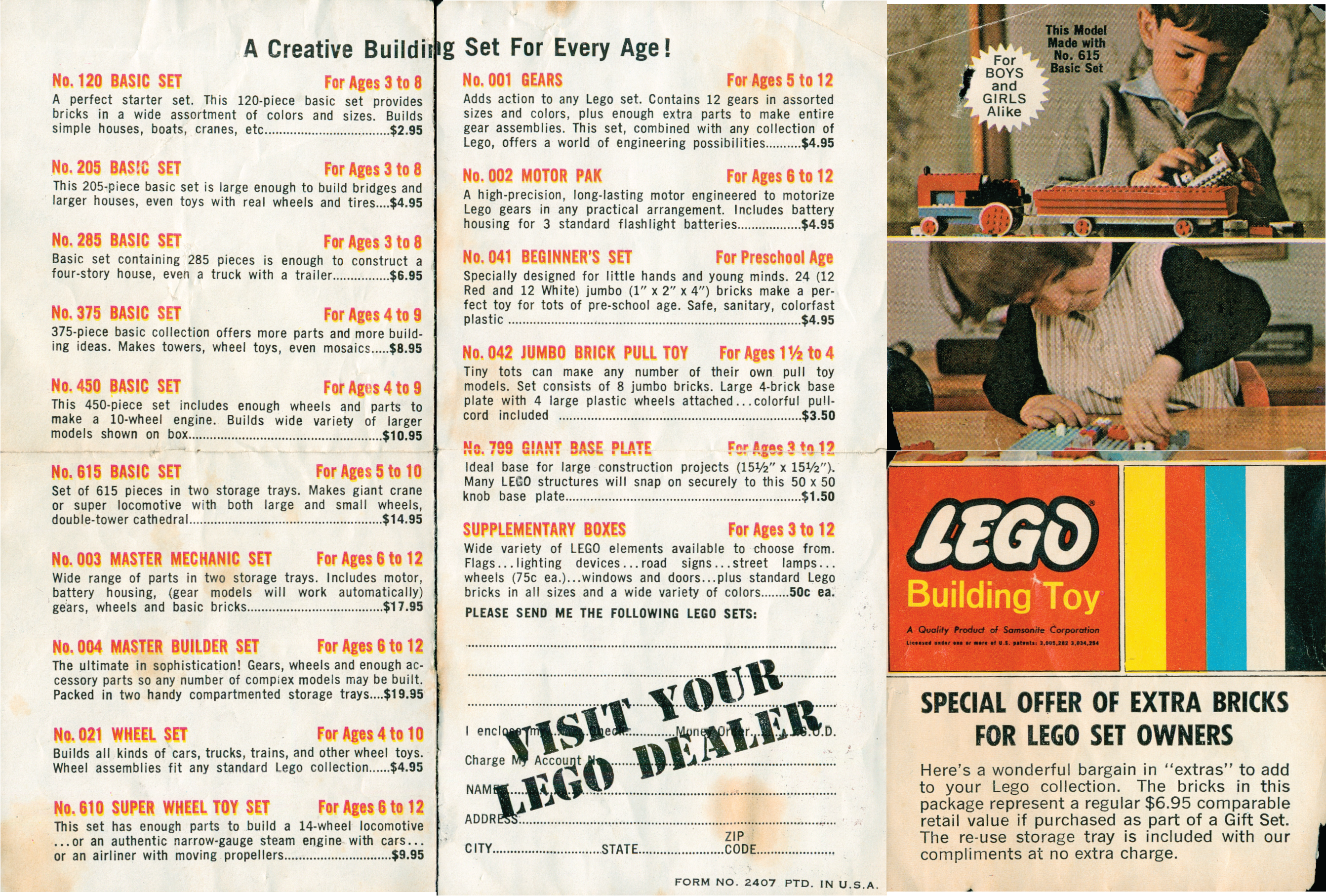
The pamphlet that came with some copies of the set as well also has conclusive provenance for 1965 and was reused for the set, but that's a story for another time:
1965 Sets
Some incorrect claims originated from the misleading nature of sources. This mistake, declaring that 12 sets released in 1966, was because of the overreliance on one type of evidence over others.
Most sets that released in 1965 were for the longest time (and most still are on popular catalog sites because changes take ages, especially ones as niche as this) listed as being from 1966. The only two exceptions are the 001 Gears and the 002 Motor Pak, those have been widely accepted as having released in 1965.
So why did this happen?
We'll get more into the real events when we get to 1965 in the actual history, but I've made the case several times onsite that the 001 and 002 were ready for market much earlier than the rest of the 1965 line, which was a direct redesign of the 1961-64 line.
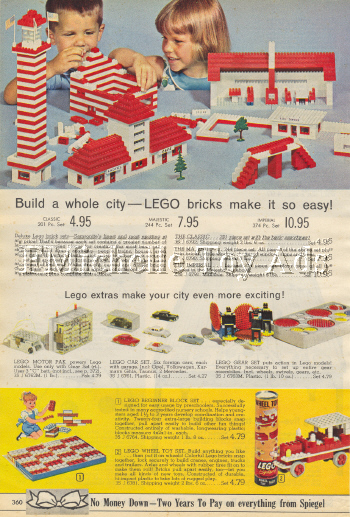
What we see in 1965 magazines and catalogs is the 1961-64 line still for sale, and only the 001 and 002 are new:
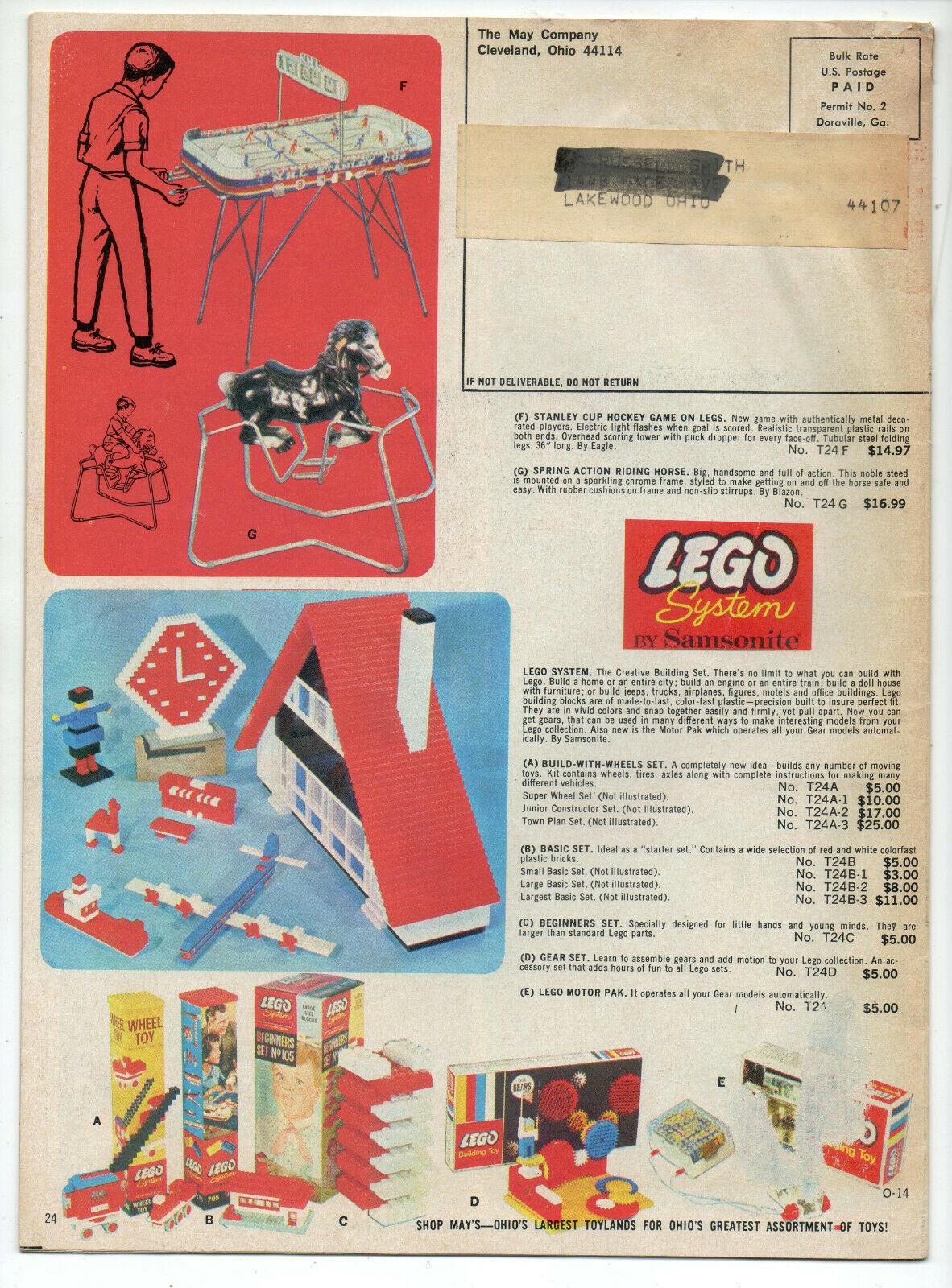
From this, it's very clear what happened, but that's not all the confusion. This 1965 Dealer Order Form also was made available in the early 2010s:
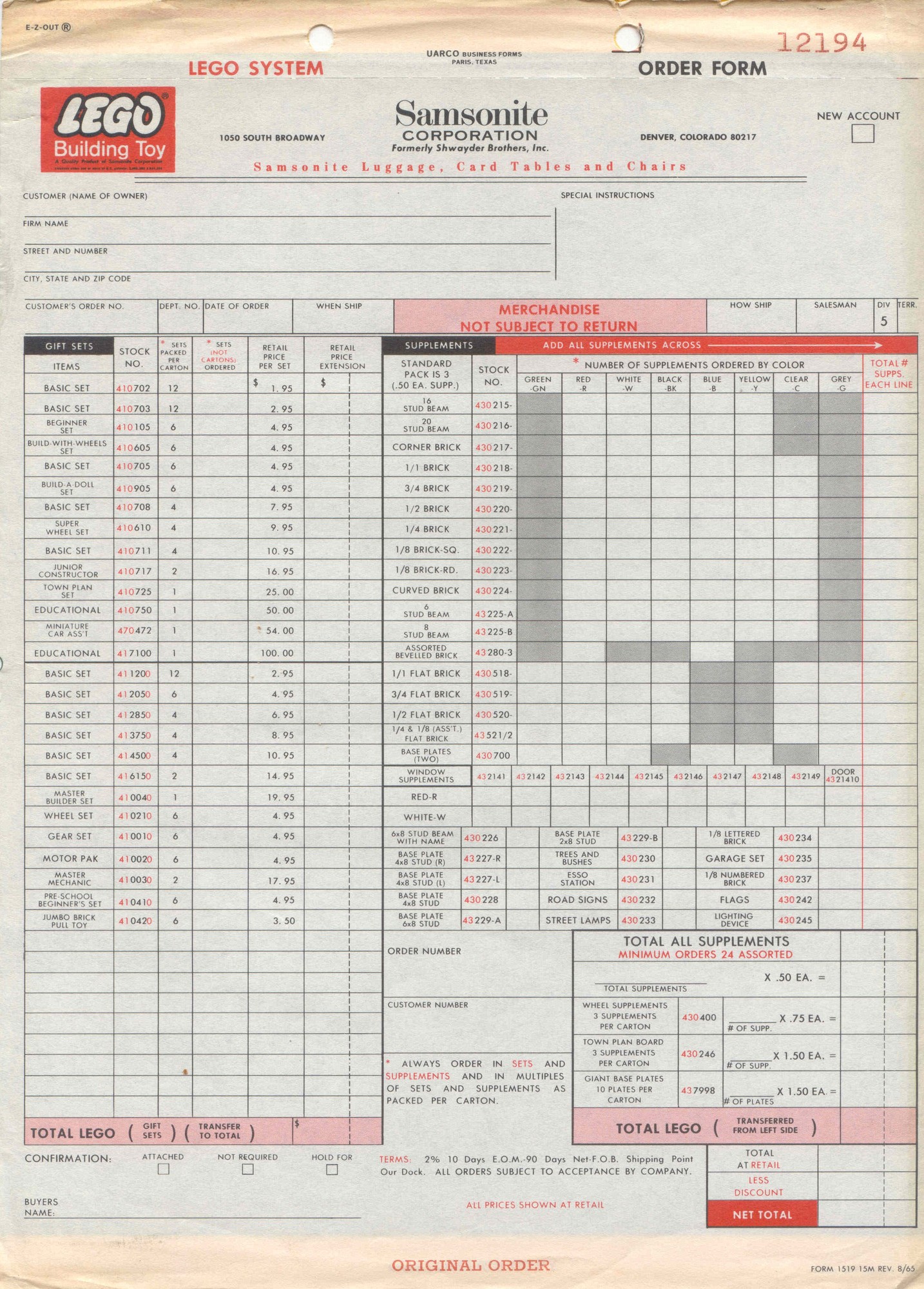
Which clearly shows both the 1961-64 sets as well as the new line. But given the above examples, the new line of sets were not appearing in 1965 catalogs. So it was assumed that these were "pre-orders" of a sort, in which they were included on 1965 documents so that dealers could order them for the 1966 season.
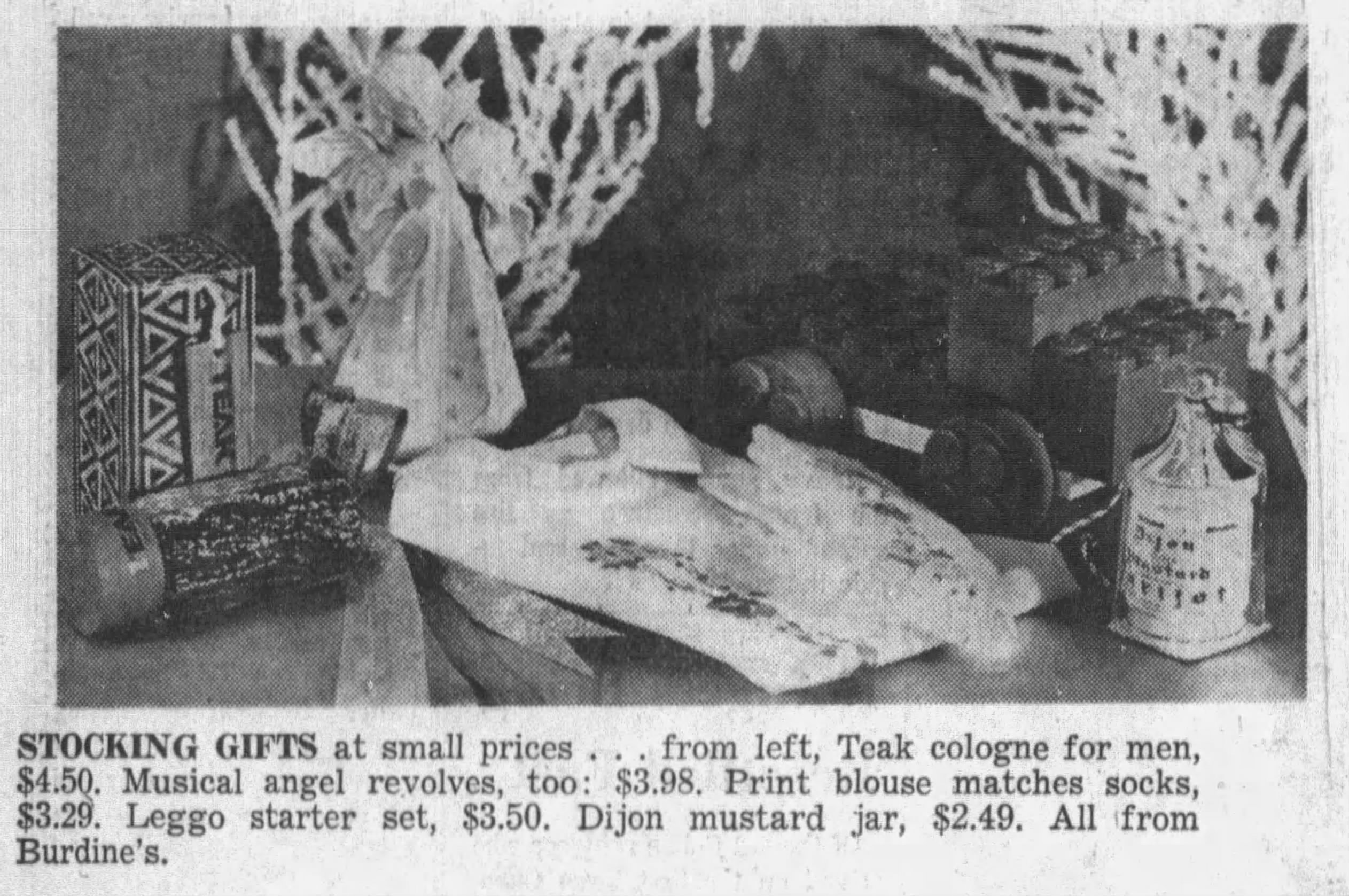
I myself also thought the 1966 date was true when I had began the initial compilation of the site, as even when I'd combed newspapers searching for "LEGO Samsonite", I only came across ads for the older line. It wasn't until a bit later, when I changed my 1965 search to just "LEGO", the new line appeared in hundreds of examples across the country, including the 042 Pull Toy, considered the least likely set to have released in 1965:
The problem that I and everyone else faced was not necessarily completely one of our own fault, it is instead a reflection of the messy nature of product releases. There is also the nuanced factor that Samsonite scaled back their own name on LEGO products starting in 1965, which is why I missed a lot of appearances my first time around. In focusing my search, searching for anything that mentioned "LEGO Samsonite", I missed everything that just mentioned "LEGO".
Again, we'll go in depth and show evidence as we go, but the 1965 line was rushed to market, and most store catalogs were already in print by the time of release. Thus the discrepancy, in that the 1965 line in catalogs appears to have released in 1966. Thus, we should not depend on just one form of evidence, but instead the triangulation of multiple. While newspapers have their own limitations, they are wonderful sources to calibrate against.
Takeaways
I think it's important to highlight that this article on its own seems drastically overdone for such simple lessons. What we're doing is setting the stage as to why this project has had to recompile everything from scratch, why our history looks much different than any other.
I want to also make absolutely certain that this is clear: this is not meant to discredit the works of anyone or impress they were working in bad faith. We all have bad information, jump to conclusions, etc. I've corrected myself numerous times, that's an expected and important part of the process, to be able to integrate and adapt to new information.
This is not a "takedown" of those that came before. These are simply lessons the community had to learn and should be remembered in order to move this field forward. That is why this site insists on such a rigorous approach, in which research and evidence should be transparent. You have access to everything that we used, comparisons and reasoning, as well as signposts marking the limits. This was also useful as a brief history of research into LEGO Samsonite, which I find absolutely necessary.
Now we are primed to cover our main topics. First, the history of Shwayder Bros, Inc.