
Why Do 1972 Cube Sets Have Two Different Boxes?
___
This is another one of those mysteries that we don't have a single element to point to, but instead a body of evidence to present and then extrapolate an answer.
For now, for those unfamiliar, in 1972 Samsonite's US subsidiary released five "cube" sets in 1972. Traditionally, it was believed they were created explicitly to sell off Samsonite's remaining inventory of LEGO, having lost the license to produce LEGO for the US market. That assumption, however, was originally built around the sudden appearance and drastic shift in design/assortment for the Imagination Sets, as people knew the loss of the license happened around this time. So it only made sense to explain them as inventory dumping sets, with both box styles being produced after the loss of the LEGO license.
However, while incorporating new information that the community did not previously have access to, the answer became there are two box styles for 1972 because one of them was essentially the catalyst for the loss of the LEGO license. One was prior to the loss, and the other was after the parting of the two companies.
There is very compelling evidence for this sequence of events, you can read more about it here: Why did US Samsonite lose the LEGO license?
But we're not going to rely on any of that for the following article. This was written prior to me realizing they were not originally intended as inventory dumping sets, but the answer found below has only been strengthened because of our inference. I've obviously had to amend my own characterization of these sets, but our arguments below didn't use that extensively.
With that out of the way, the Imagination Sets used two different box styles:
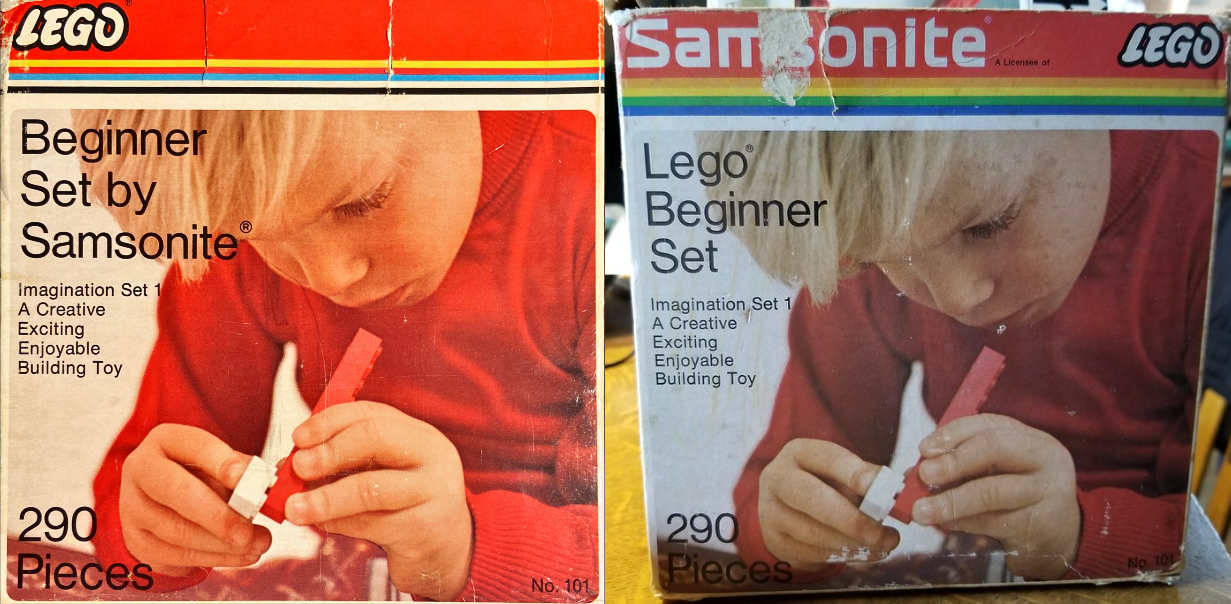
I'm curious of two things.
- Which one came first?
- Why exactly did they make the change in the first place?
It's not as simple as pointing to an advertisement or a dealer catalog, as there is a lot of nuance at play. It seems a simple topic, but there is a lot to unpack.
Before we begin, remember we are working with a relatively small window of production. Samsonite may have started production of these sets as early as late 1971 (not really important or demonstrable exactly when, but that is our absolute beginning) and released for the 1972 season. Sales went on into 1973, but Loveland closed in December of 1972.
Current Consensus
At the time of writing, only one authority in the space has written about this topic. They state (while talking about the #300 Jumbo Bricks Set): "The set is unusual because of the size of 'Samsonite' on the box top versus 'LEGO'. This was because 1972 was the last year for the USA Samsonite LEGO license, and they wanted to promote the Samsonite name before the license expired." At another point, they also write: "You will notice how huge the word SAMSONITE is on these 5 very large boxes. They already knew that their LEGO days were numbered, and no longer cared about toe-ing the TLG corporate line about how to make the LEGO logo on the boxes."
Which is a very easy assumption. I'm not immediately writing it off, only that it reaches a conclusion very quickly, and concludes something that cannot be verified or even known. It is highly unlikely the claimant had spoken with anyone related to this decision or confirmed via surviving sources that Samsonite wanted to promote their company's brand name before the license ended. They likely would've stated as much if they had official sources.
I've also since spoken with the quoted researcher, and they now have changed their mind regarding the ordering. Worth noting, but we're still going to test the claim thoroughly.
We'll get into this a bit later, but the above claim doesn't stand up well to scrutiny. If TLG was fickle about the LEGO logo, why would Samsonite open themselves up to litigation? Sure they were losing the license, but that wouldn't mean they were allowed to do whatever they like. Something worth noting now is that in 1971, Samsonite's toy division experienced "extensive losses" and that they were hoping to just break even for 1972.

If the goal was to promote the Samsonite name, why would they use LEGO, the product they had produced with poor sales (less than $5 million in sales across 1961-64, while luggage sales went $50+ million consistently every year) as well as quality issues over the last decade?
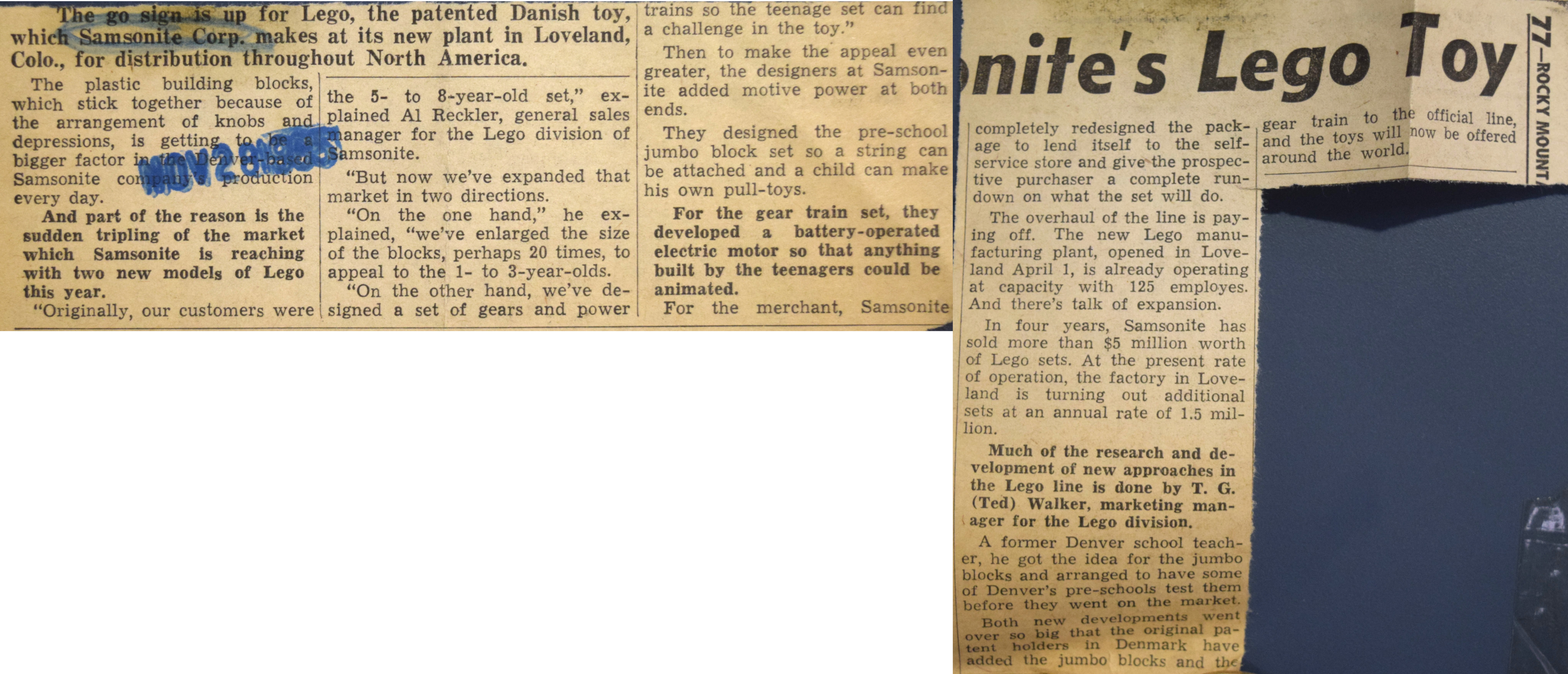
Especially these sets, molds were worn out, part variety was low, and there was no big marketing push. Samsonite's name had already been well acquainted with LEGO in the US anyway, it would not necessarily be a game changer. We've even seen Samsonite's name shrink on the packaging throughout the 1961-72 production run (turning into fine print in 1965 and moving to the back of the box starting in 1967), which indicates Samsonite did not want their name to overtake LEGO's. There'd be no reason for LEGO to mandate that Samsonite make their name smaller given how misaligned the two companies were in regards to LEGO production, that would've been Samsonite's own choice.
Let's also keep in mind that changing a box design would be very expensive. Something must justify that cost, which is where I believe the strongest arguments can be made. It isn't just a question of why Samsonite moved their name, but instead why there are two distinct box designs for one production season. Which would immediately demonstrate the ordering. The issue is, however, we have to start with which one came first to get into why. And that's going to take a lot to demonstrate conclusively.
It's important to note I'm simply pointing out that easy routes often lead the wrong direction. If we want to arrive at the answer that most aligns with reality, we must consider nuance and not just the most convenient route. That's why the Imagination Sets have been misunderstood for so long.
So with all that out of the way...
Which one came first?
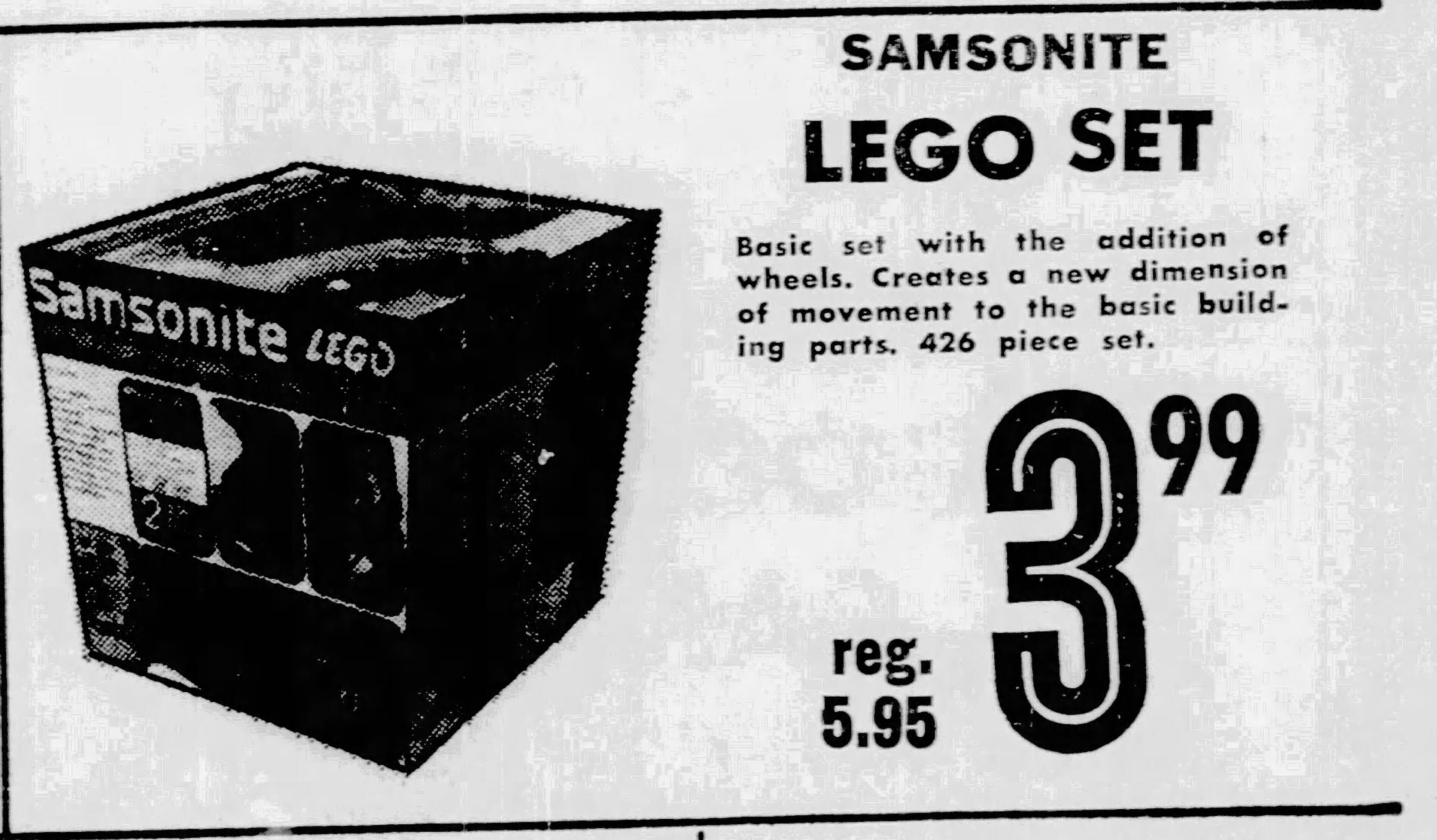
For the longest time, the earliest images I had found in dateable materials were from newspapers, such as this one from September 6th, 1972, showing the large Samsonite logo box:
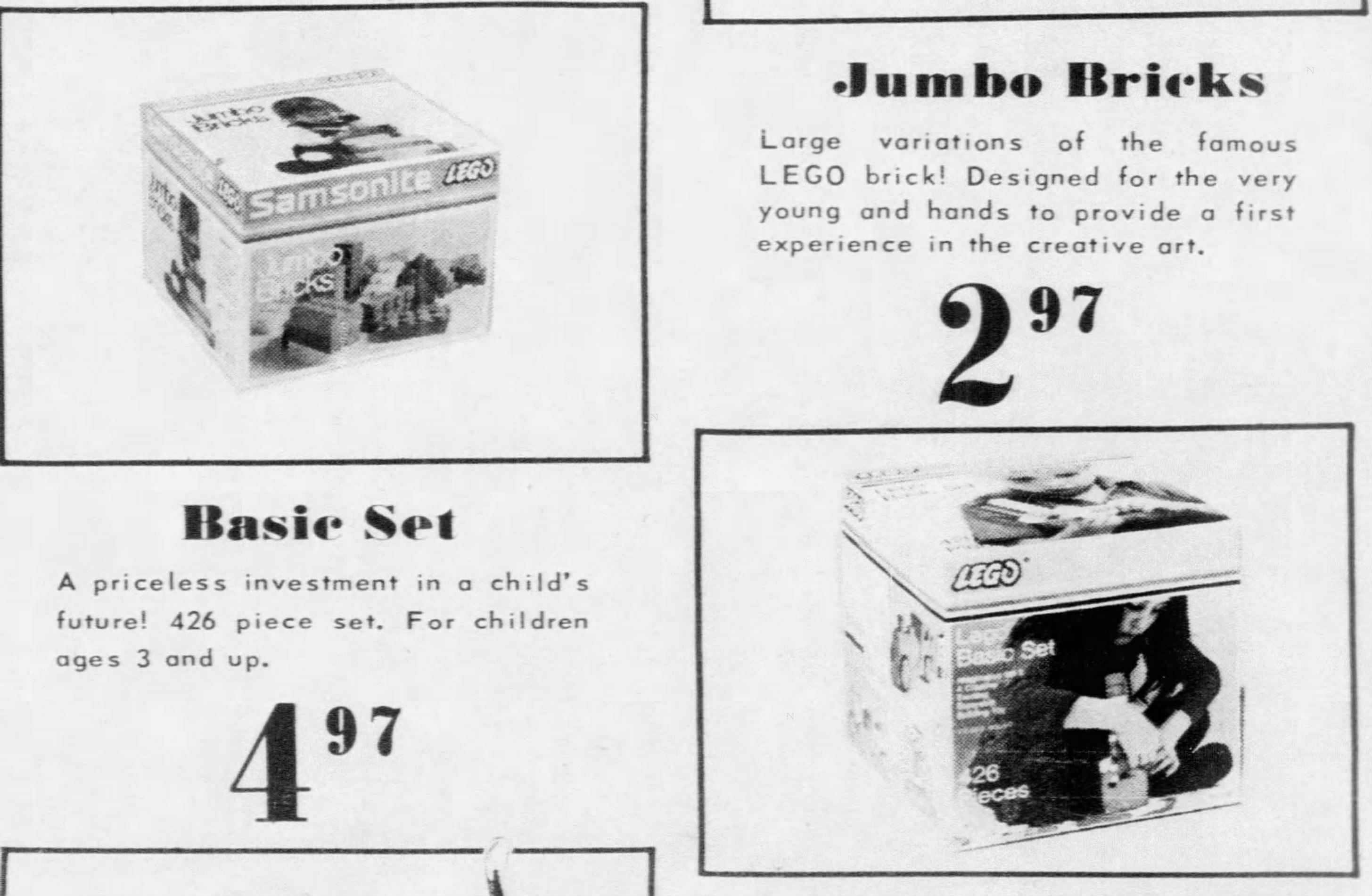
This one, from early November, shows both styles:
Then a Sears advertisement from December only shows the LEGO logo one:
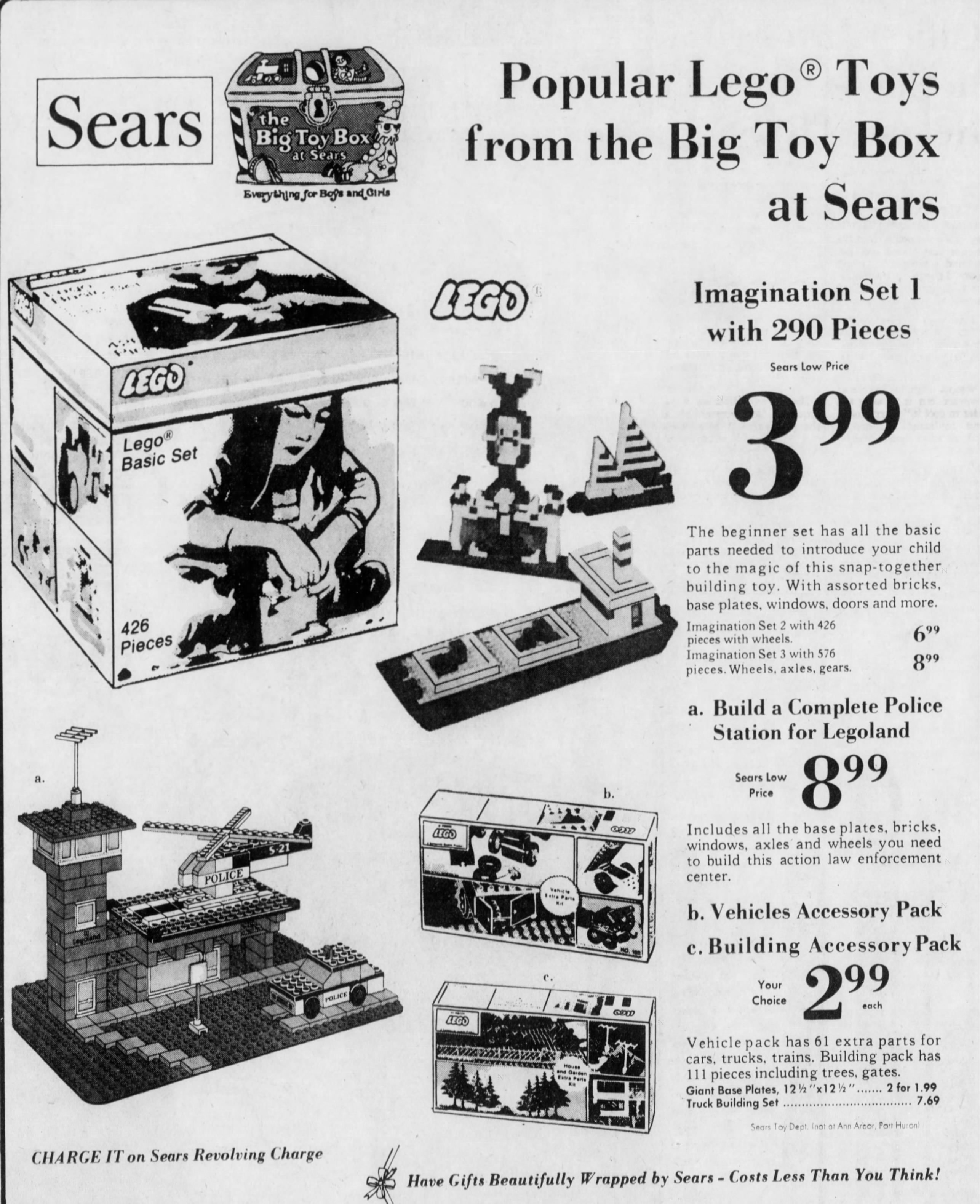
So it is very easy to go by the sequence above, that the large Samsonite logo version came first and was eventually replaced with the LEGO logo.
This is even reflected in the prepared pack-in brochure and the 1972 Dealer Catalog, as both show the large logo version of the box. From what we've seen in previous years, the dealer catalogs were typically sent out before the line's boxes were finalized (i.e. 1965 and 1970):
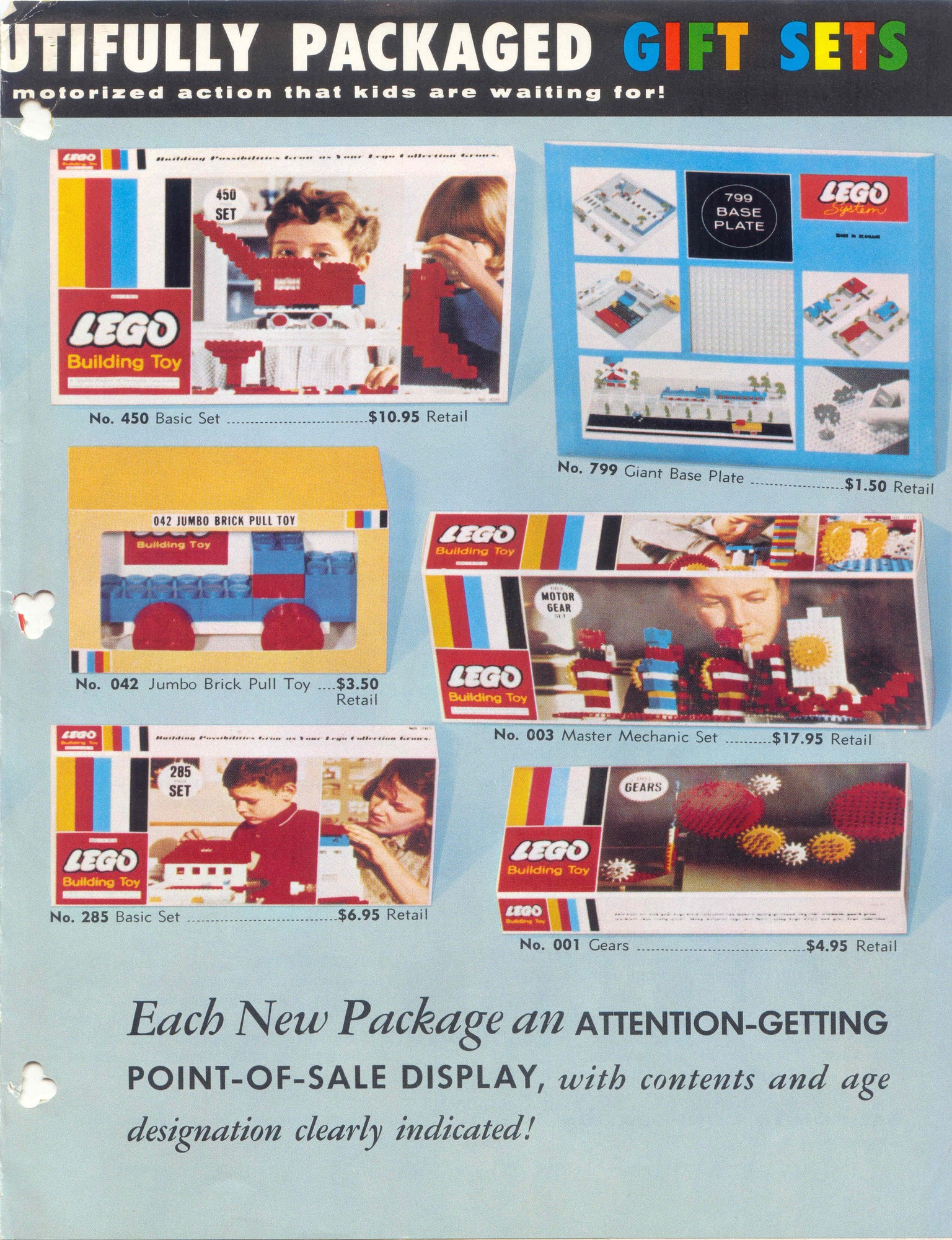
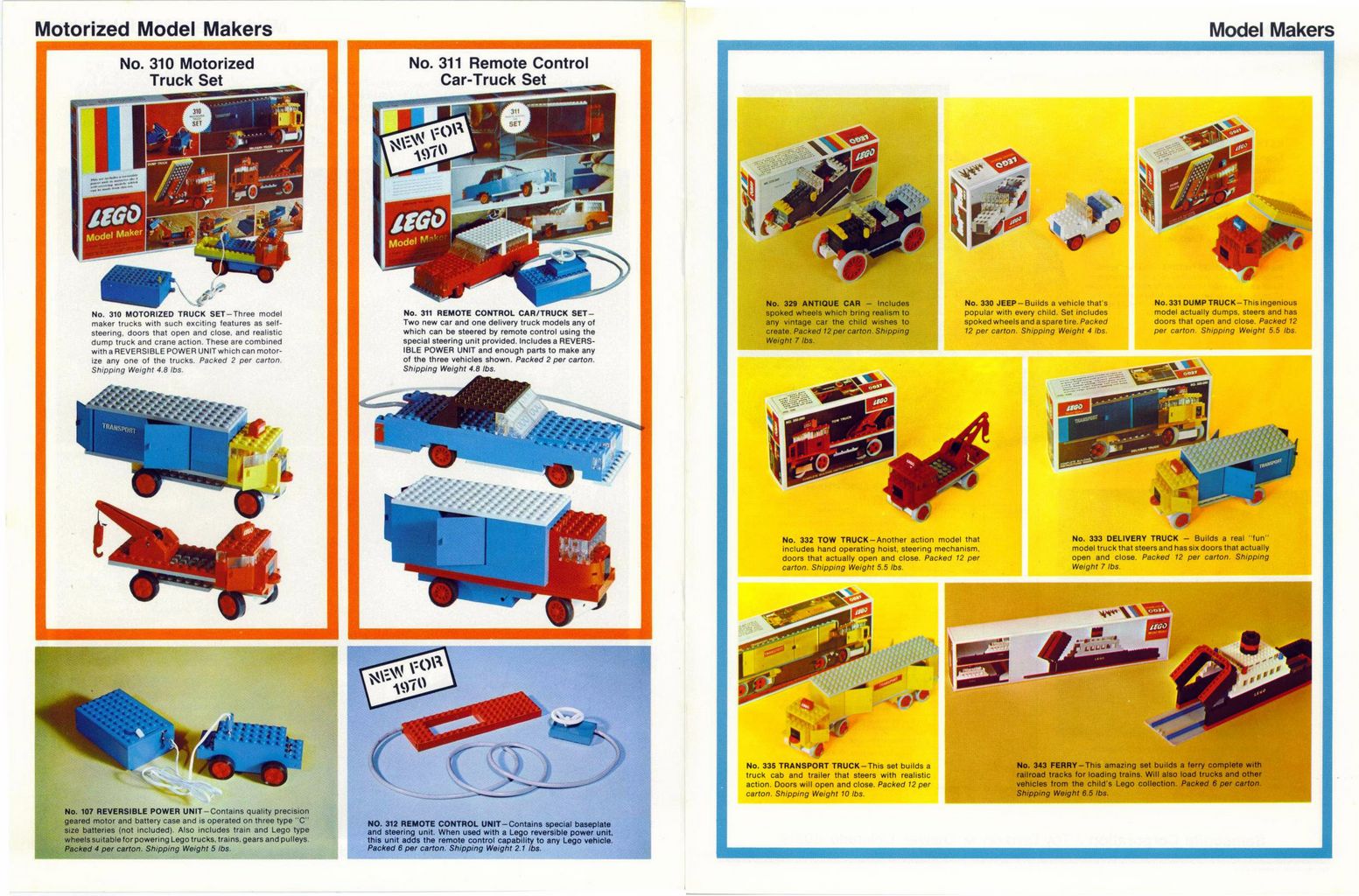
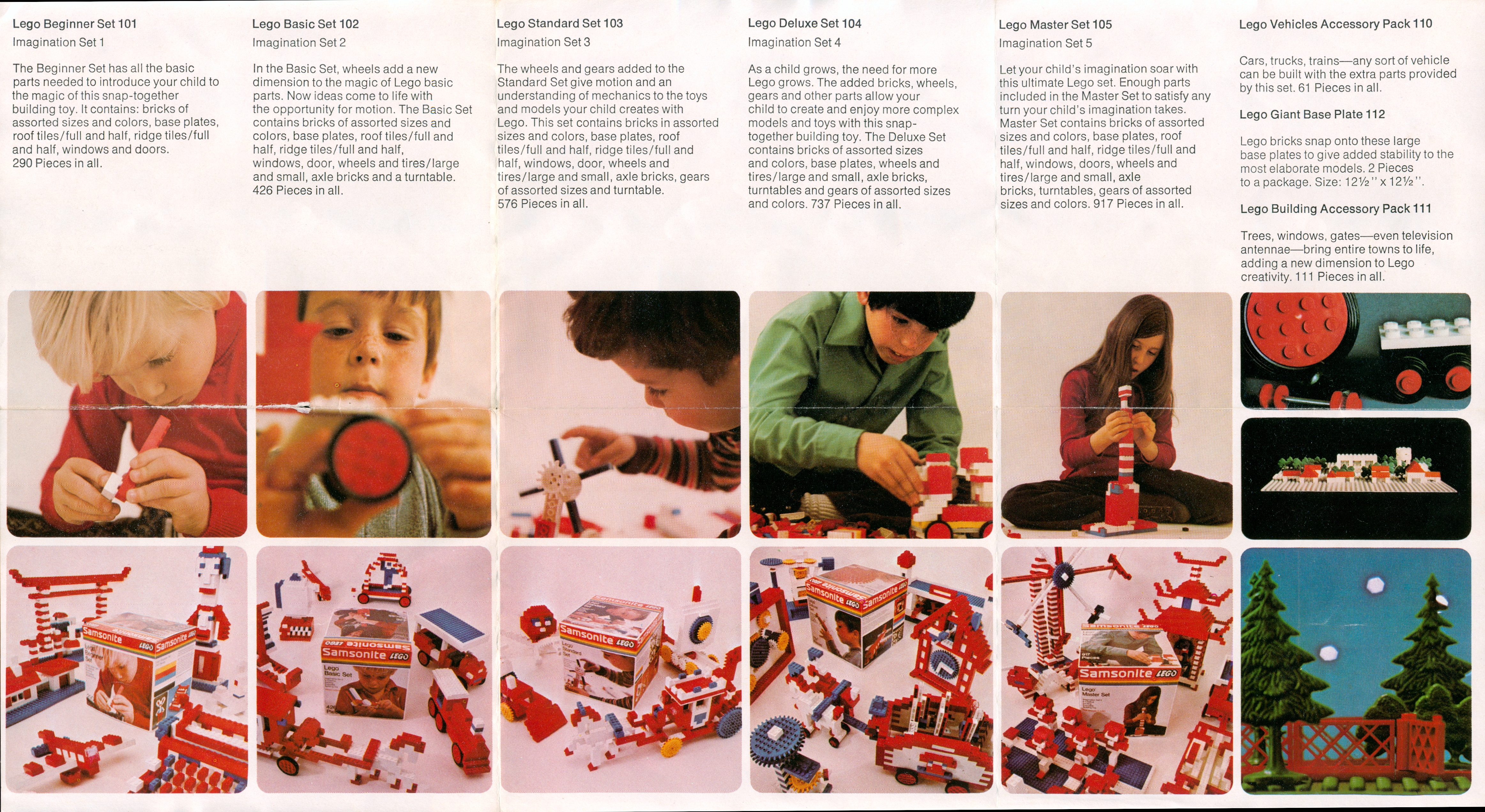
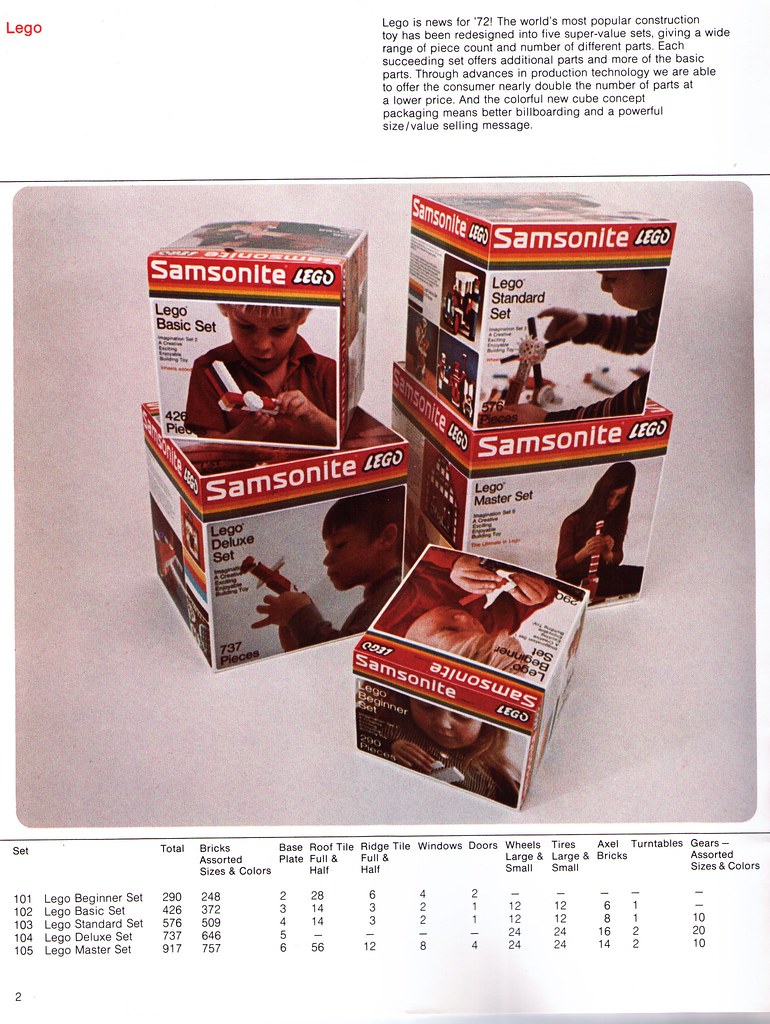
But I believe it to be the other way around. The LEGO logo variant came before the large Samsonite logo version.
What Newspapers and Catalogs Cannot Show
While the site's collection of catalogs, newspapers, and magazines have immensely boosted our understanding in a number of ways, there are fundamental limitations to the medium. They cannot, for example, tell us why certain decisions were made internally. Instead, we have to infer off of the sequence of information we have available.
But then, you might ask, why don't you agree with the sequence of information above?
Not only have I been holding my cards relatively close thus far, there is yet more context for us to cover, but also because of the ambiguity inherent to newspapers and catalogs and their preparation. Think about this.
For the sake of argument, let's say the large Samsonite logo variant came first.
Remember that most the cost of these sets are in the packaging, as the goal with these sets was to simply use up what's left. If Samsonite started out with their name very large, logically, there would have to be something to force Samsonite to spend the money (remember they were already in dire straits in 1971) to minimize their own logo. Two entities would have sway in that: Samsonite and LEGO.
Could it be on the part of Samsonite to encourage retailers to purchase stock of fairly generic sets, as maybe diminishing the Samsonite name would positively impact sales? I'm not going to say it's impossible, but that requires a level of contrivance and is not stood on completely solid ground.
It's based on a historical observation, absolutely, as Samsonite's LEGO was not nearly as popular as the rest of the world's LEGO. But consider internal documents (retailer catalogs) had the Samsonite name, some retailers had already carried Samsonite sets for over a decade by 1972—I don't see how making the logo smaller would be worth all the logistics required.
Maybe it was on the part of Samsonite for consumer confidence, as LEGO kits began to be imported in 1972? They were being sold on the same shelves as Samsonite sets, like in FAO Schwarz in 1972:
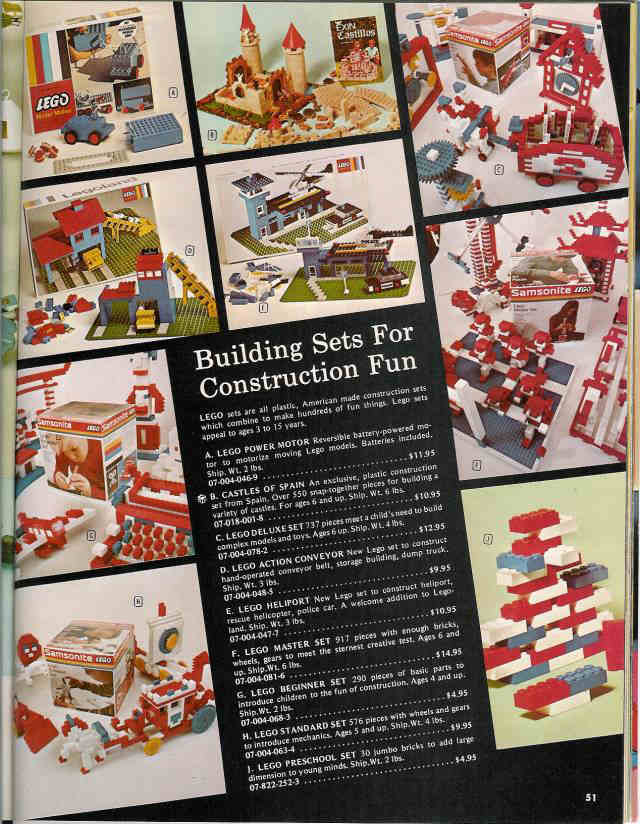
After all, the goal for Samsonite was to sell the sets, going from a large Samsonite logo to a large LEGO logo could potentially trick the consumer. I disagree with this interpretation heavily, mostly because Samsonite's name is still fairly legible on the smaller logo version. It also isn't very concordant with ephemeral evidence, as Samsonite's name still appears in many newspaper, magazine, and catalog adverts for 1972.
The most reasonable one, however, is that Samsonite initially put their name very large on the box and early in production LEGO told them no, thus the smaller logo version. This, I feel, is unlikely.
For one, I do not see a world in which LEGO wanted their own sets/brand to be seen as associated with Samsonite's quality (or lack thereof) any more than it already has. It would not make sense for LEGO to want to "take credit" for Samsonite's production. Instead, it would make more sense to request to distance themselves from Samsonite to prevent consumer confusion going forward.
Moreover, think about the progression of the size of Samsonite's logo on LEGO packaging.
It starts prominent in 1961, secondary to LEGO's still but very easily seen. Then in 1965, it turned into fine print on the front of the box. Then with the Model Maker sets introduced in 1967, the Samsonite fine print moved to the back of the box.
So we have a very clear trend of Samsonite's name shrinking on the box and moving, hiding their own association and impressing upon consumers the LEGO name more than their own.
With that background, why would they then put their name on the box very large, only to revert back?
Hence why I believe the above sequence is backward—first the LEGO logo version was produced and then the large Samsonite logo variant came after.
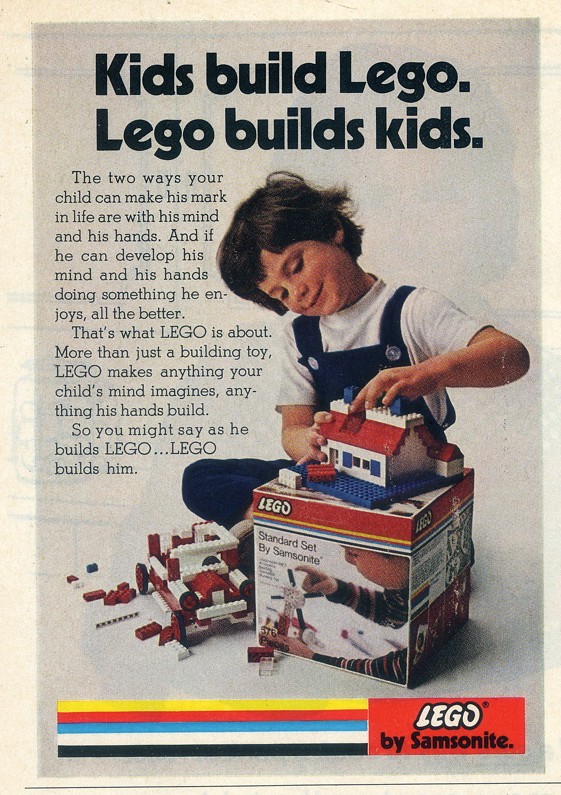
But not only can we demonstrate this logically, we have some important evidence to cover. For one, we have an earlier appearance than the September newspaper. The earliest appearance of the Imagination Sets I can find was in the August 1972 issue of Good Housekeeping. It features the small LEGO logo variant (and is a finalized box, which is also important):
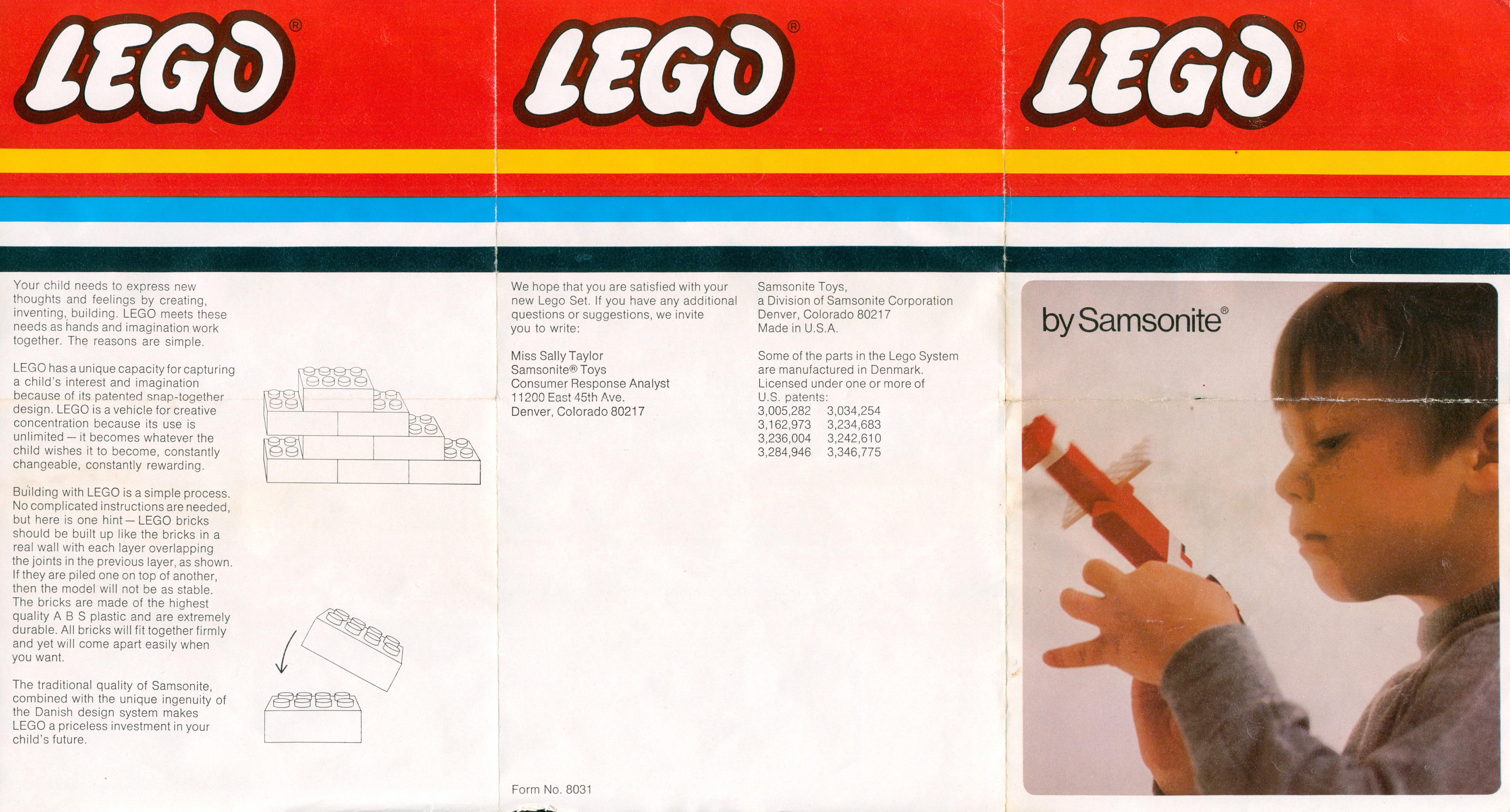
Also note that while the 1972 brochure pictures the large Samsonite logo boxes, the fundamental design uses the LEGO rainbow bars (from 1965-71 sets and the magazine ad above), as well as a cover design directly similar to the small logo boxes:
Also note the inside of that brochure, while it pictures the large Samsonite logo boxes, does not picture boxes for the 166/167 Extras Parts Kits (which released in 1971), the 40x40 baseplates, or even mention the #300 Jumbo Bricks Set:
This is also reflected in the 1972 Dealer Catalog, which does not picture a box for the #300 Jumbo Bricks Set or any of their pre-school toys. Only LEGO has a box shown, which going along with the newspaper quoted earlier (that Samsonite was completely revamping their toy division with all new packaging), implies that the packaging hadn't been designed or finalized at the time that the dealer catalog was assembled:
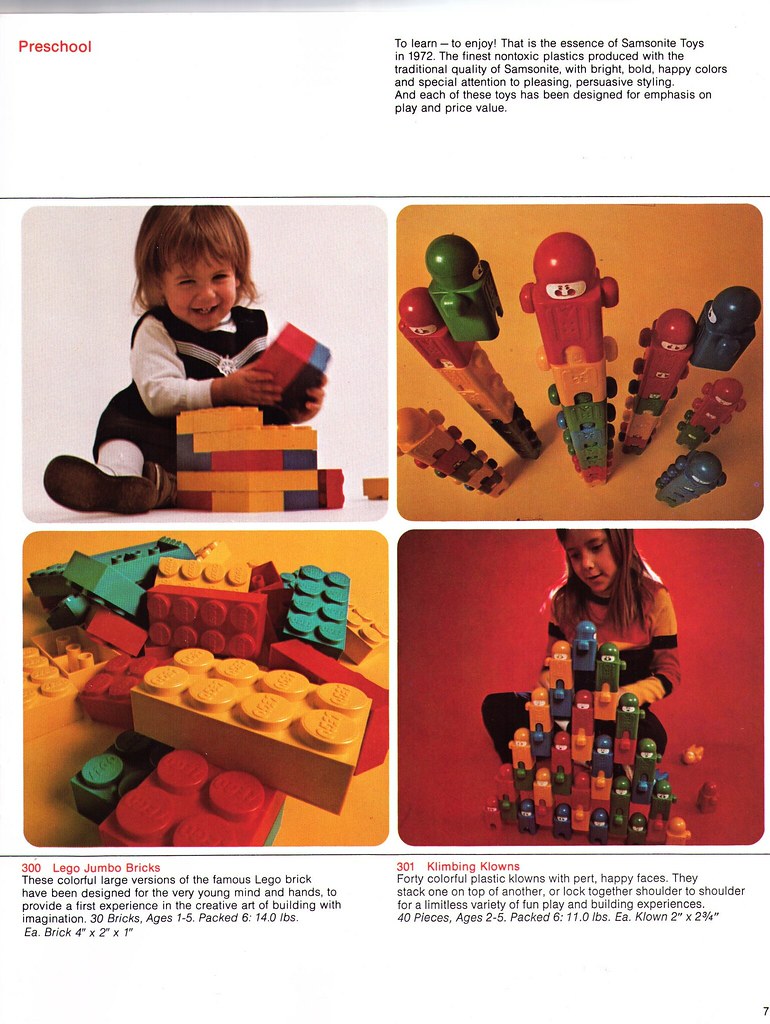
Now factor in that both the 40x40 baseplate insert and the #300 set only have variants with the large Samsonite logo. The 166/167 sets do not have variants with the large Samsonite logo. Thus, we have a very distinct point in Samsonite's marketing.
Putting the small LEGO logo version first explains questions we've posed before. For example, why are the boxes/inserts for the 166/167 Extras Parts Kits, 40x40 baseplates, or #300 Jumbo Bricks Set not pictured here? Simple. They hadn't finished being redesigned (or weren't going to be). If it was that LEGO forced Samsonite to shrink their logo, it would not make sense that the #300 Jumbo Bricks Set only has large Samsonite logo boxes.
So now we've modified one of our original questions. Instead of asking what prompted Samsonite to make this change:
Why is the small logo version first?
From what we outlined above, when I'd first written this article still believing these sets to have been inventory dumping sets, this was my original sequence of events:
"1. Samsonite loses the license sometime in 1971 and must sell off the rest of their inventory, as obviously LEGO would not want it."
"2. Samsonite designs and begins production of the large LEGO logo box for basic sets."
"3. Some point during production, LEGO requests Samsonite to change the box. Instead of the normal LEGO design, to prevent consumer confusion, it should have Samsonite's name front and center and be more inline designwise with the rest of Samsonite's toy line instead of LEGO's."
Which I've left here so as to demonstrate just how convincing the inventory dump theory was prior to the following discovery.
Incorporating the new information that the toy division suffered in 1971, prompting a complete redesign of all toys to hopefully break even (according to King D. Shwayder), as well as an employee anecdote (both of which discussed in Why did US Samsonite lose the LEGO license?), we finally have the causation of why Samsonite lost the LEGO license so suddenly, as well as why we have two box designs for one season.
-
Samsonite's toy division reports a net loss for 1971.
-
All lines are redesigned, including LEGO sets (which the 1972 sets are very much recreations of the 1971 line, 205 Beginner Set -> 101 Beginner Set, 285 Basic Set -> 102 Basic Set, etc.).
-
Samsonite presents their redesigned line, missing many staple colors and pieces such as 1x1s, 2x3s, 2x10s, etc. to LEGO executives. LEGO themselves created idea books and brochures for Samsonite and did all photography, which a complete line redesign would obviously require LEGO's knowledge and would likely incite a meeting.
-
LEGO is not happy. The LEGO license is lost, and LEGO requests for Samsonite to change the box as they finish production. Instead of the normal LEGO design, to prevent consumer confusion, it should have Samsonite's name front and center and be more inline designwise with the rest of Samsonite's toy line instead of LEGO's.
Why would LEGO do that? Because Samsonite's parts were not produced with the same quality as was found in Europe. Samsonite used molds that were well beyond their expiration, especially in 1972. There'd be a mix of logos/part styles within sets (just general inconsistency), etc.
It's much more likely LEGO wanted to differentiate their own imports (which were shown earlier to be for sale by 1972) from Samsonite's offerings and requested the change themselves. Because the opposite scenario would be for LEGO to want to be front and center on Samsonite's bulk boxes. Or for Samsonite to spend money in redesigning an entire line within one season, which goes against Samsonite's own past behavior as well as financial situation. Again, it would not make sense for Samsonite to shrink their logo throughout 1961-72 (by their own choice, sometimes omitting their own name entirely from brochures and promotions through 1965-72), only to suddenly boldly present their logo, and then switch back in the same season.
Wrapping Up
All in all, I think we've proven our point. The small logo version came first and then the large Samsonite logo followed second.
About the only thing to address is exactly why Samsonite would've respected LEGO's wishes and changed the box art. It would not make sense to "tempt" LEGO into a suit, thus Samsonite would pretty much have their hands tied.
And that's an important thing to keep in mind. Just because you are losing the license to produce something does not mean you are no longer beholden to the rights holder. They would still have final say in everything you do, and because Samsonite's toy division was in financial dire straits by 1972, it wouldn't make sense for Samsonite to suddenly decide to trailblaze and risk litigation for something they'd never sold well.