
Orgin of Imagination Set Inventories
___
As a note, this article is not my original work. This was written by LusiferSam in 2019 on the Brickset forums. You can see the original article via the WayBack machine (as the forums are gone now) using this link:
https://forum.brickset.com/discussion/30617/explanation-on-the-inventories-of-1972-era-samsonite-sets.
I do want to preface with something, however. Common thought online for decades has assumed the Imagination Sets to have been purposefully designed to dump inventory, but I no longer agree based on new information. Essentially, Samsonite's toy division experienced extensive losses in 1971 and completely redesigned/repackaged/expanded all their toy lines with the hopes of just breaking even for the 1972 season. That decision is what I believe to have been the inciting incident to make Samsonite lose the LEGO license for the US, and it lines up beautifully with a story by a former Samsonite employee. You can read more about it here: Why did US Samsonite lose the LEGO license?
Instead, I'm leaving the original post as it was as it stands as an excellent example as to why the original explanation (that the Imagination Sets were designed as inventory dumping sets) was so convincing and went unquestioned for so long. I myself agreed to it. I also do not want to give the false impression of consensus to the new interpretation.
So I've made formatting/light edits throughout, as well as used my own images, but I've not changed the original meaning. Personal asides/notes, if they need to be made inside the article will be (italicized parentheticals)
With that out of the way:
Explanation on the inventories of 1972 era Samsonite sets
This is a post that has been several days in the making. It's a bit of an obscure topic, so hope you guys find it interesting. This is an extra long post, so I'm going to have to do it in three or four segments. I've done a lot of proof reading, but there still maybe some typos, sorry about that.
I finally been able to crack the code on what has been a bit of a standing mystery for me, that is the inventories on the 1972 era Samsonite sets. The so-called Imagination Sets, 101, 102, 103, 104, and 105, along with Sears, JCPenney's and some promotional sets were made with a very different philosophy in mind then earlier sets. They were basically dumping grounds for Samsonite to clear out their inventory of Lego elements. I've long felt there was a pattern to these, but have been unable to figure it out. Until now.
For some background, Samsonite was putting very little effort into these sets. The licensing agreement with Lego was coming to an end and they were looking to liquidate their remaining inventory. Minimal effort was being put into these sets as is evidenced by their lackluster nature. A way to put further minimal effort into them would be to make them highly formulaic. It is this formula that I have been working on cracking.
A couple of years ago I bought a 103 set that was partially sealed. The box was open but there were four bags of basic bricks, two were sealed and two were open. There were also three other bags. One was taped closed and the other two had the same type of tape stuck to the side, but were otherwise open. The two sealed bags of basic bricks looked to have a very similar inventory of bricks and were very close to having the same inventory as the open bags. This got me thinking; what if they were identical? Or more importantly what if the bags had the exact same number of pieces in them?

The bottom of the box for each of the Imagination Sets lists a rough inventory for each set. The inventories list the number of basic assorted bricks, base plates, roof pieces, windows and doors, wheels and their accessories, and gears. Looking at a couple of these sets there seem to be a bit of a pattern. At the time I couldn't make the numbers work as I had too little information to work with. With limited information I put these away and left the problem for another day.
I was recently spurred to revisit this issue by a recent eBay listing. There's a 101 set that had an open box but sealed bags, similar to my 103 sets. This eBay listing shows two bags of slope, window and door elements in bags that are taped closed rather than heat sealed. Interestingly this is the same type of tape that is on some of my open bags in the 103 set. This is a strong indicator that these bags and the tape is original. Using the sealed bags as a rough guide and looking at the basic inventories of all 5 Imagination Sets I was able to devise a workable system.
The System
The system I'm proposing as each set being made up of four types of bags. I call these bags A, B, C, and D. This is my own terminology and was not used by Samsonite to the best of my knowledge. But they are useful in showing how the sets were made and how they should be inventoried.
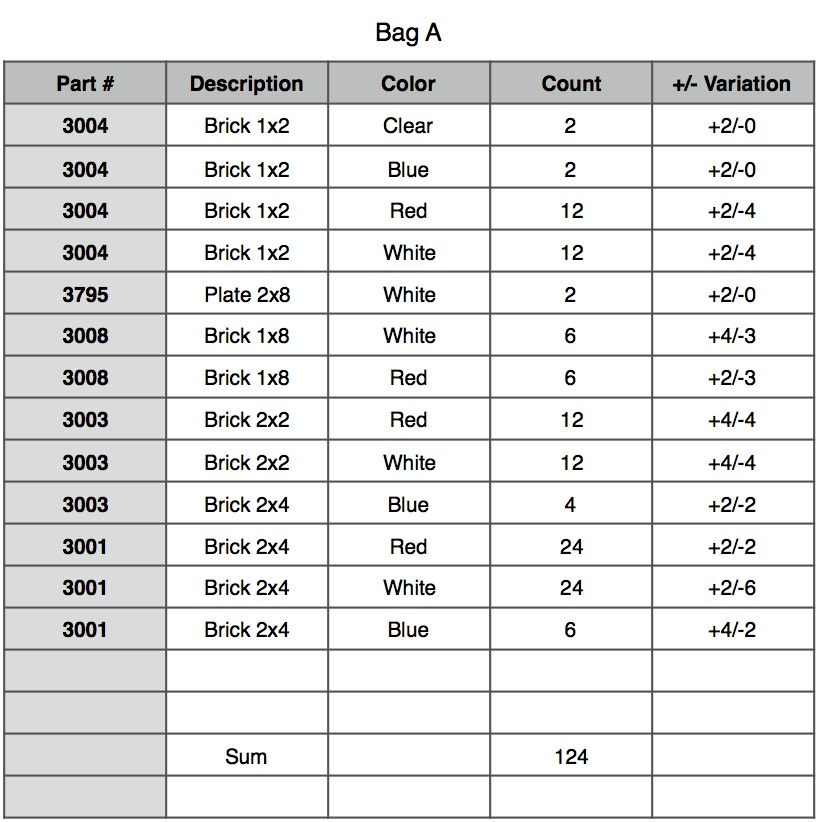
Bag A would have 124 basic bricks. 2x4s, 2x2s, 1x2s, and 1x8s bricks in red, white, blue, and clear with white 2x8 plates. White is the most common color followed by red. A limited number of elements are in blue and clear is the least common only a couple of parts and that color. The number of bag A's in each set is the same as the number of base plates. 101 has two base plates and two A bags. Whereas 105 has six base plates and six A bags. Bag A likely has a large degree of variation due to Samsonite's low quality control and the fact that they were liquidating their remaining inventory.

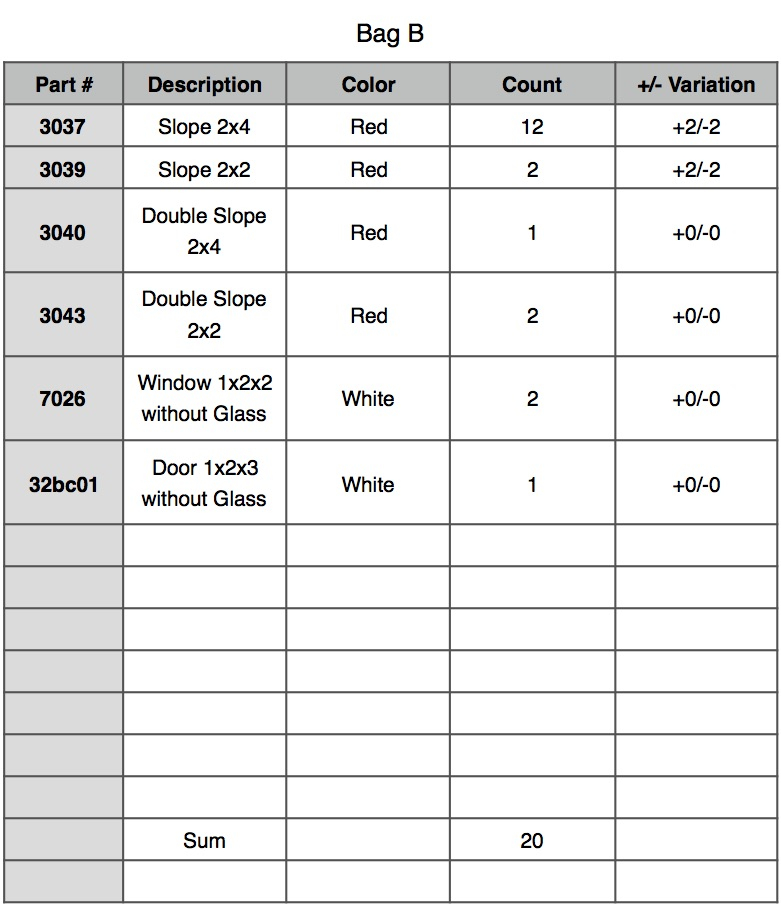
Bag B are where the slope, window and door elements were packaged. It would have 14 2x4 and 2x2 single slopes, two 2x4 double slopes, one 2x2 double slope, two windows and one door. The eBay photos of the sealed 101 set show two bags with a mix of slopes, windows and doors tape closed. The slope bricks were all in red. While the windows and doors were all in white with no glass.

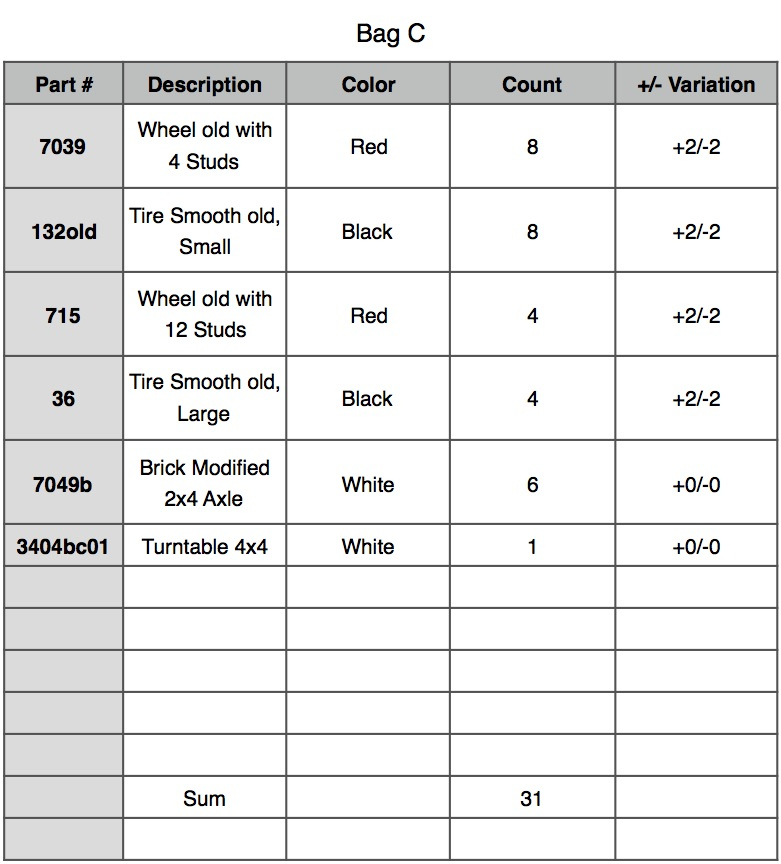
Bag C has the wheels, tires and some of the axle bricks. It would have 12 wheels and 12 tires in a mix of large and small sizes, six axle bricks and one white turntable. My 103 set has a bag that is taped closed of wheels, tires, axle bricks and two turntables. I don't believe this bag is original to the set. There are two turntables rather than the single and there are a lot more wheels than 103 should have. Even if you assume that somebody miscounted, it's a stretch to have somebody miscount every single piece by more than 50%. On the other hand these bags could have been made in single, double or even triple varieties. It is possible that a double was used rather than a single.

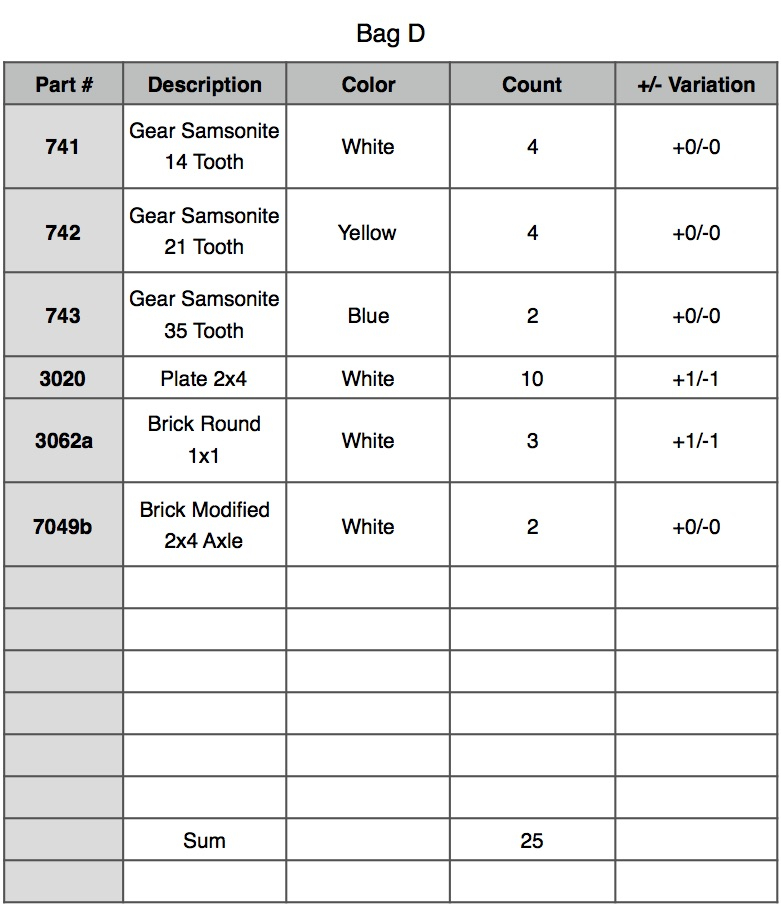
Bag D holds the gears and miscellaneous other parts. The bag has 10 Samsonite gears: four white, four yellow and two blue. There are two additional axle bricks and 13 basic bricks. These are white 2x4 plates and white 1x1 round bricks. This is the key to making this all work. Sets 103, 104 and 105 all have extra basic bricks that aren't factors of 124. The difference between the inventory number and the multiples of 124 are in factors of 13. The difference in the axle bricks follows a similar pattern. Once these are accounted for all of the numbers work. My 103 set as an open bag with tape on it that has ten gears, two axle bricks, ten 2x4 plates and four 1x1 round bricks. The fact that there are 14 basic bricks is either accounting error or somebody added a brick after the fact.

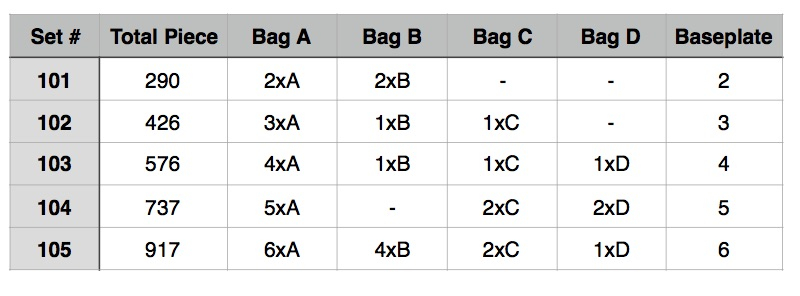
The only parts that don't fit into a bag in the system are the blue base plates. But as stated earlier the base plates always have the same number as the A bags. The numbers all work with this assumption the base plates appear to be loose and not in any type of bag. My 103 and the eBay 101 both have loose base plates as does a late Kraft promotional set. Below is a table that summarizes each bag.

And a table that summarizes each of the Imagination Sets in terms of the bags.
Testing
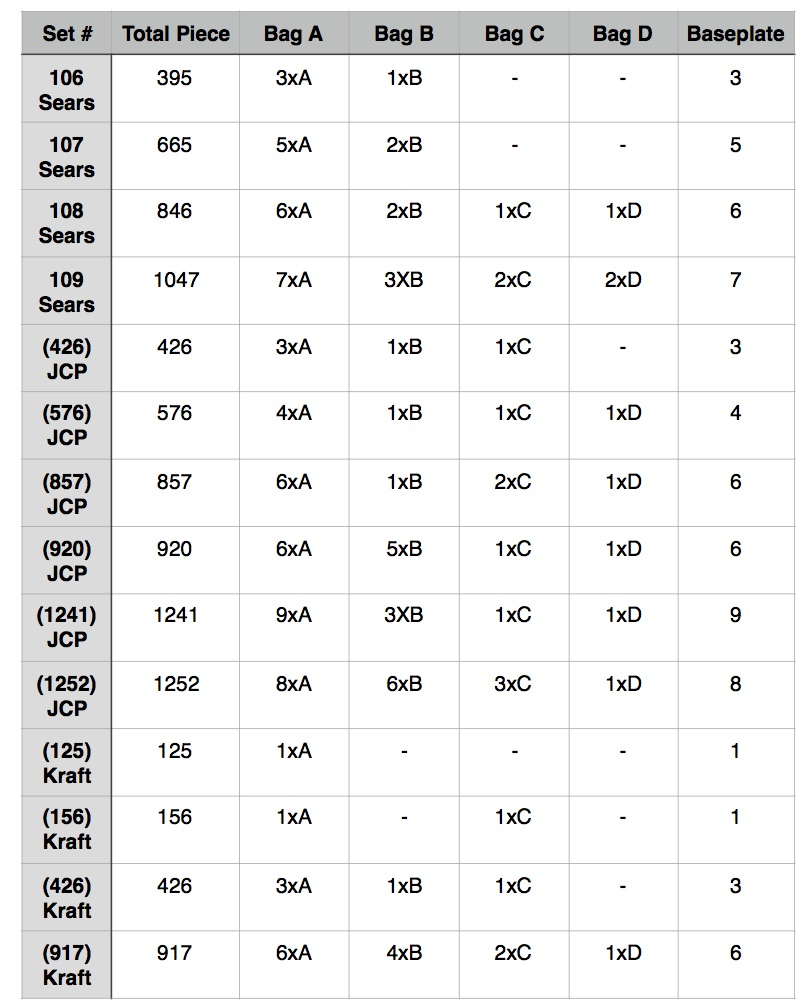
I've been successful in using the system on nearly all of the catalog and promotional sets of this era. The four Sears sets and the late Kraft promotional sets fit into the system. The Sears catalog and Kraft flyer have some descriptive guidelines to work with. JCPenney's catalog is much more vague. The I’ve made up the table of these to show that they work and that the piece counts is correct. I am assuming the 426 piece JCPenney's set and 426 Kraft set are the same as 102. And that the 576 piece JCPenney's set and 917 piece Kraft set are the same as 103 and 105. The description of the Kraft 426 piece set says it includes gears, but 102 does not have gears. I found a solution that works adding gears, but needs six B bags. This is too many slopes, windows and doors in my opinion and the accompanying photo does not show any gears. Below is a table that summarizes each of the Sears, JCPenney's and Kraft set in terms of the bags.
And a table that shows a rough inventory of each similar to that of the Imagination Sets.
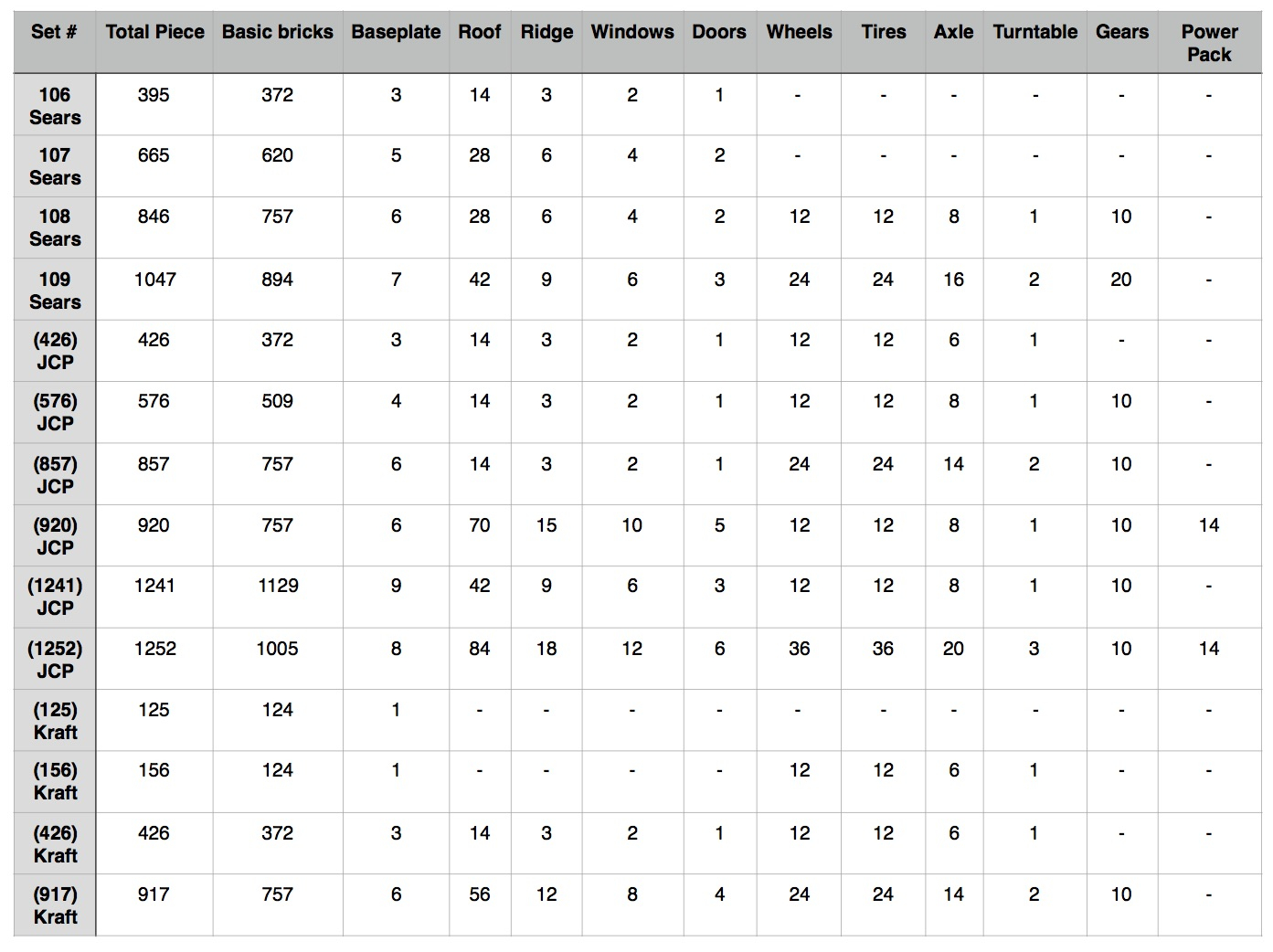
The only sets I've not been able to truly work into the system are the 920 piece and 1252 piece motorized JCPenney sets. They are lacking enough information from me to confirm much about them. The addition of a power pack or bag E is needed for these sets. If I assume the power pack is the same in both sets, I found solutions that require the power pack to have either 3 or 14 pieces in order to meet the required piece count. 3 is a good answer but the motor needs special cam wheels in order to function, so this seems unlikely. 14 is a far more reasonable answer. However every time I count parts in this possible power pack I get an odd number, either 11 or 15. So either Samsonite is counting oddly, they have additional pieces I don't know about or I'm lacking other critical information about these sets. In any case this is a mystery for another time.
So there is a fairly important caveat here. This should not be taken as an absolute guide to an exact inventory for these sets the way that a modern set would be inventoried. What I've done here is explain the inventories of these sets at a high level. Samsonite's quality control was mediocre at best. I don't think it is unreasonable to expect that there were counting errors in each of these bags, as well as substitutions. Bag A with the most parts is the most likely to have errors and substitutions. Remember Samsonite was liquidating the remaining inventory of product, not making a modern set with exacting details. Samsonite was known to have made substitutions or have different versions of the same set early in their history with Lego. The sealed bag A's that I have been able to do a visual inventory of show differences in key bricks. Such as different numbers of various blue bricks, different numbers of 2x8 white plates and different numbers of 1x8 bricks. I'm working with a small sample size, I own three sealed bags, someone had previously inventoried such a bag, and I have images of three others. The important thing is that bag A has 124 bricks, give or take a few (hopefully give rather than take).
I think bag A can have some general guidelines to its inventory. Such as there should be no black, yellow or gray bricks. Clear elements seem to be limited to only 1x2 bricks and the only plates seem to be white to be 2x8s. Blue bricks show up only as 1x2, 2x2 and 2x4 bricks. I’ve made up some tables of the inventories of each of the bags. There is a pieces count as well as a +/- variations that I’ve been able to document. Absolutes are difficult to come by and may not exist for these sets.
Takeaways
I'm back. A very important point mentioned toward the end of the article that I want to reemphasize is that this should be taken as a general guide and not as an exact inventory shared between all copies.
It's the reality of LEGO by Samsonite, there'll always an exception to the rule.
I also want to take the opportunity to point out that the Imagination Sets' consistency in inventory (i.e. no 2x10 bricks, 2x3 bricks, 1x1 bricks, 2x8 bricks in red, etc.) points more to a scaled back production, not an inventory dump. If it were an inventory dump, we'd see much less consistency as we do with known inventory dumping sets.