
Was There a System to Determine a LEGO Set's Inventory? (1961-64)
___
This is by far the most impossible question I've ever tackled in this project.
Other questions, i.e. "What was Three Worlds?" simply relied on gathering, evaluating, and recording all information that I could find. It was already out there just waiting to be compiled. For things that lacked direct confirmation, i.e. "When did the 022 Doll Furniture Set release?", context from the larger line informed our conclusions, as well as anecdotal evidence and extrapolations from market performance of the 905.
That all is child's play compared to this question, as any answer we give, if we are to claim a revealed truth, would need to apply universally. There can be exceptions, but we cannot find a system with two sets and claim it applies elsewhere. We need the entire line to demonstrate this. Which sounds reasonable, but different than all other things we've investigated before, we must rely on the inventory of used examples. Which means that any conclusion we make has a possibility of being challenged citing bias or whathaveyou, which fair enough.
But I've long since repeated this notion that Samsonite was abhorrent with quality control. That may be true in the regard of the set a consumer received, but not necessarily so in the theoretical. That is what we're interested in, and that's why a proper, fully diligent investigation into this kind of question is near impossible. But in my experience, the assortments found in sets aren't random.
As I've worked on the site, I've come to believe there is a larger algorithm at play when Samsonite or even LEGO themselves designed a set. And I don't mean that as a computer algorithm, but instead a very convenient system to develop a basic assortment of parts and have an even spread, without having to think too much about what parts to include, and then start all over when designing the next set. Which would help consistency, decreases complexity, which would cut down packaging times, which cuts down cost, etc. I believe the system likely evolved overtime as well.
It was rather easy to prove such a system existed for the 1972 Imagination Sets, it consistently applies across the entire line and the parts were already organized by bags and such. But I don't believe that to have been an original idea. I believe that to just be a less veiled use of an earlier system, one that we may yet be able to prove existed.
So here's what we're going to do. I'm going to start small, in that we're only going to cover things we can be absolutely certain of, i.e. the number of trees, windows, baseplates, etc. I don't believe a system will be evident immediately, but as we gather everything, I can guarantee we will come out of this having learned something even if we can't answer the original question. For example, I just realized, before having written the rest of the article, that the 725 Town Plan, taking the popular number of 711 pieces (the most consistent piece count for the 725 in print media, across the US and Canada as well as Sears in 1965), actually became the 615 in 1965. How do I know that? Take the piece count of the Esso Station (96 according to Bricklink) and subtract that from 711. You get 615.
There's some nuance with the 725 of course, which likely won't be covered here. To keep from complicating things too much, we're mainly going to stick to 1961-64 basic sets for the first round.
And that distinction is important: basic sets. Model sets would likely deviate. I think something like the 725 would be interesting to explore(thinking in terms of it is essentially an Esso service station + an assortment of bricks), but we can speculate on that when we get there.
With that out of the way...
1961-64 Basic Sets
Let's just list them now. Some of these numbers (such as windows and trees) are easily identifiable, as flat box sets have individual places for these parts to reside. Baseplates were almost always consistent, so no worries there. Some things, such as corner bricks, may not be from a direct source and may instead be based on my opinion from everything I can find, based on surviving examples and the creations on the boxes themselves(as that is the best way to factcheck what is in the set). That is up to you as to what you believe, but I encourage you to seriously consider the following:
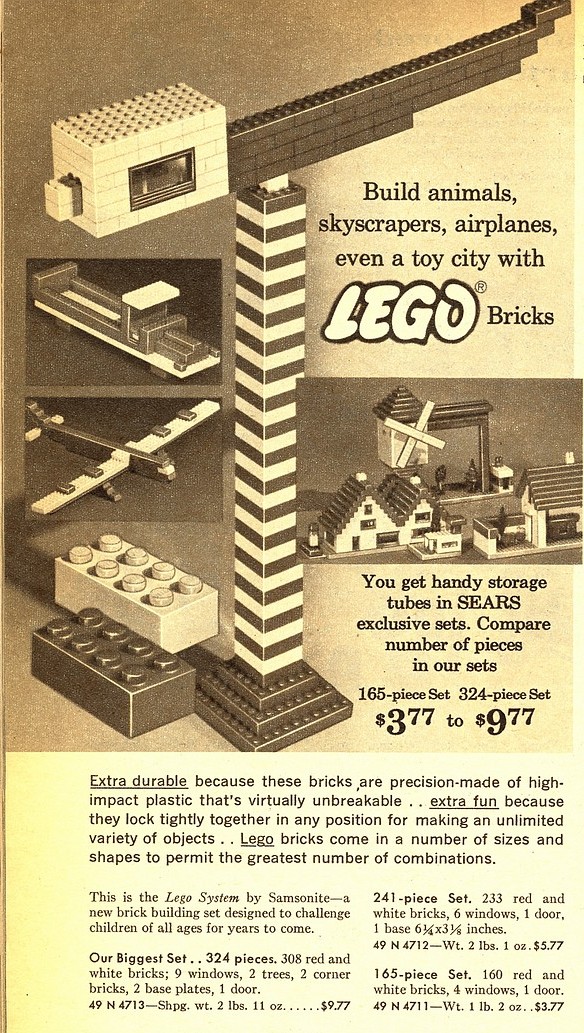
702 - 3 windows, 1 door
703 - 4 windows, 1 door
704 - 4 windows, 1 door
705 - 6 windows, 1 door, 1 10x20 baseplate (we're only considering the flatbox version here)
706 - 6 windows, 1 door, 1 10x20 baseplate
708 - 9 windows, 1 door, 2 10x20 baseplates, 2 trees
710 - 9 windows, 1 door, 2 10x20 baseplates, 2 trees
711 - 13 windows, 2 doors, 2 10x20 baseplates, 2 trees
Immediately, sets above a certain tier (the 708) always included trees. The 711 is the only basic set to have two doors, otherwise all sets had at least one.
And, most fascinating, is the factor the windows are increasing by: 1, 2, 3, and 4! And the Sears canister sets (704, 706, and 710), adopt their numbers from the previous sets. This is a very important detail.
As covered in Patterns with Exclusive/Catalog Sets, later catalog sets for Sears specifically were very likely created using the already developed basic assortments, only adding parts to build a specific model. For example, the 565 uses models from the 450's box, the 324/335/835 uses models from the 285, the 244 from the 205, etc. I've not yet done the nitty gritty work, but the fundamental comparison is undeniable.
But the issue I'm postulating we'll run into here is that the exclusive canister sets may have actually been derivative assortments, not necessarily dependent on the system used for the 1961 sets. We see that with the number of windows (and specialty pieces in general) being "borrowed" consistently from the set priced directly below it.
Let's compile a different list now—part counts and US retail price only. The part counts chosen will be the ones that are reported by the most sources, as again, we're not going by what any particular example was packed with but instead an ideal, theoretical set. Not all sources will agree (i.e. FAO is notorious for reporting unique part counts), and that's okay.
I've bolded the canister sets.
702 - 93 pieces - $2
703 - 126 pieces - $3
704 - 165 pieces - $4
705 - 201 pieces - $5
706 - 241 pieces - $6
708 - 244 pieces - $8
710 - 324 pieces - $10
711 - 374 pieces - $11
So, we have something I feel is incredibly fascinating. I'm not great with math, but I can recognize when a pattern is at play and I feel infinitely validated so far. What's interesting is that I just noticed the piece counts are roughly based on the retail price multiplied by 40. Check this out:
$2x40 = 80
$3x40 = 120
$4x40 = 160
$5x40 = 200
$6x40 = 240
Here is where we run into an issue. It seems the flat box 708 and 711 require adjustment(assuming they cost more to package as someone had to checkerboard out the pieces manually (which would explain why the 706 and 708 have similar part counts but differ by $2), or maybe there's a factor we've not yet accounted for, such as printed parts).
708(subtract $2) $6x40 = 240
711(subtract $2) $9x40 = 360
The 710 has is the oddball. The $2 adjustment works, 8x40 = 320, but I don't really have an explanation as to why. Even with that outlier, the piece counts are fascinatingly similar to the rough calculated ones.
Generally, the sets follow a division of the original part count by 40 to get the retail price and some decimal. So 241/40 = 6.1, 706. As we've noted, the main deviations are the larger sets, the 708-711, but I suppose those sets also contained more specialty pieces like trees and printed beams.
The 702 also deviates some as well, as most of the sets are within 1-6 of their piece counts. The 702 is 13 off, which may be due to its more colorful assortment compared to other sets.
Let's account for the missing specialty pieces, such as printed beams. We also might account for 1x1 cylinders and 2x2 macaroni bricks, as they all follow the system of hierarchy we found earlier:
708 - x12 cylinders, 4 printed beams
710 - x12 cylinders, 4 printed beams
711 - x12 cylinders, 4 printed beams, 8 macaroni bricks
Which leaves me at a bit of a dead end, as we've reached the limits of what rough calculations can tell us. The ~40 factor is a neat observation, but does not create as succinct of a system as I'd like. But we're definitely onto something.
So here's what I'm going to do. I'm gonna bite the bullet and inventory all these sets myself to the best of my ability based on loose examples. I want to be extremely careful with these, but as we covered with the 1972 Imagination Sets, some level of variance is to be expected. And as we covered above, our counts are not going to be shared between every single example.
702 Basic Set:
| White | Red | Blue | Yellow | Trans-Clear | |
|---|---|---|---|---|---|
| 1x1 Brick | 4 | 7 | - | 2 | - |
| 1x2 Brick | 10 | 12 | - | 3 | - |
| 2x2 Brick | 1 | 6 | 6 | 2 | 1 |
| 2x3 Brick | 3 | 4 | - | 1 | - |
| 2x4 Brick | 7 | 7 | 1 | - | - |
| 2x10 Brick | - | 1 | - | - | - |
| 2x8 Plate | 5 | - | - | - | - |
| Windows | - | 3 | - | - | - |
| Door | - | 1 | - | - | - |
| 2x2 Slope | - | 2 | - | - | - |
| 2x4 Slope | - | 3 | - | - | - |
Total: 92 (should be 93).
703 Basic Set:
| White | Red | Blue | Yellow | Trans-Clear | |
|---|---|---|---|---|---|
| 1x1 Brick | 3 | 3 | - | - | - |
| 1x2 Brick | 5 | 5 | - | - | - |
| 2x2 Brick | 15 | 15 | - | - | - |
| 2x3 Brick | 5 | 5 | - | - | - |
| 2x4 Brick | 30 | 30 | - | - | - |
| 2x8 Brick | - | 2 | - | - | - |
| 2x10 Brick | 1 | - | - | - | - |
| 4x8 Plate | 2 | - | - | - | - |
| Windows | - | 4 | - | - | - |
| Door | - | 1 | - | - | - |
Total: 126 (should be 126).
704 Basic Set (Canister):
| Piece Type | White | Red | Blue | Yellow | Trans-Clear |
|---|---|---|---|---|---|
| 1x1 Brick | 4 | 4 | - | - | - |
| 1x2 Brick | 10 | 10 | - | - | - |
| 2x2 Brick | 15 | 15 | - | - | - |
| 2x3 Brick | 10 | 10 | - | - | - |
| 2x4 Brick | 40 | 40 | - | - | - |
| 2x8 Brick | - | 1 | - | - | - |
| 2x10 Brick | 1 | - | - | - | - |
| Windows | - | 4 | - | - | - |
| Door | - | 1 | - | - | - |
Total: 165 (should be 165).
705 Basic Set:
| Piece Type | White | Red | Blue | Yellow | Trans-Clear |
|---|---|---|---|---|---|
| 1x1 Brick | 5 | 5 | - | - | - |
| 1x2 Brick | 10 | 10 | - | - | - |
| 2x2 Brick | 20 | 20 | - | - | - |
| 2x3 Brick | 10 | 10 | - | - | - |
| 2x4 Brick | 50 | 50 | - | - | 2 |
| 2x8 Brick | - | 1 | - | - | - |
| 2x10 Brick | 1 | - | - | - | - |
| Windows | - | 6 | - | - | - |
| Door | - | 1 | - | - | - |
| 10x20 | 1 | - | - | - | - |
Total: 202 (should be 201).
706 Basic Set (Canister):
| Piece Type | White | Red | Blue | Yellow | Trans-Clear |
|---|---|---|---|---|---|
| 1x1 Brick | 4 | 4 | - | - | - |
| 1x2 Brick | 15 | 15 | - | - | - |
| 2x2 Brick | 20 | 20 | - | - | - |
| 2x3 Brick | 15 | 15 | - | - | - |
| 2x4 Brick | 60 | 60 | - | - | 2 |
| 2x8 Brick | - | 1 | - | - | - |
| 2x10 Brick | 1 | - | - | - | - |
| 4x8 Plate | 2 | - | - | - | - |
| Windows | - | 6 | - | - | - |
| Door | - | 1 | - | - | - |
| 10x20 | 1 | - | - | - | - |
Total: 242 (should be 241).
708 Basic Set:
| Piece Type | White | Red | Blue | Yellow | Trans-Clear |
|---|---|---|---|---|---|
| 1x1 Brick | 4 | 4 | - | - | - |
| 1x2 Brick | 15 | 15 | - | - | 2 |
| 2x2 Brick | 20 | 20 | - | - | 2 |
| 2x3 Brick | 20 | 20 | - | - | - |
| 2x4 Brick | 40 | 40 | - | - | 4 |
| 2x8 Brick | 2 | 2 | - | - | - |
| 4x8 Plate | 2 | - | - | - | - |
| Windows | - | 9 | - | - | - |
| Door | - | 1 | - | - | - |
| 1x1 Round | 4 | 4 | 4 | - | - |
| 4x4 Corner | 1 | 1 | - | - | - |
| Printed Beam | 4 | - | - | - | - |
| Tree | 2 | - | - | - | - |
| 10x20 | 2 | - | - | - | - |
Total: 244 (should be 244).
710 Basic Set (Canister):
| Piece Type | White | Red | Blue | Yellow | Trans-Clear |
|---|---|---|---|---|---|
| 1x1 Brick | 6 | 6 | - | - | - |
| 1x2 Brick | 20 | 20 | - | - | 4 |
| 2x2 Brick | 30 | 30 | - | - | 2 |
| 2x3 Brick | 20 | 20 | - | - | - |
| 2x4 Brick | 60 | 60 | - | - | 4 |
| 2x8 Brick | 4 | 4 | - | - | - |
| 4x8 Plate | 2 | - | - | - | - |
| Windows | - | 9 | - | - | - |
| Door | - | 1 | - | - | - |
| 1x1 Round | 4 | 4 | 4 | - | - |
| 4x4 Corner | 1 | 1 | - | - | - |
| Printed Beam | 4 | - | - | - | - |
| Tree | 2 | - | - | - | - |
| 10x20 | 2 | - | - | - | - |
Total: 324 (should be 324).
And finally, 711 Basic Set:
| Piece Type | White | Red | Blue | Yellow | Trans-Clear |
|---|---|---|---|---|---|
| 1x1 Brick | 6 | 6 | - | - | - |
| 1x2 Brick | 20 | 20 | - | - | 4 |
| 2x2 Brick | 40 | 40 | - | - | 2 |
| 2x3 Brick | 20 | 20 | - | - | - |
| 2x4 Brick | 60 | 60 | - | - | 6 |
| 2x8 Brick | 4 | 4 | - | - | - |
| 2x10 Brick | 3 | 3 | - | - | - |
| 2x4 Plate | 4 | - | - | - | - |
| 4x8 Plate | 2 | - | - | - | - |
| 4x8 Round | 2 | - | - | - | - |
| 6x8 Plate | 2 | - | - | - | - |
| Windows | - | 13 | - | - | - |
| Door | - | 2 | - | - | - |
| 1x1 Round | 4 | 4 | 4 | - | - |
| 4x4 Corner | 1 | 1 | - | - | - |
| Printed Beam | 4 | - | - | - | - |
| Tree | 2 | - | - | - | - |
| 10x20 | 2 | - | - | - | - |
Total: 373 (should be 374).
Again, I want to reiterate that this carries a bias in a way, in that I've looked at several used examples and evaluated what I believe to have been the approximate original inventory based on my judgement on the validity of the used example. I fully realize these sets included oddball things as production continued (i.e. a few more blue and yellow parts), but I'm mainly considering 1961-62 examples, of which are usually just red and white with a few trans-clear parts too. Those are the least tainted inventories in my opinion, as they would follow the closest to the original system.
The one I trust the most is the 708's inventory, as my 1961 example is only missing 7 pieces. Rounding all the numbers to the nearest five or tens place, the piece count lined up beautifully. My 711 was 8 over, so I rounded some numbers down and got a close match, 373 instead of 374. I figure its best to leave the number as it is rather than guess what might've taken that number's place. The ones I'm least confident about(specifically regarding basic bricks) are the canister sets.
So I'd like to point out that any deviations may not be the fault of the system but instead the numbers I've gathered. We're modeling a system that hasn't been documented or used in over sixty years, but having seen all that I have, I'm confident there existed such a system.
So right off the bat, the 702 doesn't match any patterns I see above, so I'm going to largely exclude it from evaluation. It's a lot more frugal with colors as well, so we can consider that our exemption.
The most consistent pattern is that for any number of white bricks, there is an equal number of red bricks. This excludes beams on smaller sets, where they only contained one of each.
Another pattern is that the number of 2x4 bricks is the price x 10 until the 708. We already identified the 708 as the pivot point for specialty pieces, so no surprise there.
Another general rule is that the number of 2x2s is half of the number of 2x4s, though the 705, 706, and 711 deviate.
The number of 1x1s is almost always the number of 2x4s/10. The only exemption is the 706.
The number of 1x2s is almost always equal to the number of 2x3s. The only exemption is the 708.
We also see a progression of the tiered system we outlined before. Wherein when a set contained specialty pieces (trees, 1x1 round bricks, etc.), the next set up would still contain those parts. This also generally applies to trans-clear parts and 2x8/2x10 beams.
What's really cool is that we have an outline of how exactly these part counts were derived, only using the retail price. You use the retail price to determine the number of 2x4s, then you have the means by which to solve for the number of 1x1s, 1x2s, etc.
What I'm most curious of now is how this system could have applied across 1961-64. We know the part counts changed a bit between the 1961 sets and 1965 sets, so we won't likely be able to apply the same system there. The last candidate we can evaluate and check our work is the 725.
My town plan copy, however, has another basic set mixed in along with supplements, thus while I have a physical copy to check against, I don't really want to speculate what does or doesn't belong to the set.
Besides, the Town Plan cost $25, but the assortment within shouldn't be beholden to the extra specialized add-ins, i.e. the 1:87 vehicles and accessories. If we use our earlier rule, wherein the price of the assortment will be roughly 615/40 that gets us $15, but is largely(unfortunately) based on speculation. But it's interesting that the 615's original retail price was $15 in 1965.
All that is to say that I think a proper inventory of the 725 is no longer hopeless, it's just currently out of reach.
I'm the one who wrote the description for the 725 on Bricklink. While I generally agree with my assessment there, over the course of the compilation of this article, my original idea that the set was produced by weight doesn't fit the evidence anymore. When I wrote that, several years before I'd done any proper research, I assumed that these basic sets were just whatever Samsonite fit into the box. But that was largely influenced by my inability to demonstrate what parts exactly belonged where, I couldn't recognize dissimilar elements from different sets or production runs. It was also influenced by LEGO historians, who claimed based on observation of individual sets that it would never be possible to put together an inventory. Assessing them together as a system, however, it's suddenly within reach.
I've come to believe the 725 legitimately had an inventory, a set number of basic parts in each color alongside all the specialty elements. There was some variation of course, the popularly cited one are the lack of road signs in many production runs, but this variation doesn't mean that the rest of the set is indecipherable. It just means we have to consider nuance, as we always have.
You may be wondering why I'm excluding the 717 from this entirely. It's a model set, it most likely would have its own rules. But from one example, its difficult to show anything and support it well.
Regardless, I think we've answered the question we set out to cover. Next up would be the 1965 wave of basic sets. I believe we'll make the same discovery there as well, that there indeed was a system.