
Why did Samsonite lose the USA LEGO license?
___
The one thing to know before going in is that a single source of truth does not exist to answer this question. Which makes the topic inherently fascinating, in that every modern source has their own interpretation as to what exactly went down. The downside is that each will cite little to no evidence, or even present incorrect information. Either is problematic for obvious reasons.
The goal for this article is to be a catch-all. We will give the best supported answer to the question, give all evidence, and delve deep into all previous theories. It's not just what supports the claim, it's what best accounts for all contemporary evidence. Deduction and assumption alone are not sufficient to answer the question, nor are generalizations. Every scrap that has been archived is potentially crucial in solving this mystery.
The answer given below is not one you've heard of before. It takes into account a number of vital details that were previously unknown to the LEGO community.
So why did Samsonite lose the LEGO license in the US?
The best answer for why US Samsonite lost the license is rooted in a slightly different question:
Why did US Samsonite lose the license in 1972, but not Samsonite of Canada?
Samsonite and Samsonite of Canada were two different operational entities, and each one had a different approach to LEGO production after they split in 1965. Overtime, aside from basic sets, Samsonite of Canada adopted more and more European sets, many more than their US counterpart despite being a comparatively smaller market.
For example, by 1971 Samsonite of Canada had retired the original Samsonite gears for the new EU ones. They easily dropped Samsonite jumbo bricks for the newly introduced Duplo in 1969. They also had a much more expansive line of LEGO trains and accessories.
Conversely, US Samsonite often went off and wanted their own things, especially in the later years, all the while continually producing a largely outdated LEGO parts catalog. Certain specialized parts, i.e. the train signals in the Sears 118 Freight/Passenger Train Set, were simply omitted. Starting in 1967, the US toy division was giving more and more attention to the design and production of non-LEGO toys. The toy division's sales were extremely poor, and they reported a devastating net loss for 1971.
In an effort to cut costs, all Samsonite toy lines were redesigned and streamlined, marking the genesis of the LEGO imagination sets. Once TLG learned of this scaled back, incredibly limited approach (an entire line of sets missing key LEGO elements such as the 1x1 or 2x3), TLG began the negotiations to get back the license by the end of 1972.
The Evidence
The goal of this article is not to spend more time than necessary on any point, and in the section above, I consider the comparative analysis between the US and Canada to be largely self explanatory via linked media. This section is primarily concerned with the latter half, in which we will examine the overwhelming evidence that the imagination sets were causally the reason for the loss of license, as it is not as simple as an image reference.
To set the stage, a number of anecdotes from former Samsonite employees have surfaced over the years. And while most speculate the true reason, one reportedly told a very interesting story...
"In the early 70s Samsonite had a brilliant idea to save money: just make three colors. Red, White, Blue. When some executives from Denmark came to Loveland they didn't know about that plan. They were shown some of the red, white and blue models that she had made - they were not happy. This was right before the break up of the two companies. She was brought into the meeting and she feels the only reason why she was personally there was to show the execs from Denmark an example of one of the many that would lose their jobs if the partnership was terminated."
Originally, I'd personally written it off as a misremembrance of events, as in my mind Samsonite had been releasing sets normally in 1971, and then lost the LEGO license however that happened and needed to dump their remaining inventory. Thus the inexplicable sudden switch in 1972.
The switch to the imagination sets actually isn't so inexplicable. According to a 1972 Denver newspaper, quoting Samsonite's president King D. Shwayder, their toy division experienced "extensive losses" in 1971, and that "we were hoping that the completely revamped, redesigned and repackaged line would be well received and enable the toy division to break even for the year..."

Before, everyone thought that the Imagination sets were a way for Samsonite to dump remaining inventory after losing the LEGO license. Based on the above information, the timeline reverses: the Imagination Sets were conceptualized after that net loss, Samsonite's attempt to cut costs across the board. Hence why the sets were insanely standardized and simplified compared to the 1965-1971 basic sets. Parts were packed into generic bags that could be used across the LEGO line and produced in very few colors.
Which explains something that never sat right with me, that the Imagination sets are surprisingly consistent for being "inventory dumping" sets. Not every bag is a carbon copy of the next, absolutely, but wouldn't you think Samsonite had a larger part variety left? Why are these bags always missing 1x1 bricks, or 1x4 bricks, or 1x6 bricks? Why are certain colors only ever found in one brick size?
Why are the assortments virtually indistinguishable between two of the same bags? Take this example below:

Try to find a part that is in one bag that is not present in any other bag.
The answer: they're virtually the same, with only minor counting variations between each bag. We'll cover this further in depth, but given the above context, it is much more likely that the Imagination Sets were originally intended as a complete redesign of the LEGO line to streamline production and cut costs.
You may ask why Samsonite would've even told TLG about their change at all, as many things Samsonite did were completely without TLG's knowledge.
TLG took over the responsibility of preparing and producing Samsonite's pack-in brochures starting in 1969. At the bare minimum, Samsonite would have to notify TLG that they didn't want more pack-in pamphlets shipped to the US for the 1972 season, while their Canadian subsidiary received an updated 1972 pamphlet. That would almost certainly have prompted questions from TLG. This is only a potential mechanism, but an undeniable one.
Beyond that, any theory must be able to account for the evident reality that there are two box variants for some sets in one season. Based on the linked article's work, which does not rely on the mechanism by which the license ended, there is a causal, chronological design process evident: Samsonite began production on the original boxes with the smaller Samsonite logo (as they had always done), some event took place, and Samsonite finished production with the redesigned box that emphasized the Samsonite name more within the same season.
The identity of that event is most consistent with my explanation, as redesigning the box mid-production was very cost prohibitive (especially considering the toy division's financial situation), and is supported by surviving examples as well as what the redesign accomplishes. The original design was limited to basic sets, and was designed exactly as Samsonite's LEGO had always looked. It carried LEGO's trademark rainbow bars, a prominent LEGO logo on most sides, and a less pronounced Samsonite logo. Conversely, the redesign replaces those rainbow bars and puts a massive Samsonite logo on the box. It also unusually makes it a point to state "Samsonite, a licensee of LEGO". Other sets, such as the 300 Jumbo Bricks or 112 40x40 Baseplates, do not have the earlier variant but instead feature the Samsonite version exclusively.
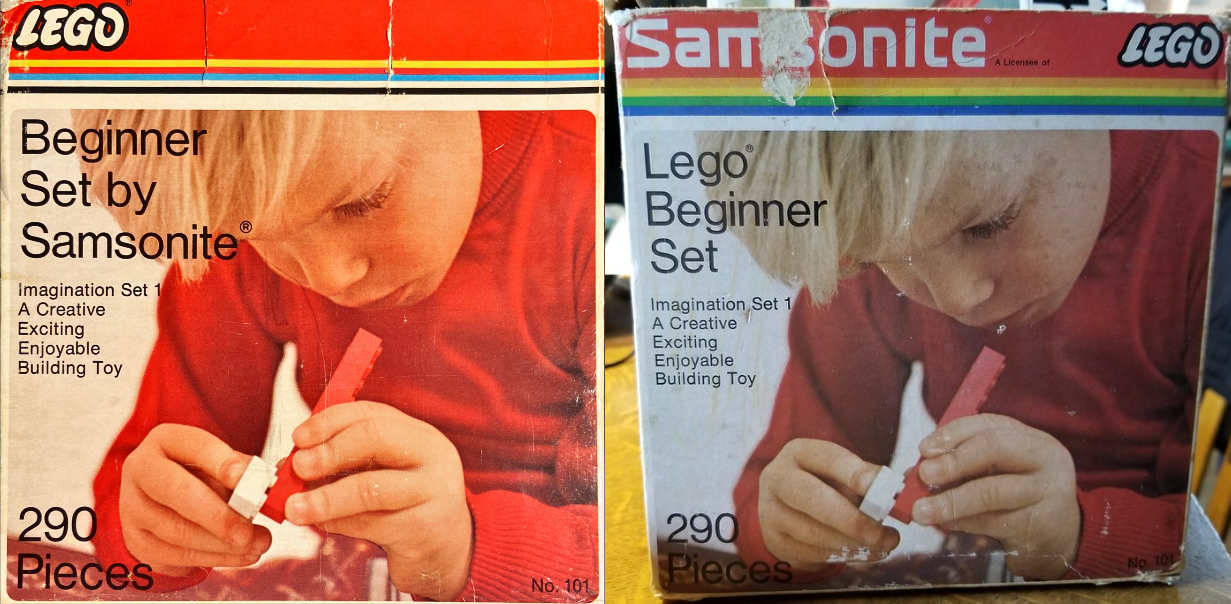
We know LEGO's own imports began as early as Christmas of 1972, which would cover why a box change would even exist: to prevent consumer confusion.
You may ask: "Doesn't it make more sense for Samsonite to introduce a completely new line of LEGO sets because of the loss of the license? Wouldn't King Shwayder predict an overall net loss for 1972 because of the loss of the LEGO license?" Which is completely fair. Forgetting the anecdotal memory by the employee who had witnessed the meeting, there is an argument to be made there. We can also write off the redesign of the boxes as some other external factor, unrelated to the loss of license.
However, even with all that context stripped away, we must still acknowledge the sets themselves, as they are.
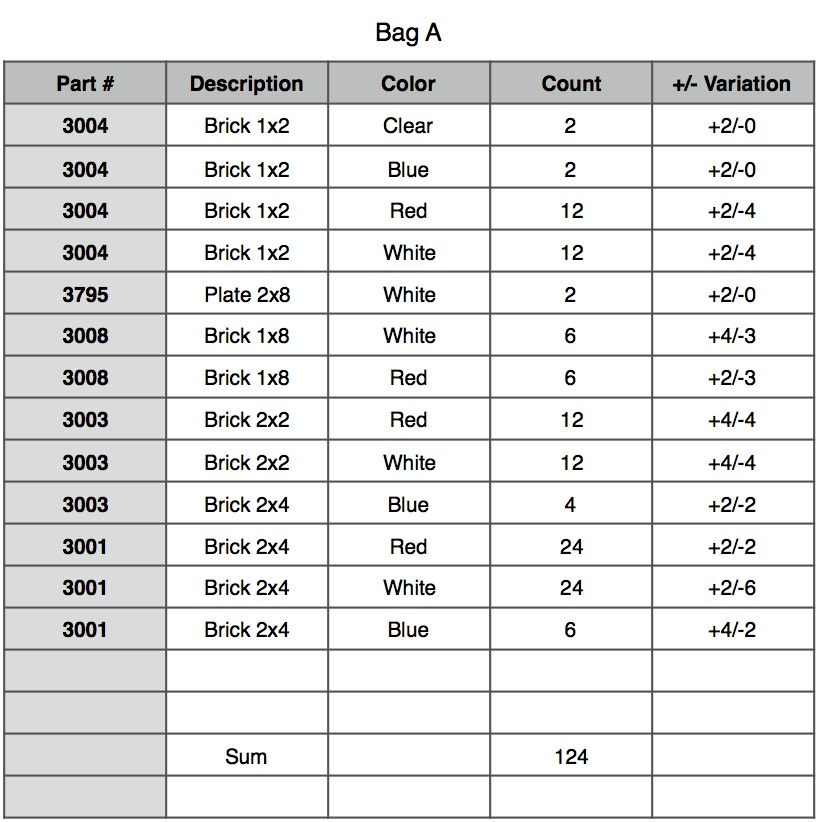
What we see are purposeful assortments of varied parts with specific ratios of colors, not a haphazard, careless dumping of inventory. It is so systematic that LusiferSam was able to inventory each bag with most variations of only +-2 and a select few +-4 (which between a small sample size is also considering the most extreme cases too). If it was truly an inventory dumping set, we would not see such a consistent assortment of each part/color applicable across different examples:
Remember the 695 Bulk Assortment Set, the one we know was dumping inventory of the 1961-65 supplements line? Remember how it is so inconsistent it is impossible to apply any sort of rules to it? Remember the 704 Master Discovery Set? The set dumping 1:87 inventory? Remember how no two examples share the same variety of specialty pieces?
If the Imagination Sets were originally intended as inventory dumping sets and were designed in response to the loss of licensure, we would not see severe consistency. Based on previous Samsonite behavior, we'd see chronic inconsistency for the inventories of these part bags. Instead, they read as very keenly designed to have a diverse assortment of bricks and colors within a constraint. And remember, slight packing variations largely stem from the human element and what is on hand, not necessarily careless handling or simply dumping inventory.
Again, wouldn't Samsonite have 1x8 bricks in any color other than red/white? Wouldn't they have 2x8 bricks in any color other than white? Where even are the 2x10s? Or the 1x1 bricks, you're telling me they had no 1x1s left over? Or 2x3s? All of these questions can be answered with the new explanation, not the original popular story.
It is a pattern of design that goes all the way back to sets from 1961, which was found in Was There a System to Determine a LEGO Set's Inventory? (1961-64). In short, Samsonite always produced assortments based on basic ratios. There we see the same variation between examples, again because of human error and available stock. That original system matches in many ways with what we see with the 1965-71 redesigned assortment and even Imagination Sets: an equal number for each type of brick in red and white (i.e. 24 2x4s in white, 24 in red), the number of 2x2s is half the number of 2x4s, etc.
All of it points to a deliberate, scaled back production with very little actual inventory dumping taking place. Bringing back the financial context from King D. Shwayder and the anecdotal story about the meeting, it makes much more sense why this was occurring.
Internal decisions such as these are incredibly difficult to track through surviving sources. So I don't tout this as absolute truth, as there are very few sources that could possibly reconstruct this confusing story, but it is the first explanation to be rooted in several avenues of evidence.
Previously, the best explanation was that because sales were poor in the US, LEGO took back the license. It makes sense, but it was assembled via deduction based on the seemingly sudden appearance of the Imagination Sets. Those sets needed some mechanism of explanation, and so the story was built around that oddity. I myself was convinced by it until I investigated myself.
LEGO may have had their foot partially out the door for Samsonite in the US anyway, as sales were indeed pitiful, only that the redesign was the inciting incident. Samsonite of Canada kept the license because they kept a low profile, simply curating their LEGO line and not trying to reinvent it.
But I'd be remiss if we didn't at least cover some other explanations, and why exactly I do not endorse them.
The Beatrice Merger
Some modern sources propose that LEGO took back the license in 1972 out of fear for Beatrice Foods being in control of the LEGO license. This theory, however, is largely predicated on several mischaracterizations of both the nature of the deal and the timeline.
Samsonite history is not well or accurately documented (very much a victim of citation drift/haphazard gap fills), so when LEGO Samsonite history was first being explored, the Beatrice merger was a very attractive explanation as to why LEGO took back the US license around that time. But I’d recommend reading up on it via contemporary materials. Some modern retellings often claim Samsonite was in financial ruin or the Shwayder family wanted out after the death of Jesse Shwayder, but when you trace back these ideas none have contemporary attribution and are often contradicted by the details.
At the time, Samsonite had broken sales records again ($150 million) and was interested in going public, and Beatrice essentially “made an offer they couldn’t refuse”. As part of the merger (which was not limited to the US but also included all Samsonite subsidiaries including Samsonite of Canada), virtually everything was to remain the same including leadership. King Shwayder remained the president of Samsonite (and was quickly voted onto the board of directors for Beatrice), and Richard Shwayder was still the president of the Canadian subsidiary. The deal was subject to Samsonite shareholder approval after it was first announced in April of 1973. It wasn’t a cash sale but instead an exchange of Samsonite stock for Beatrice stock.
While I don’t know exactly when the LEGO license was bought back (LEGO themselves call it “a negotiation in 1972”), the timeline can be approximated based on the Imagination sets. All toy lines were redesigned and early production was ready for the 1972 toy fair in March(?). That means, regardless if the imagination sets were created before or after the loss of license, the most likely date for the license buyback was early 1972. In my opinion, any date in 1972 is a little too early for LEGO to know about the merger, if there was any discussion started at that time.
Likewise, my biggest hang up for that theory is that Samsonite of Canada was part of that merger (reported in newspapers), and yet they continued to operate under the LEGO license normally. If Beatrice was problematic, it would be odd that it wasn’t an issue for the Canadian subsidiary that was also being acquired by Beatrice. Thus, Beatrice likely was not the causal reason for the loss of license.
Poor Sales
Yes, it can be demonstrably shown that Samsonite's LEGO sales were a fraction of Europe's, as well as Samsonite's own numbers. Projected US LEGO sales in 1965 was only 1.5 million, compared to the 50 million in Samsonite luggage sales.
So while it would serve as a sour point between LEGO and Samsonite, and very likely was a factor at play, it does not produce a causal reason for why the license would've been pulled at that exact point in time, and so quickly. One could argue that it could've been a legally binding factor of the contract, but if that were the case, the cited 'negotiations' by LEGO would not have been needed. Nor are any legal filings evident.
Alone, this popular explanation does not do well to account for the chronology of the imagination sets. Instead, many proponents of this theory usually propose that the chronology was reversed, and Samsonite purposefully put their logo big as a way to advertise their own name at the end of the license. The issue is that this does not fit the evidence or Samsonite's previous established behavior.
If poor sales were enough, especially in a legal sense, the license would've ended much earlier.
Author's Note
This is a fascinating case study as to why we've gone into such granular detail about Samsonite and why we have such strict sourcing standards. We could absolutely record only what has been repeated for decades, but history should not be a static retelling of the first conclusion. In that very Flikr post that the Samsonite employee's memory is shared, it is immediately doubted and discounted with the popular story of events that make it impossible.
However, when you disconnect yourself from what you already believe and interrogate it with only knowledge from that era, it explains several things that were odd before, as well as allows us to better understand the LEGO and Samsonite relationship.
It is up to you as the reader to examine the materials yourself and draw your own conclusions. Very few sources cite their evidence, so if you really want to know what happened, ask questions and follow what the evidence shows.
That's what we did today, that's the best way we can answer a question that has no easy answer.