
All About the 704 Master Discovery Set
___
Coming from having dated the 005's trial offer to 1965 to 1967, as well as having completed research on Discovery Playthings (both of which have their own dedicated articles), there's one set in particular that I feel is very important to address: the 704 Master Discovery Set.
If you're unfamiliar, it's essentially an 004 Master Builder's box with a different set number and piece count. So very unassuming, but a lot more to unpack than you'd expect. It's another set commonly known as an FAO Schwarz exclusive. We'll cover its availability below, just note it never appears in any known FAO catalogs.
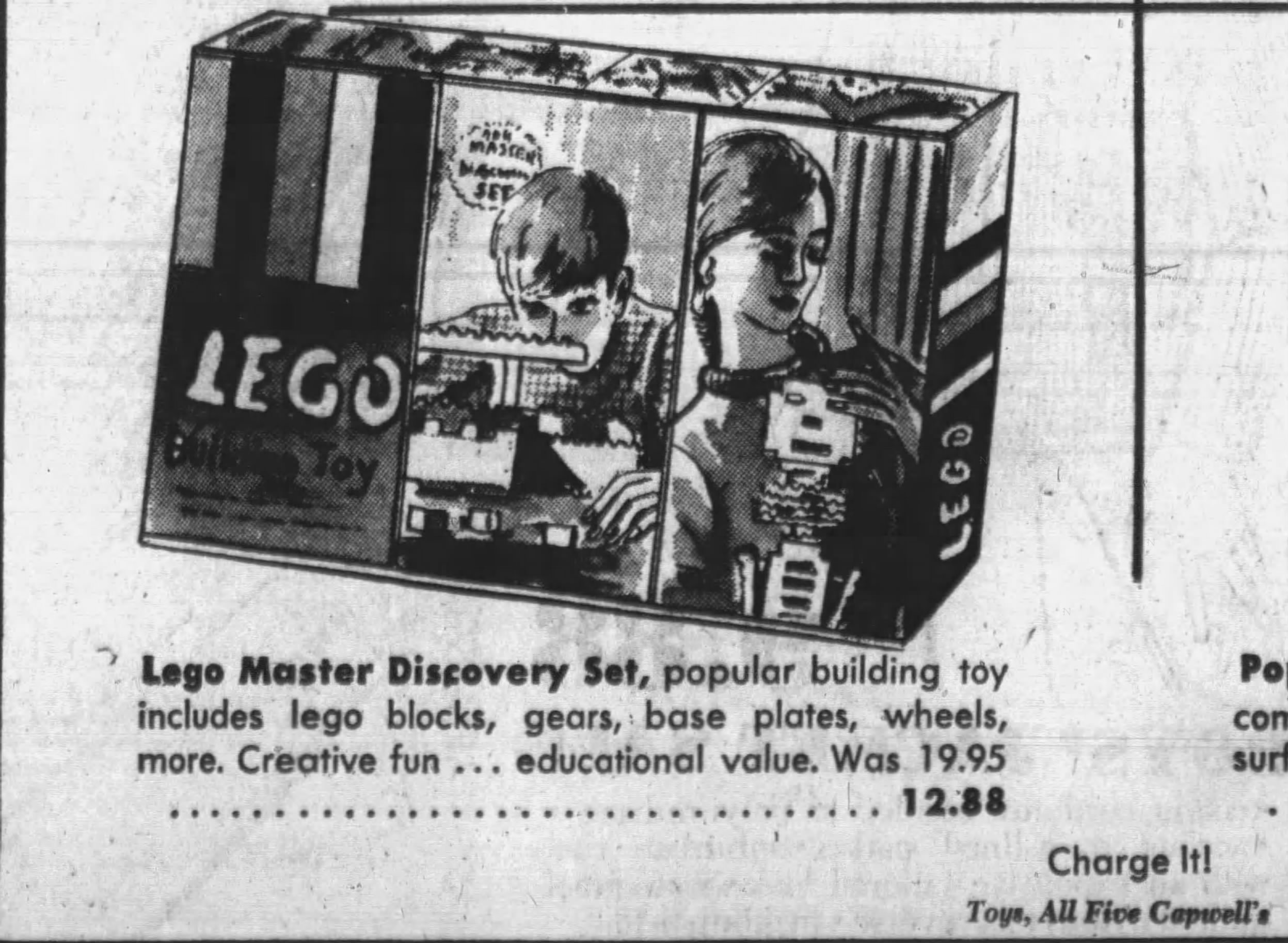
In print media, the set first debuts rather unceremoniously at a Capwell's in August of 1968:
Then goes on to later appear in many 1968 catalogs from Allied Stores (Bon Marche, Pomeroys (they share the same catalogs), Jordan Marsh, and various stores in newspapers like Jacobson's).

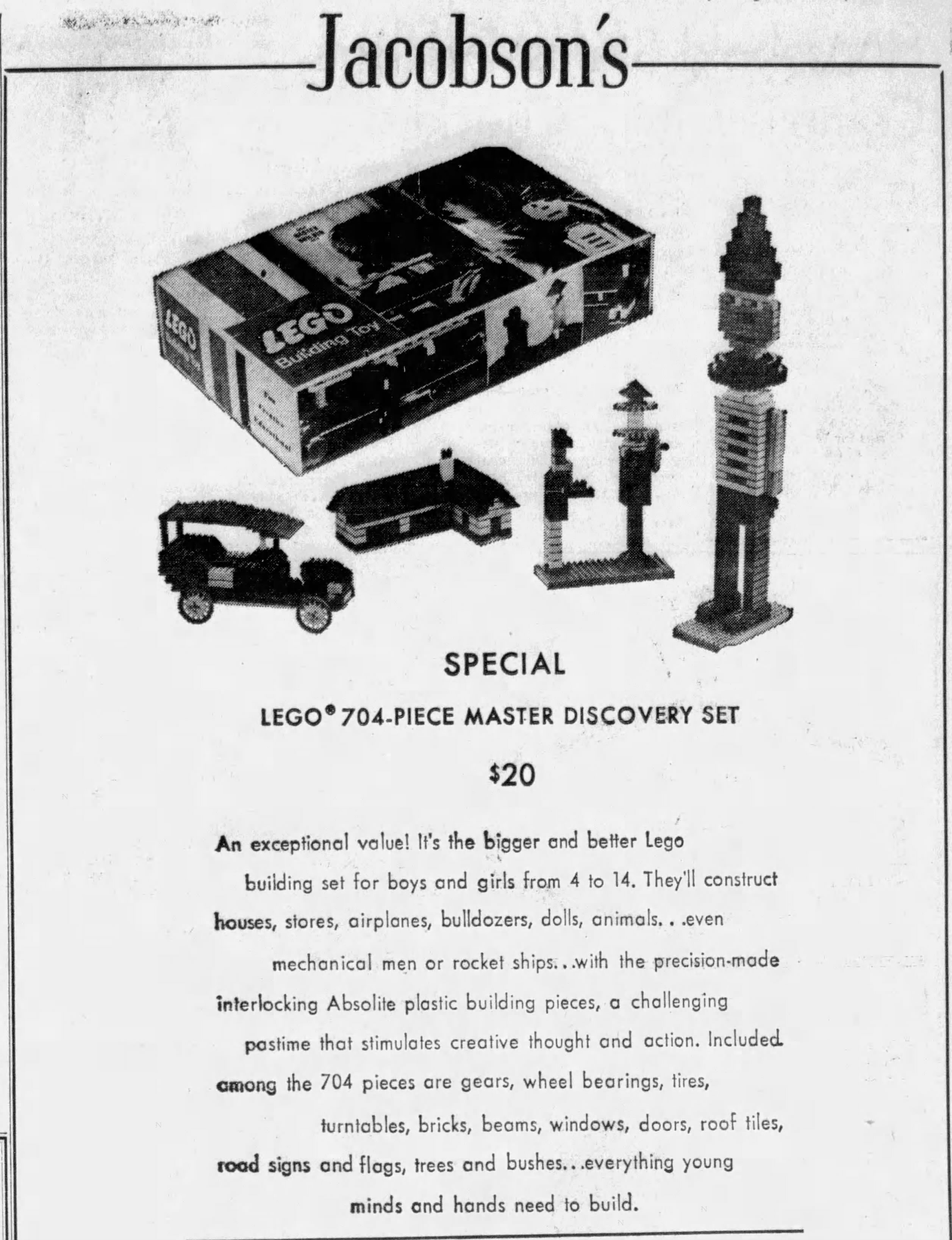
So it released in mid-1968?
Not exactly. After all, it's a bit odd that the first appearance is a 35% off sale in the middle of the year. Almost every Samsonite set released for the Christmas season because of course that's when you'd release a toy. Even the 005 Discovery Set's release in 1965 demonstrated this, but we won't rule it out just yet, as the 102 Super Value Set in 1970 and the 360-363 Model Maker Vehicles in 1971 released early in the year.
This is where we have to get into what the 704 Master Discovery Set was and why it was produced. That's the only way we can accurately date it.
For one, if it didn't release in mid-1968, where would it have been available? Mail order.
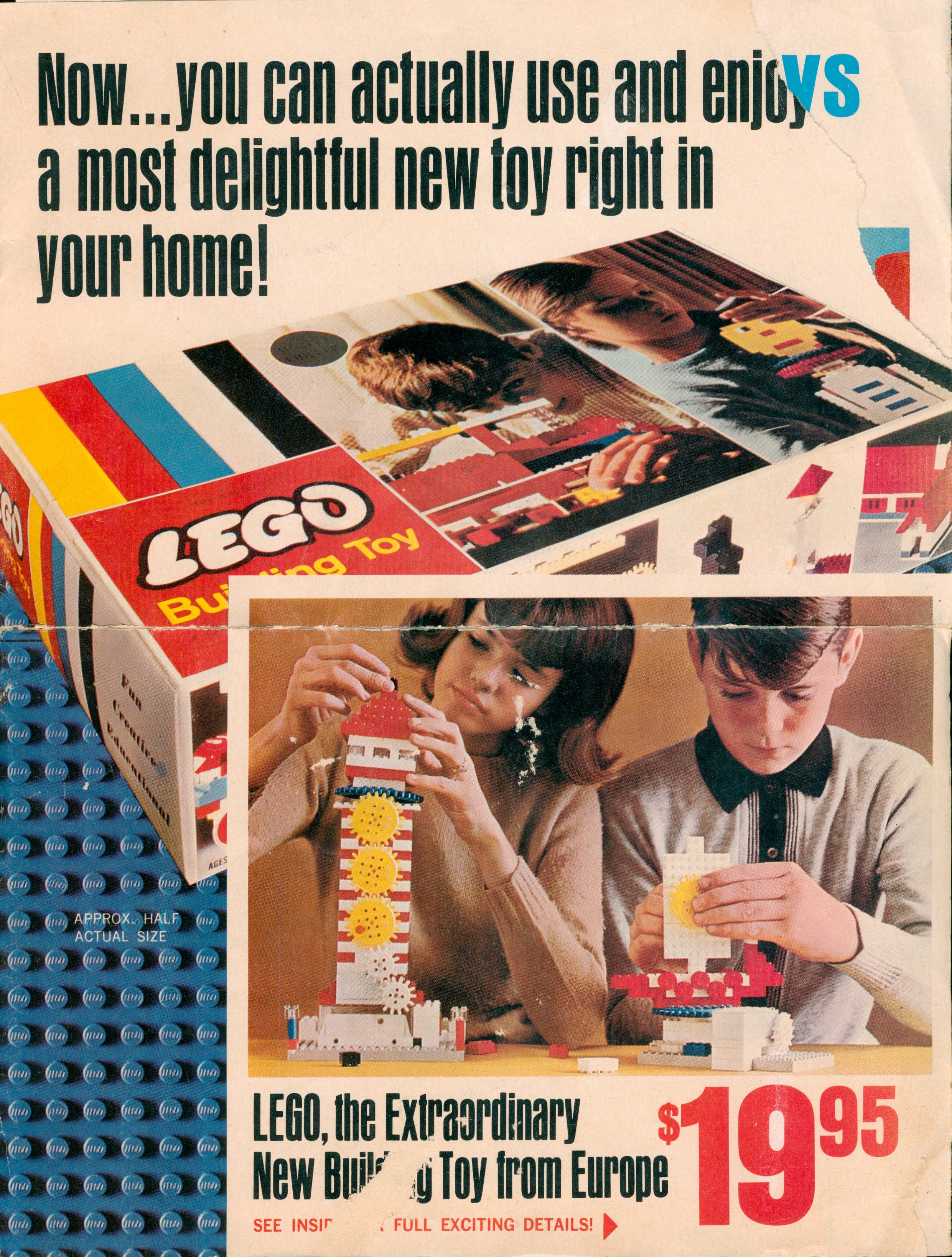
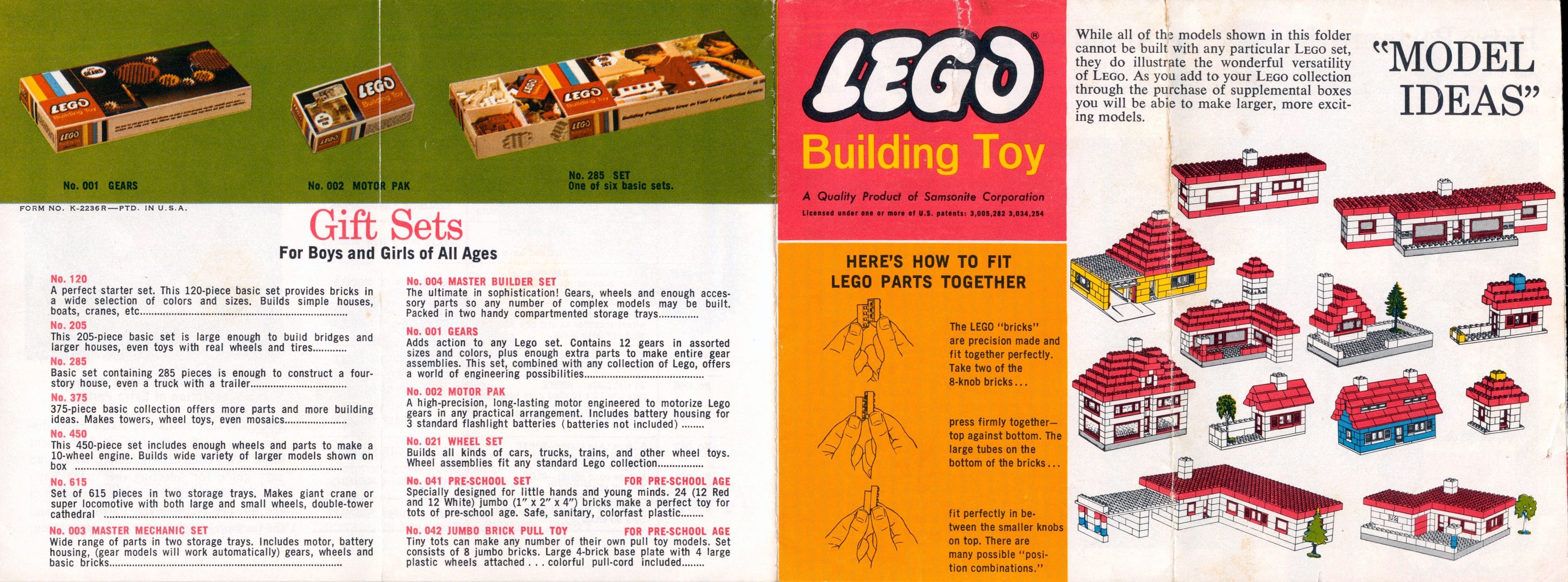
Comparing it with my 005 trial brochure, it's clear the 704's came later, as the white was added to make the text easier to read and the missing margin on the image shown has been fixed along with smaller refinements:
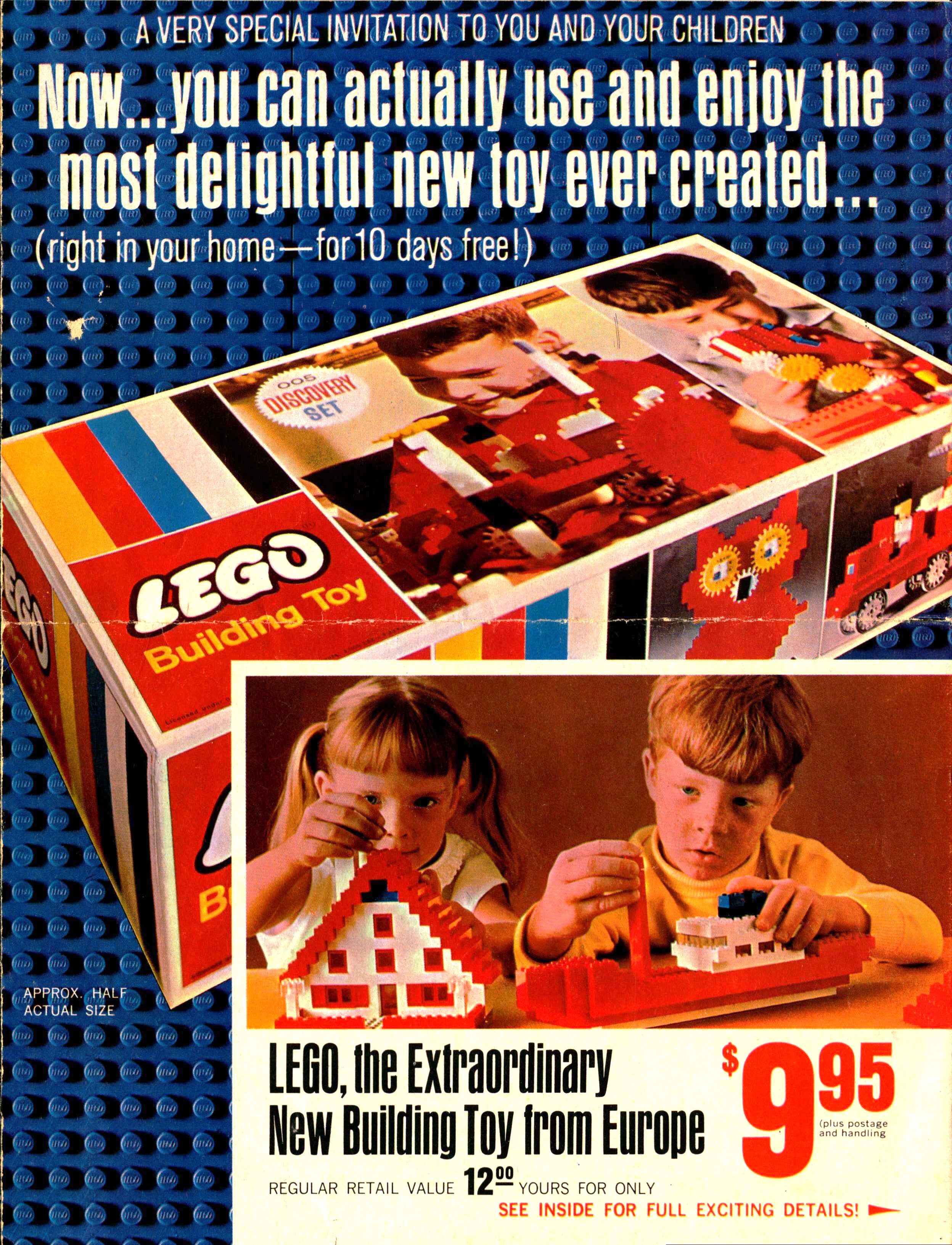
Unfortunately, this only places the release to be somewhere between 1967-68 (as my pamphlet was created in 1966, it couldn't have originated in 1966), which is not really helpful, but we still have recourse. Instead, given we know sets were releasing in anticipation for Christmas consistently, as well as given we have an odd discounted appearance in the middle of 1968, 1967 is our most likely candidate for the release.
I discuss this pamphlet in relation to other Imagination Inc pamphlets in Dating Various Mail-Offer Pamphlets.
But there's a lot more to unpack to support the 1967 date.
The Box
The strongest piece of evidence for the release date of the 704 is the front of the box:
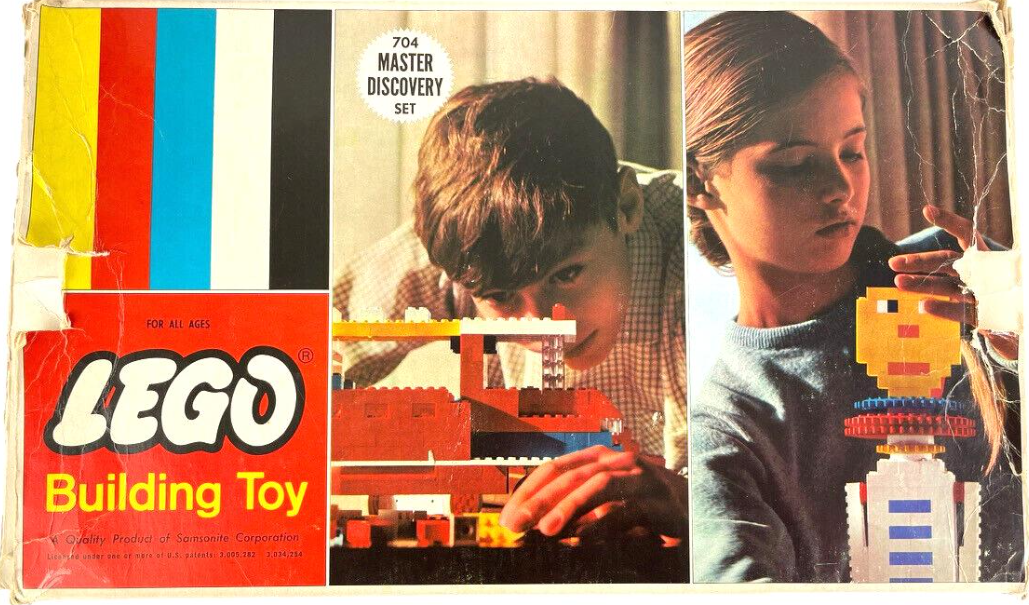
It has two patents(used from 1961-67 with eight patents starting in 1968) and "FOR ALL AGES", which began in 1967 (the year they removed age ranges from idea books). The prototype version of the box, using an existing 004, had the age range on the box.
Thus, I think that is rather conclusive evidence that the set was designed and released in 1967. It has no box variants.
The Piece Count
While the pamphlet is mostly the same, fortunately the 704's parts are shown:
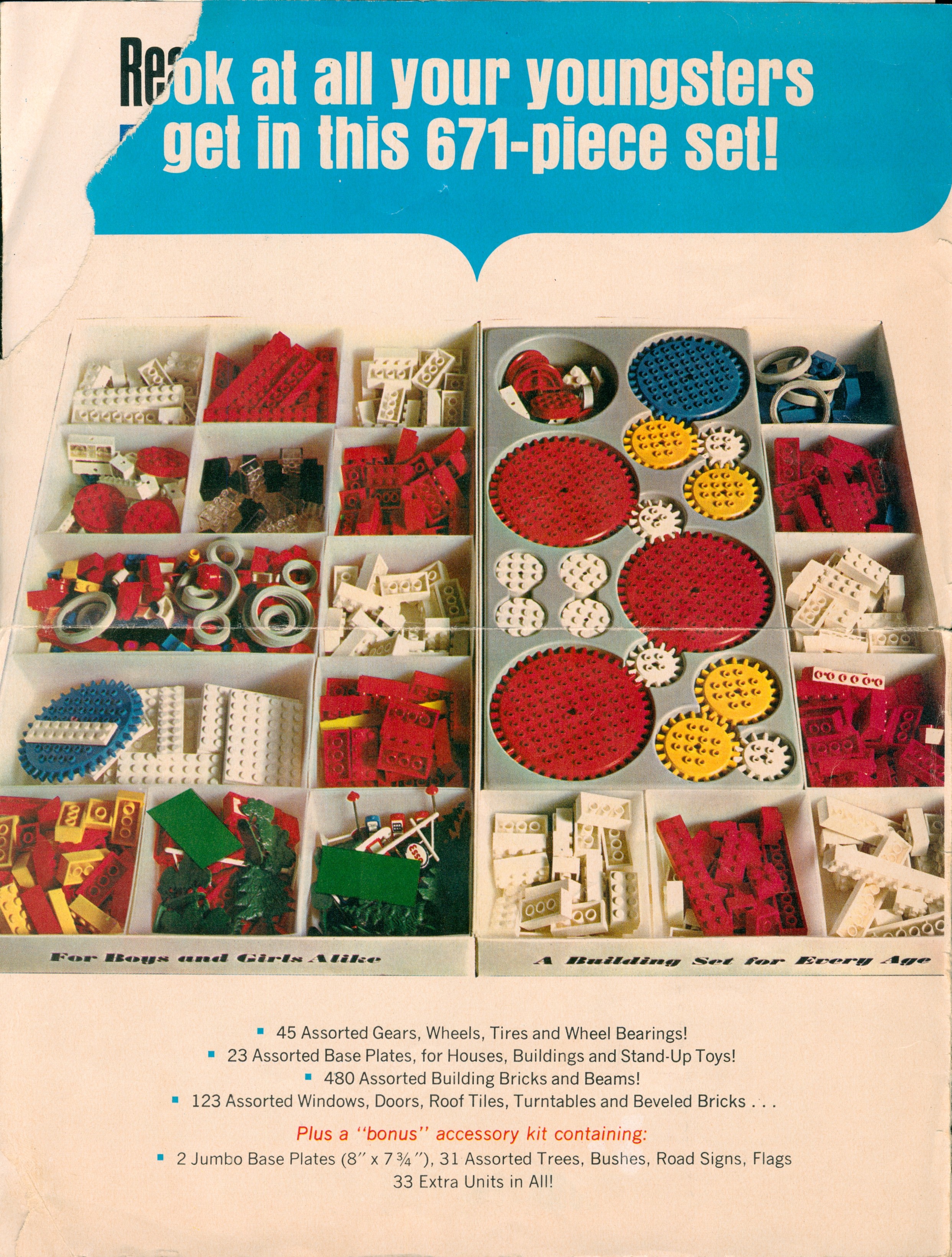
If you add up the numbers above, one would expect to get 670 to coincide with the 004 Master Builder Set's piece count.
Except we don't. It's 671 here.
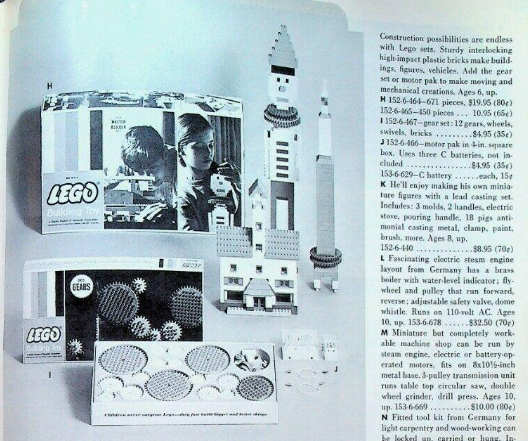
No big deal, they simply miscounted or Samsonite made an error, right? It happened in this 1966 Marshall Fields Catalog, the Master Builder is advertised to have 671 pieces. Which fair enough, their quality control was a little subpar, to put it in a nice way.
So why could 671 be an important lead? This matches something that confused me in the past. Check out this Macy's advertisement from 1968, advertising a 671 piece set and saying it's an "exclusive":
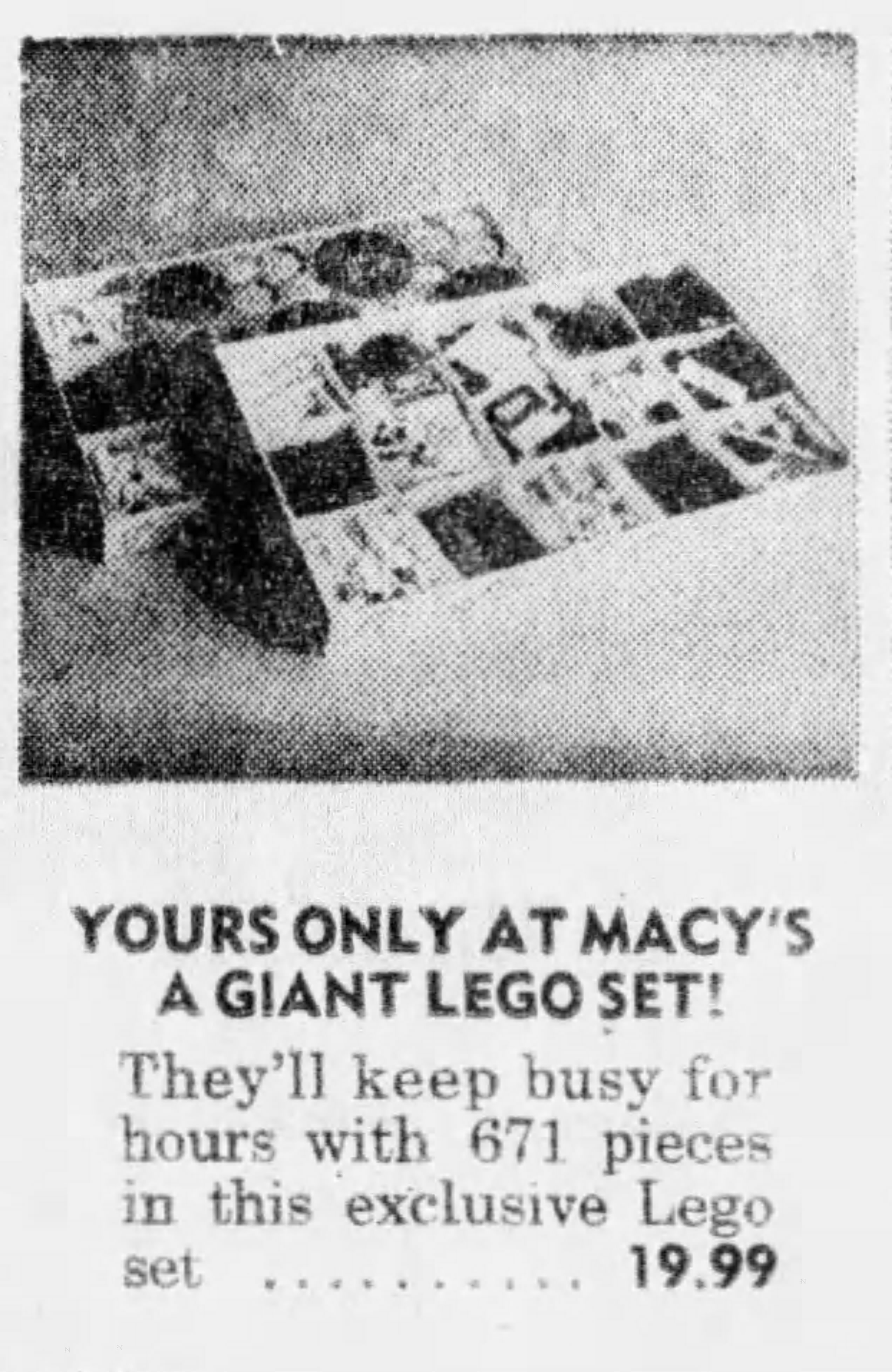
It appeared in a different Macy's advertisement with different wording as well, so I don't think it was a typo.
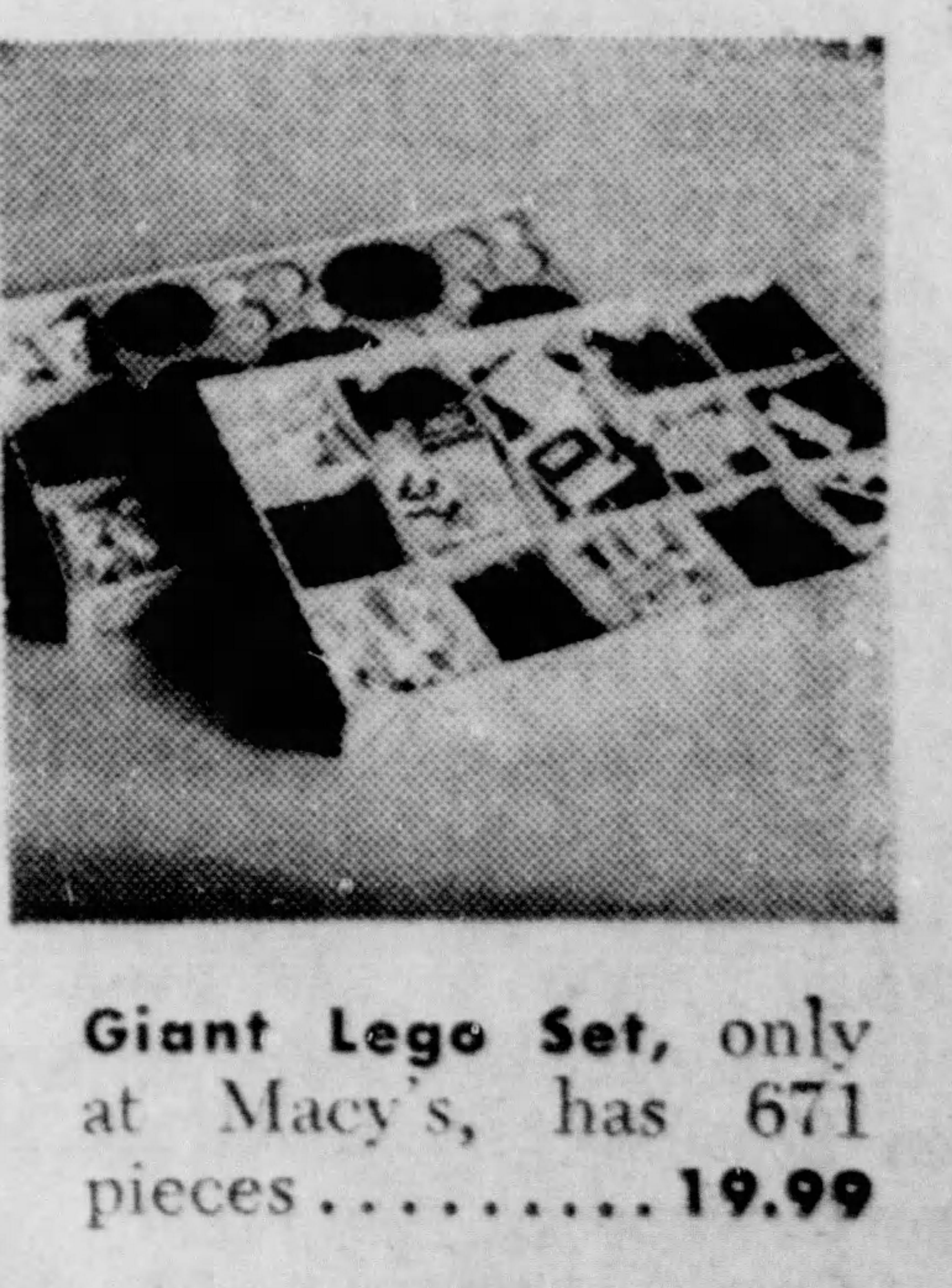
There are some sets advertised as exclusive at one retailer but in fact was concurrently available at at least one other retailer (take for example the 326 Suburban Set being available at Ward's, Pogue's and Jordan Marsh in 1969, with two of the three claiming exclusivity).
But while the set wasn't truly exclusive, it still had a very limited distribution and was exclusive for select retailers. So the Macy's advertisement may have an important detail, as the exclusive 671 piece set would be a 704 without the "bonus" specialty pieces. We will go into more detail why this set may exist.
For now, just keep that detail in the back of your mind. Now we can go into the bonus pieces.
The Bonus Pieces
While the pamphlet only pictures Esso signposts, trees, and gas pumps, the set could've come with any variety of the following elements: "31 Assorted Trees, Bushes, Road Signs, Flags... 33 Extra Units in All!"
The baseplates are the guaranteed elements. "2 Jumbo Base Plates (8" x 7 3/4")" The plate's dimensions are 25x25 studs, the 1/4 inch difference likely accounts for the edges of baseplates not being cut evenly. A quality product of Samsonite.
Beyond that, Esso posts, gas pumps, flags, and road signs... all specialty town plan elements. They were retired from the US in 1965 but remained in Canadian parts packs at least until 1966 (via this supplements assortment). They are also anecdotally said to have remained in production into 1967 in select countries, Canada included (thank you The Unofficial Collector's Sets/Parts Guide).
So here's the thing. It seems rather bizarre to create a massive $20 set (which was a lot of money then) just to eliminate stock of a relatively small amount of items (road signs, Esso accessories, etc.). 34 pieces at a time.
And also... why add the trees/bushes? They're Samsonite's own unpainted version, and its not as if they were retired after this year. The molds were not updated until around 1970 (see the trees/bushes article for more). So why add the trees?
A simple explanation would attribute their presence as complimentary to other town accessories, which fair enough. But there's something I've been getting the feeling of that I go into below.
Before we move on, it's also important to point out the green cards used to cover (cover used loosely, as they are still incredibly visible) the Esso accessories. As this image predates the promotion's beginning (so there'd be no reason for them to already be out of Esso accessories), it is likely the cards are present simply because the inventory of specialty parts was variable.
As this was a mail offer, it'd be a courtesy so as to not disappoint those who looked at the image and not the text.
The General Inventory
Beyond the specialty pieces, it's important to note that the set's inventory is inconsistent with the 004's standard assortment, which further supports the earlier notion that the 671/704 was simply a different assortment. I'll show the image of the 704's trays again:
Most obviously (and easiest to prove as Samsonite set inventories are not exactly the most consistent) are the plethora of wheels/tires present, far more than should be here if it was just an 004.
For sets like an 004, the gears tray means it includes an 001 (4 large wheels and tires, 6 small wheels, 4 small tires, etc.). But there are nearly double the number of large wheel tires in this image, so many it does not fit in the 001's tray.
It also has a random extra gear. Not even sure why that is, but again may be a clue. Samsonite inventories were inconsistent, but they weren't erratic, especially for prepared photographs.
The blue, yellow, and black parts seem to be normal for the 004 and without proper inventories of either sets, its impossible to say i anything else is different (as these are all mainly basic parts).
But again, I ask the question: Why go through the trouble of creating a massive mail offer set if the goal was to get rid of a handful of pieces at a time? Why would Samsonite use the largest set in production to do so?
My Theory
The retirement of the original supplements line in Canada by 1967 does not explain entirely why the set was created. Not even if North America was sent the world's leftover inventory of specialty parts, the size of the set cannot justify itself without something more.
So thinking that it seems to have an assortment of basic parts, but also pieces that don't exactly fit with the inventory of the 004. It was made available through a mail order offer and then at a select number of retailers. The use of Samsonite's trees, the strange inclusion of the baseplates (the first and only basic set in North America to include such plates under Samsonite's reigns), the 1968 appearance of the "exclusive" 671 piece set matching the known timeline the 704 was available, and the 671 piece count from the catalog.
And most importantly, the 704 is simply reusing packaging and not trying to be its own thing.
What else reused packaging and didn't appear in normal catalogs?
Ah, the 695 Bulk Assortment! Not only did the exclusive tray come from an earlier Samsonite product, a Streamlite beauty case, but the set's images on the outer sleeve originated from the 205 and 375 sets. Which we can parallel with the 704 Master Discovery, as it uses the 004's box with a small tweak to the set name/number.
As covered in its dedicated article, the 695 was used to eliminate excess inventory for 1961-65 supplements as early as 1966, before the release of the new 1966 Extra Parts line. And guess what happened in 1969?
A new extras line!
But the 695's inventory was immensely obvious as a surplus kit, as just by looking at it every collector could see what it was used for. Why would the 704 be any different?
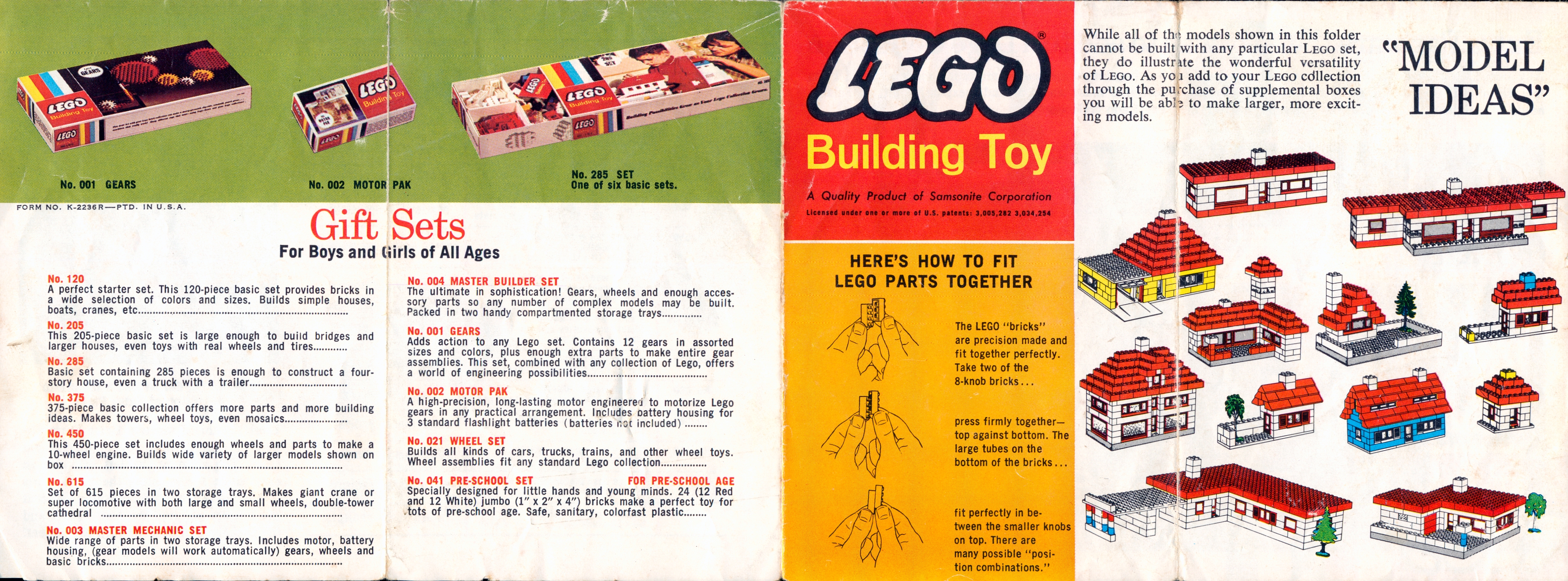
Well not only was the extras line changed, but also several basic sets did not return for 1969. Compare the basic set/extras assortment in 1968:
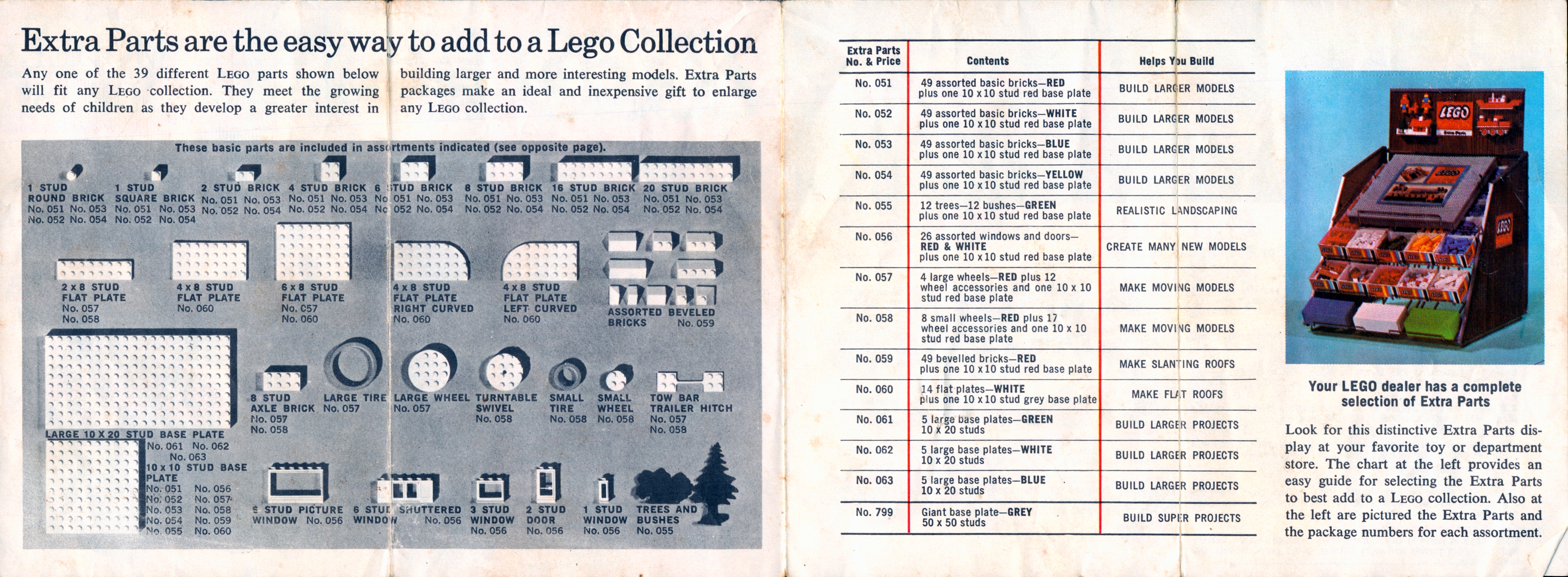
To 1969:
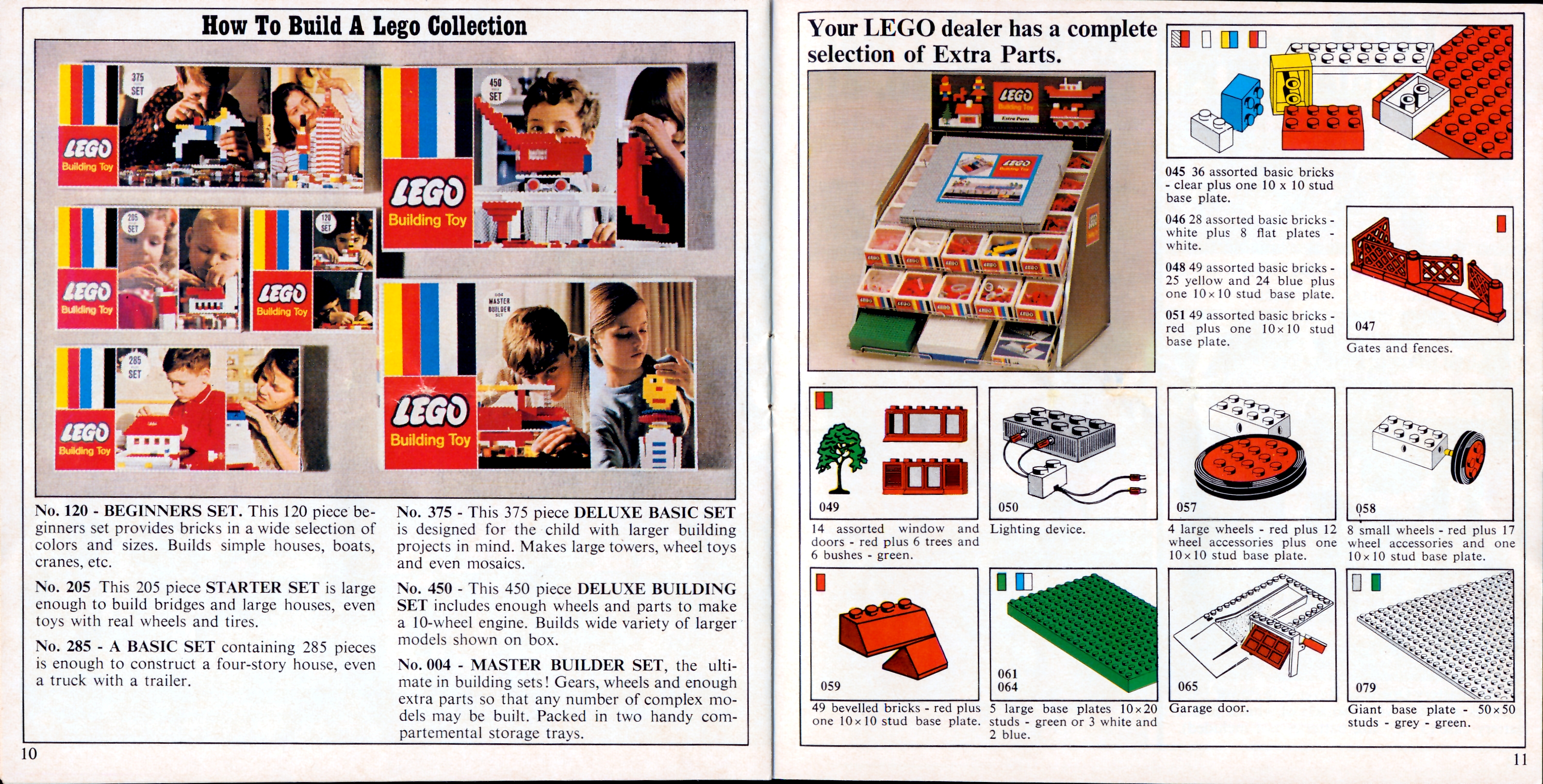
The 021 Wheel Set, 003 Master Mechanic, and 615 Basic Set all retired at some point in or before 1968 (the 003 may have been retired a little earlier than the other two because of the 107 Reversible Motor). Assortments within basic sets also were adjusted at some point during this time.
Regardless, considering several sets were quietly retiring, the extras line was due for a refresh, and the town plan elements also needed dealt with, that places a clear incentive for Samsonite to repurpose a set's packaging (as we already have precedent for with the 695) into a limited offer set to get the inventory sold.
The issue with my theory is that the set's initial release is a little late for that to be the case. After all, the set has provenance for a 1967 release. I don't have a clean explanation for that, but there are many possibilities.
Poor sales of the new 1966 supplements line to dealers (as there would obviously be hesitancy from the retailers) is a very nice explanation, but there'll never be anything I can show for that to be substantiated beyond maybe. Instead, beyond what we've noted so far, let's look at the set itself within the context it existed within.
Peculiarities
Besides the packaging parallels with the 695, the 704 has many peculiarities that can possibly be explained via my theory.
Why the trees? The dedicated 055 Trees and Bushes pack shrunk down from 25 parts to 12 in 1969.
Why the gray 25x25 baseplates? 1969 was the introduction of the 079 50x50 green baseplate. Given that E-054 (the Three Worlds suitcase set) also released in 1968, was also produced in very limited numbers, and also used a 25x50 gray baseplate (which required the creation of different inserts), there was clear intent for Samsonite to burn through inventory in limited sets.
Why the wheels? There were wheel supplements, as well as the 1968 retirement of the 021 Wheel Set and the 003 Master Mechanic.
Why would a 671 piece set appear suddenly in multiple places in 1968? A set that would perfectly match the 704 without the special advertised "bonus kit". A set that is explicitly said to be exclusive to Macy's (and appears to have been so in 1968). And beyond the 695, I've since found a similar purpose behind the 630 Diplomat Set in 1970: a purpose built set without a consistent assortment.
So we have a pattern for Samsonite:
~1966: 695 Bulk Assortment
1967-68: 704 Master Discovery Set
1970: 630 Diplomat Set
Though we should address something:
Why would Samsonite need to refresh inventory?
This is a bit more speculative, but is a good question to ask when formulating ideas about motives. You don't only think about what it was, but what it was meant to accomplish.
So why would Samsonite need to refresh? Simple. There is simply no way Samsonite was running deep logistics in determining exactly how many of each piece to produce to make each set. Instead, it is more likely parts were produced immensely liberally with the sets they would go into (and quantities they were needed) as an afterthought. Couple that with the massive expansions of the LEGO Samsonite line through 1965-68 and variable/poor sales to retailers, as well as repeated struggles with supplements, it is extremely likely there were leftovers needing dealt with.
I'm not saying there was no planning whatsoever, only that logistics had to be very complex and nothing is ever ideal.
If you were Samsonite, and you had a surplus of parts, what would you do? You don't produce more of the sets you're already making, as retailers are still only going to order a fixed amount. More stock doesn't equate to more sales. More so, 1967 and 1968 saw the introduction of a large Model Maker line, which means more and more competition between their own sets for retailers.
Instead, the mail order offer was created, likely in late 1967. And to continue the refresh in late 1968, the 704 Master Discovery Set was offered to select retailers as a limited exclusive. All stores that carried the 704 (except the anomalous Capwell's appearance in the middle of the year) had a Discovery Playthings department and were under the Allied Department Stores umbrella, the 704 was likely offered to Discovery Playthings as their exclusive. That way, Samsonite wouldn't have to worry about competition or convincing retailers to purchase the 704 and they instead have a reliable channel for them:

I think sometimes I forget about the immense pressure Samsonite would've been under to improve their sales performance. As they were nowhere near taking advantage of the North American market (there were smaller European countries outperforming their sales numbers several times over), having more sets out there on shelves or available for order means more potential sales. As that is much easier (and generally better for both Samsonite and their relation with dealers) when compared to producing sets that will be discounted immediately. Repackage the old into something new.
I don't want to immediately explain anything and everything strange or exclusive as a surplus kit or test market set either. It's only a conclusion reached after examining multitudes of angles and the context it existed within.
For example, could the set have been a test market set? The retiring town plan elements (that varied between copies and were in very limited supply) along with the reused box design speak against this. Could it have had a larger purpose after 1968? Maybe, but there's no evidence for such.
And what about the 671 piece set from Macy's, couldn't that just be an error? Given the presence of the exact same part count in the 704's brochure, it's very likely to be the 671 piece assortment just without the bonus parts as mentioned above. How to distinguish it from the 004 Master Builder Set, if any distinction ever existed, I have no idea.
And we can go a step further and address why it would have a piece count very similar to the original 004's 670. Because that's the size of the box, its made to hold ~670 pieces (or rather it was designed first and then filled with pieces until reasonably full). And as this is a set to deplete surplus, the incentive would be to fill it as full as possible. So 671 pieces, with room for 34 variably sized accessories and two baseplates if needed.
And finally, after all that, we can now formally answer the original question with an important caveat.
By everything we were able to gather, the 704 Master Discovery Set released in late 1967. The original purpose of the set, however, is largely unknown.