
Dating Samsonite Boxes
___
One thing I want to make very, very clear from the very beginning is that there is almost always an exception to the rule for LEGO Samsonite. Tracking its production is an absolute nightmare to say the least. So when I say that a particular box style was introduced in 19XX, it generally means for sets releasing that year. It can reasonably be assumed that there was unused/holdover inventory from the previous season, as it generally seems Samsonite's production was focused around Christmas.
With that out of the way, we can get down to brass tacks. This article is not a "this specific set had this variant this year", as there is a ton of nuance at play and any rules I lay out here will inevitably have a special exemption. Instead, if you are curious about a specific set, the set's page will have the specific details you need.
This article will more be in the vein of "this is how we know what era these examples belong to", wherein rather than having to prove why a date is given for each set on each set's page (especially for 1965+ which have many variants), we can have this article for reference and avoid sacrificing credibility for brevity.
It'll be structured chronologically, separating US lines from Canadian lines, as they were almost never synchronized and would lead to more disorganization. What we know about Canadian sets largely depends on context from the US side of things(what I mean will be made abundantly clear when we get there), so this article will first focus on the USA.
And one more thing before we begin... before the compilation of this site, I had noticed there were different styles but I thought it was impossible to deduce the timeline with any amount of confidence. Newspapers left a lot of gaps and catalog images typically seemed untrustworthy as images could've originated from any point. There would always be an air of "maybe", as is the case with most things Samsonite.
While I don't claim to know specifics about every possible variant, I've managed to correlate very compelling contemporary sources into a nice timeline. And this approach is important, as not only do we rely on catalog/newspaper evidence, but it also proves that just because Samsonite LEGO is confusing does not mean we are stuck without recourse. The problem is that it's not always the most intuitive and will require many forms of evidence working together.
And that's the best thing about this: it's the archive firing on all cylinders. Every scrap we've gathered is vital.
USA: 1961
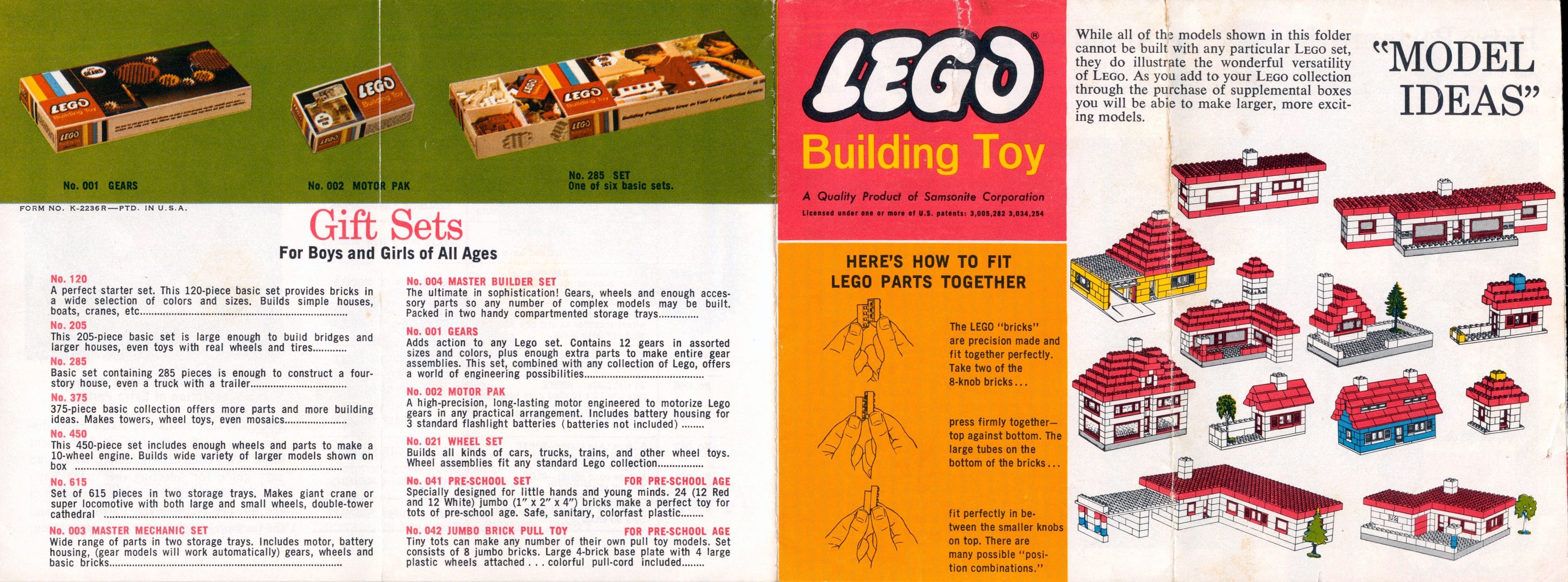
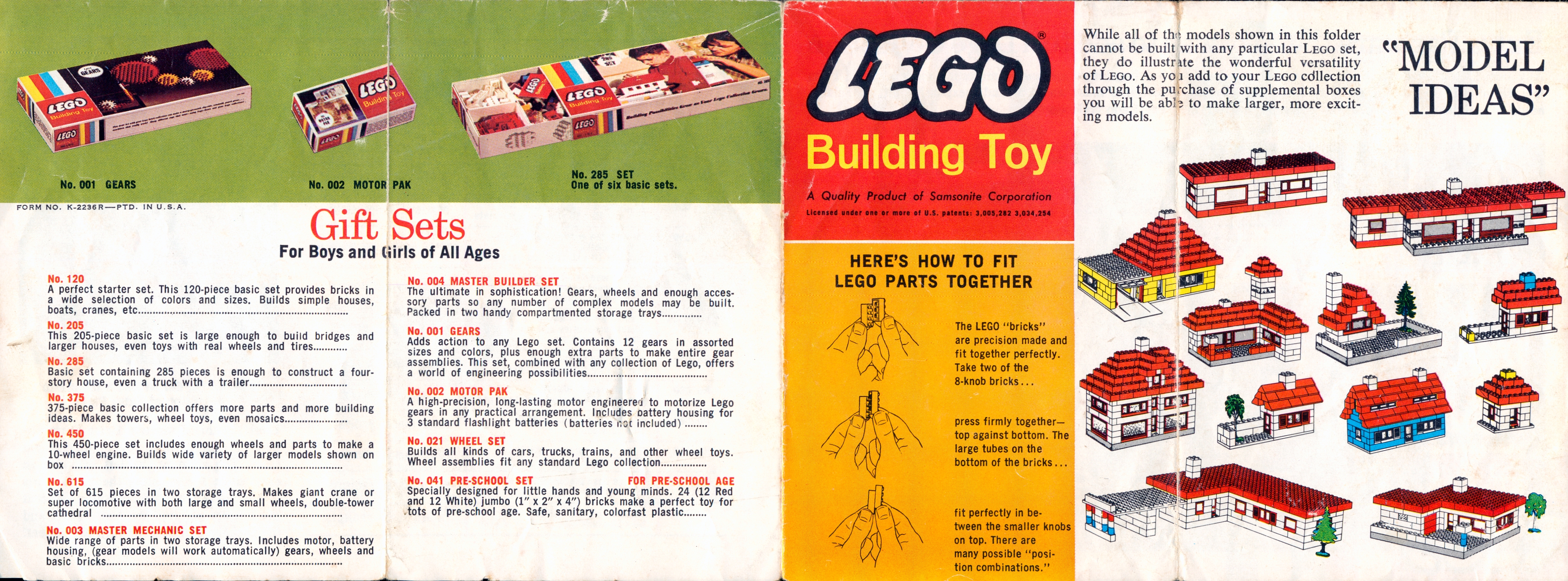
All sets and materials produced in 1961 in the USA, had no patents or registered trademark symbols. Compare the two brochures below, one is the 1961 brochure and the other is the updated 1962 version:
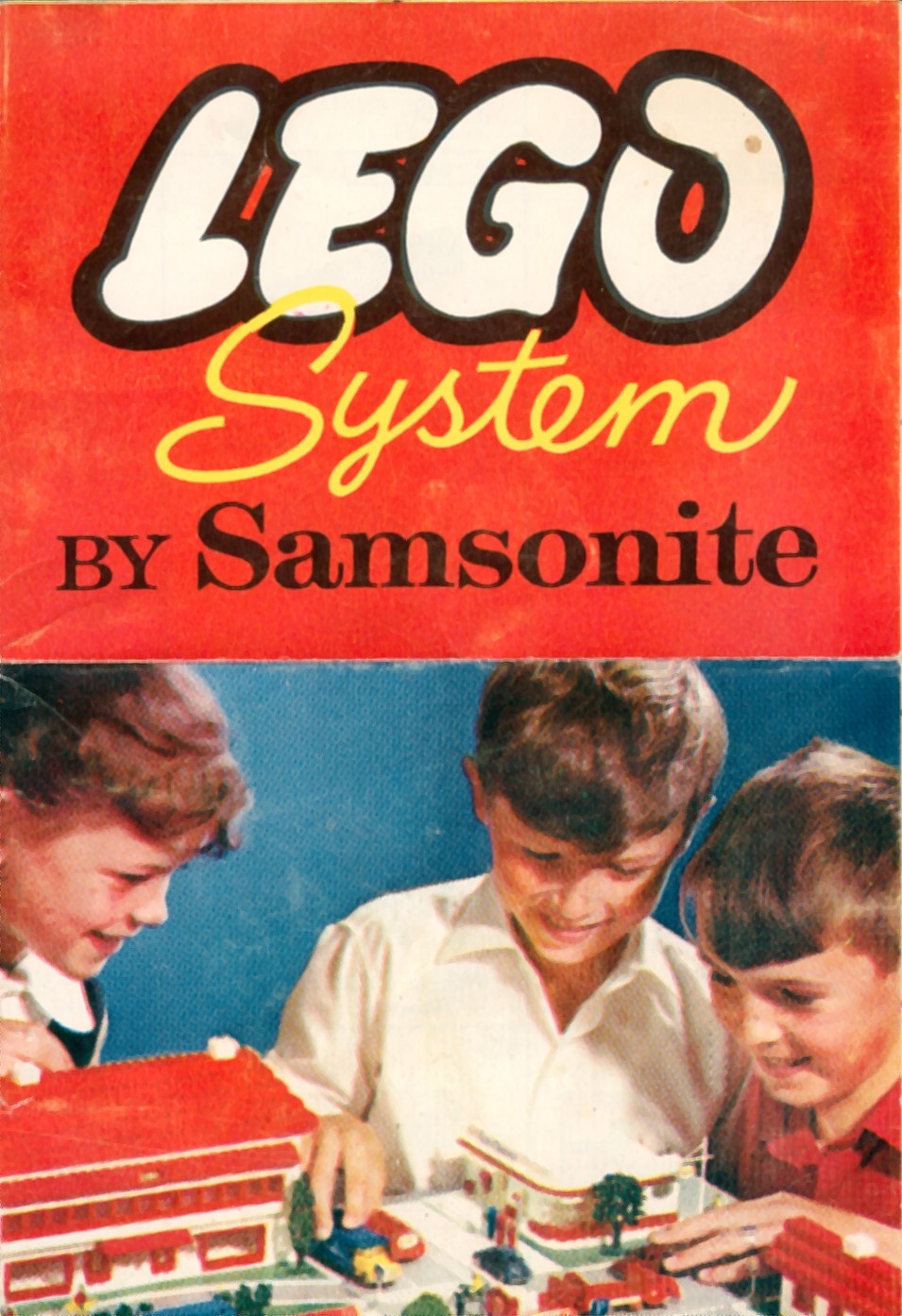
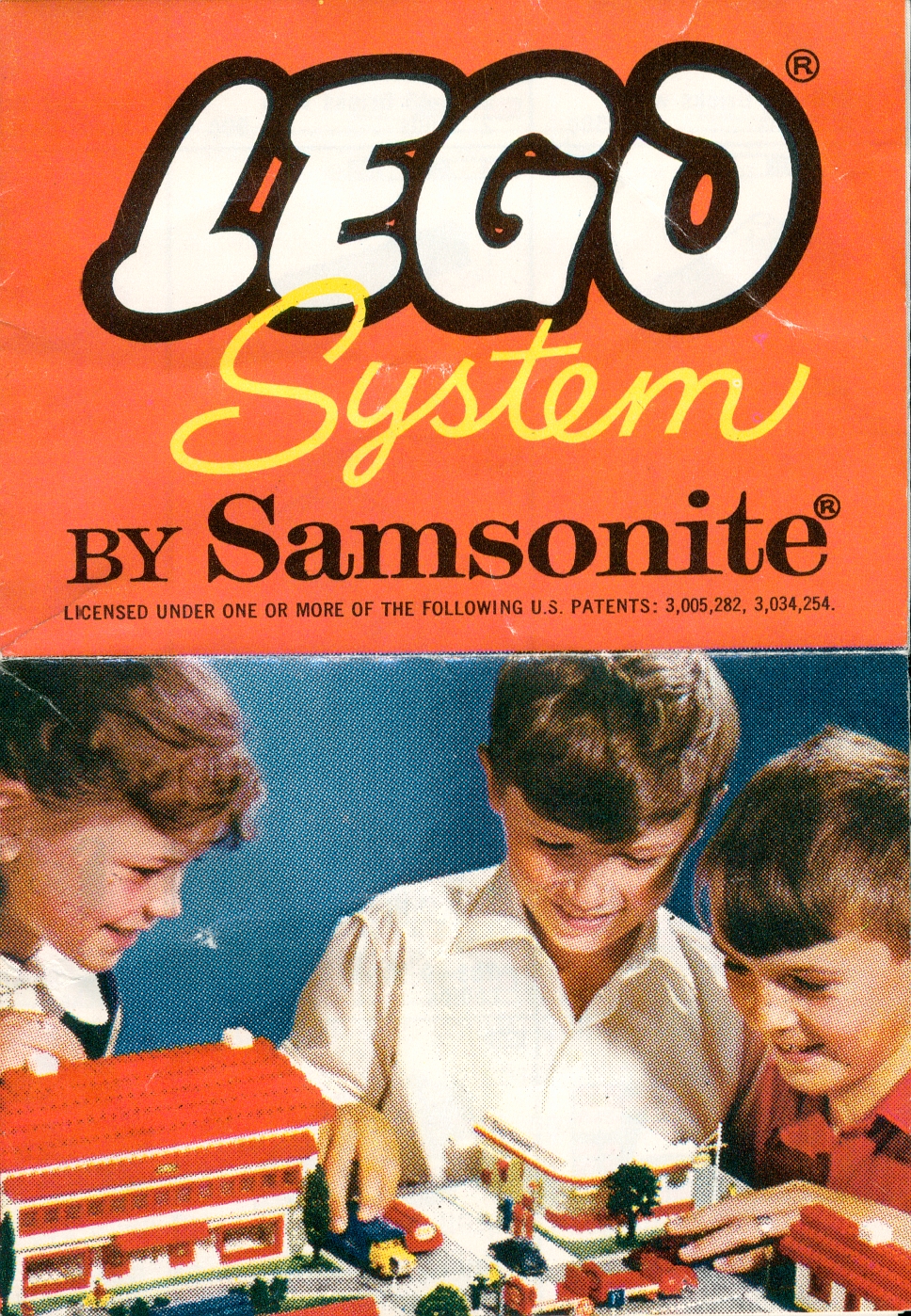
And a set box, the difference between the original and the updated version is subtle. Click on the images and zoom in for yourself:
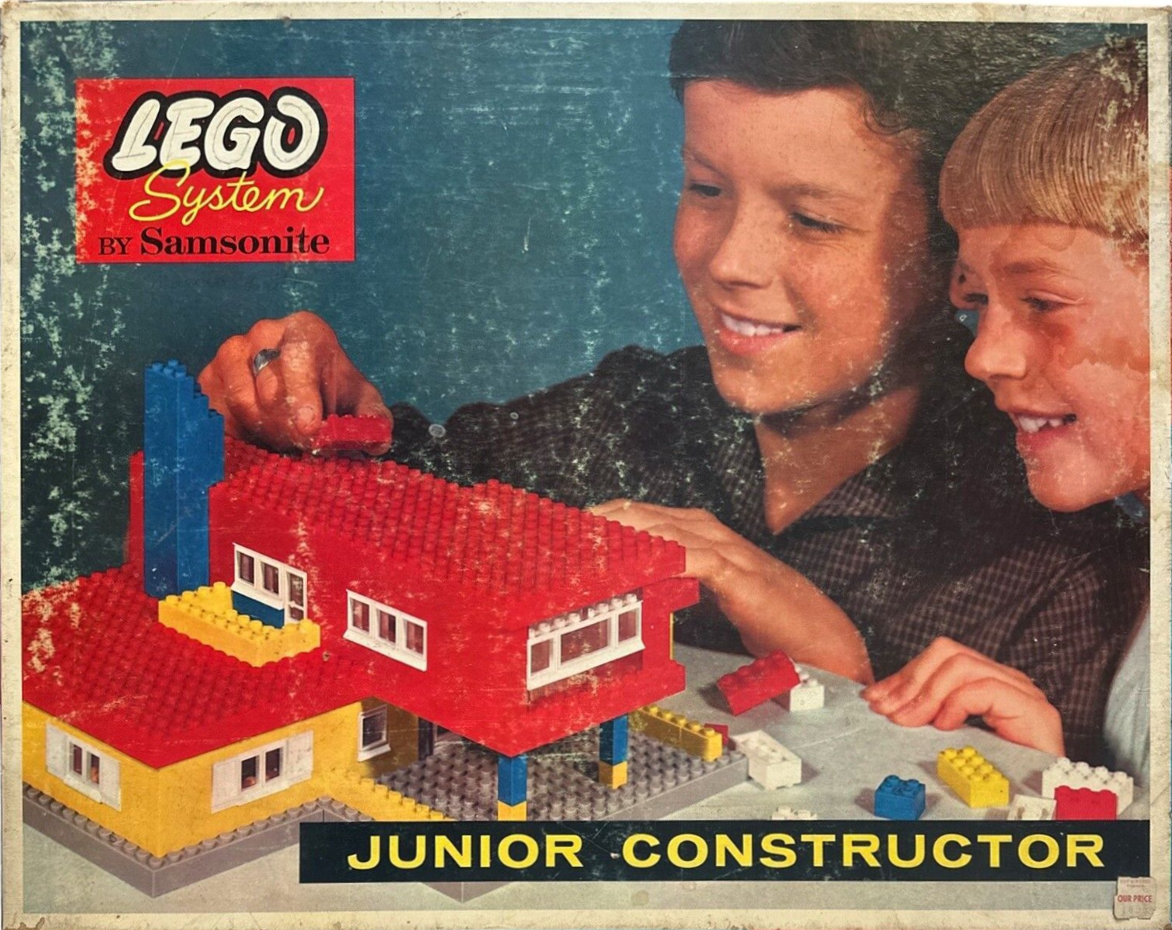

But that is not to say that everything that is missing the patent text was only produced in 1961, as say the typical Samsonite instructions used 1961-62 in the US evidently was never updated as no updated version exists. And Canadian Samsonite is another can of worms, but I'm getting ahead of myself.
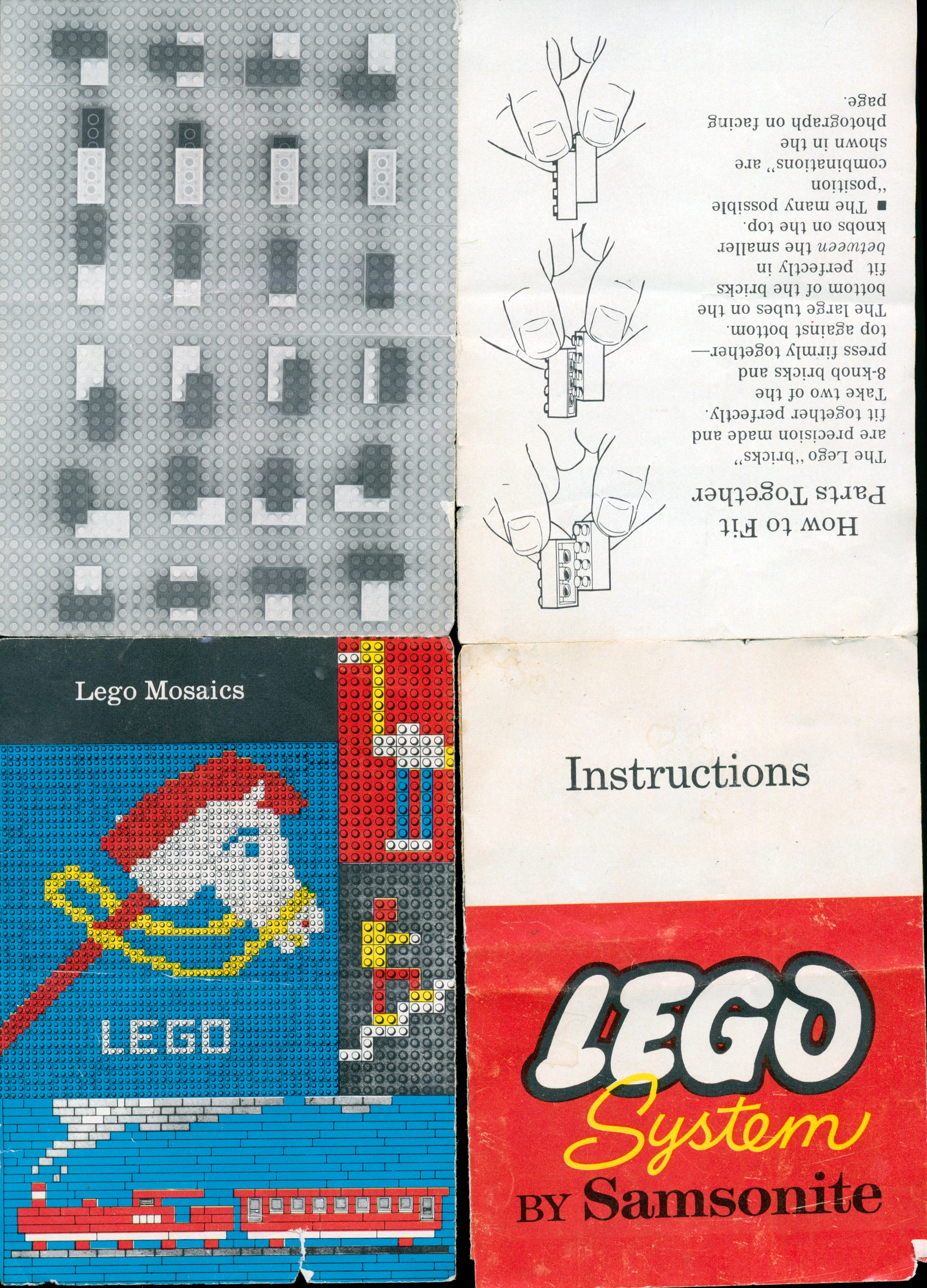
Supplemental boxes from 1961-65 have a similar update, in which the earlier version will be lacking the registered trademark symbol and later supplement boxes included it (but strangely still lacked patent text).
Also, sets belonging to the 1961-62 era had a very distinct format. There would be a prepared image with both a boy and a girl featured and on the reverse (or inside of the box for the 717 and 725), there would be isometric drawings of models that can be built with that particular set.
Lastly, most sets from 1961-64 will have a set number that correlates to its price. So for example, the 702 sold for $2, the 703 for $3, the 717 for $17, and the 725 for $25. The exception would be supplements and the cardback Model Makers.
USA: 1962
Two patents and registered trademark symbols first appeared on new boxes in this year, evident by the 704, 706, 710 canister sets not having a variant missing either(as well as the 1962 705 redesign):
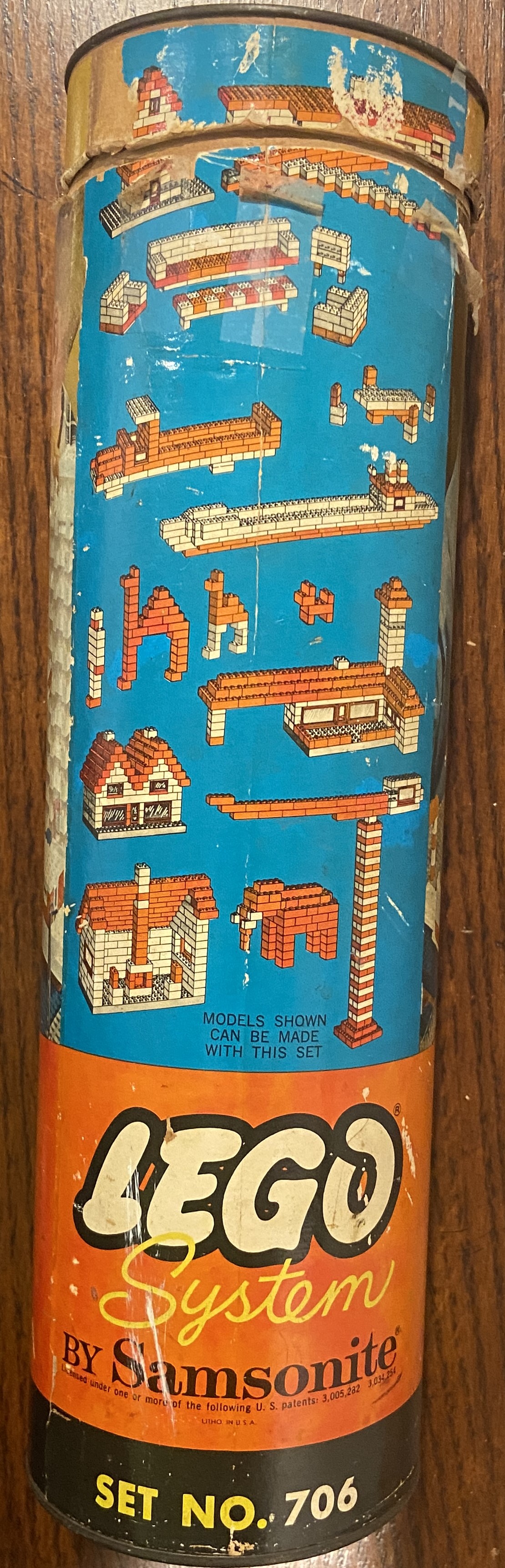
Existing US set boxes could've also been updated this year, though its incredibly difficult to corroborate as press photos might have been using older sets/images or are not in high enough quality to deduce whether these small changes have been made. Generally, the patent text never appears in any 1961-65 materials. However, given what we know about the later lines, it is not unreasonable to assume existing set boxes were not immediately updated for 1962, as even small changes on the box required heavy investment.
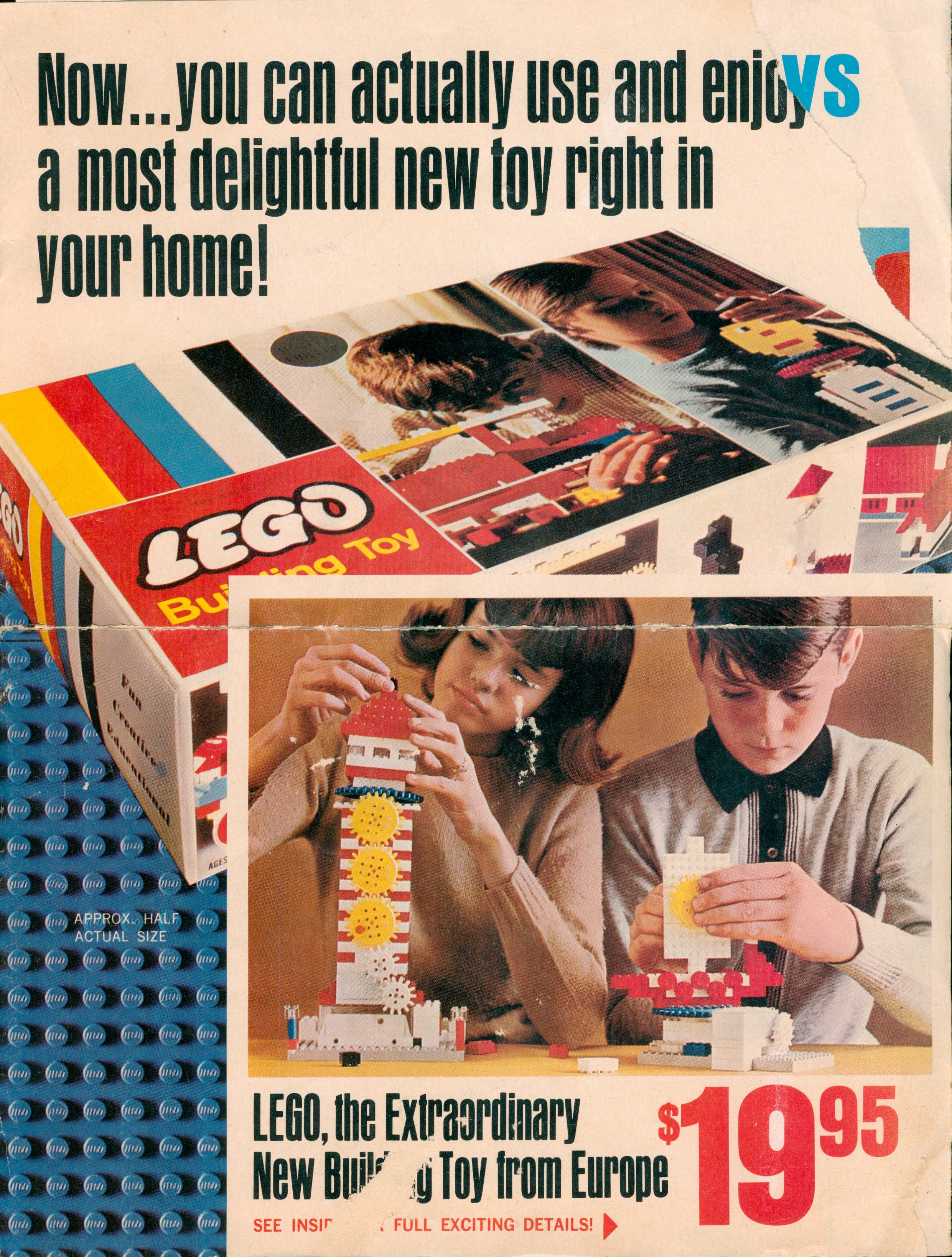
The earliest date that can be confirmed is sometime in late 1962 to early 1963, as in the below brochure (which was created before the 605/905 sets (both released in 1963)) the 1961 sets appear to have the registered trademark symbol on their boxes:
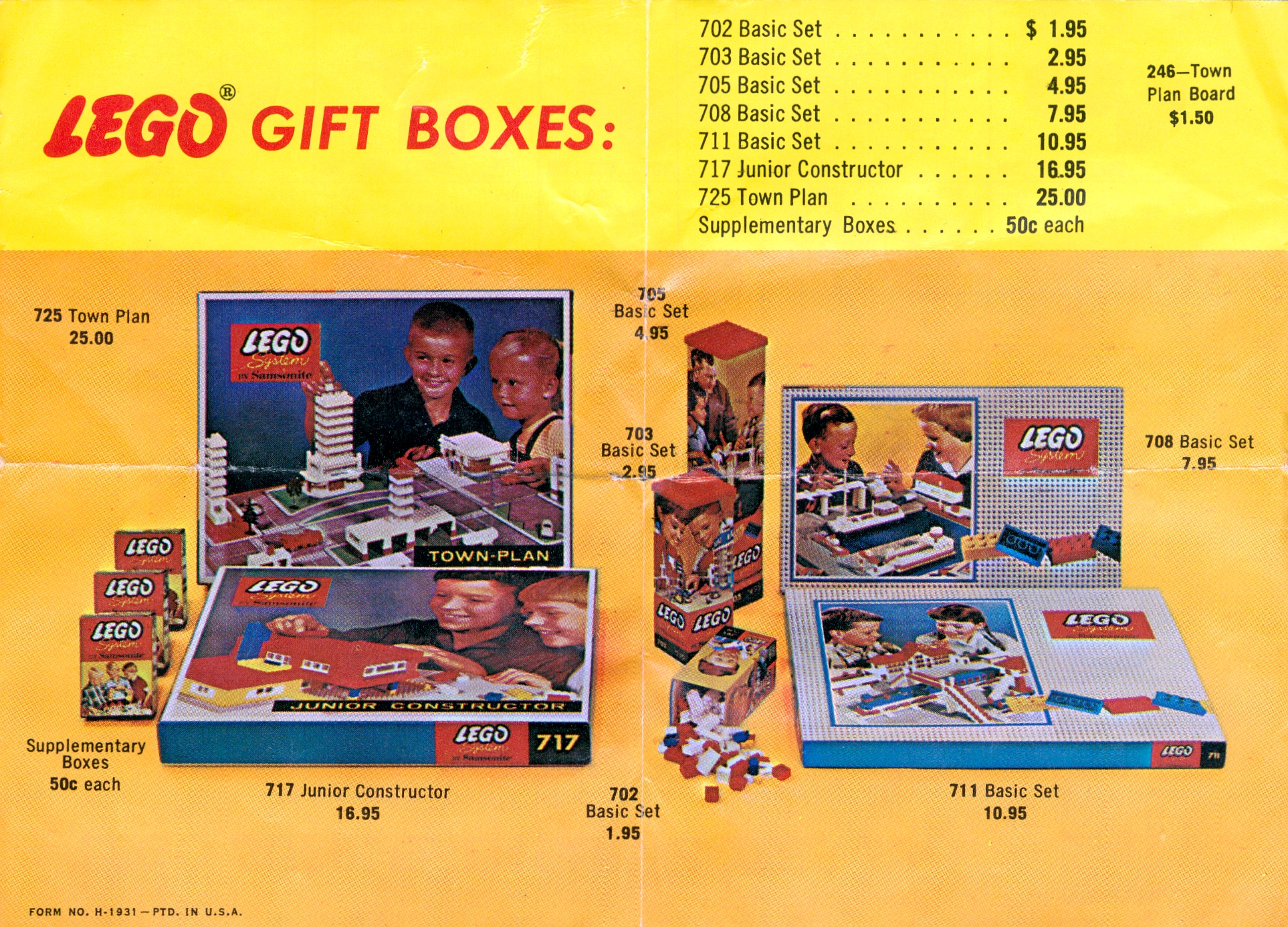
As such, the change would've most likely started at some point in 1962, with existing sets updating by 1963. After all, surviving no-patent-text boxes are a little too common to have only been produced for the 1961 season, in my opinion.
USA: 1963-64
Sets released in 1963-64 have a distinct design drift from sets released in 1961-62. Instead of having the pictures of children feature on the box, they opted to only show the isometric drawings of models:
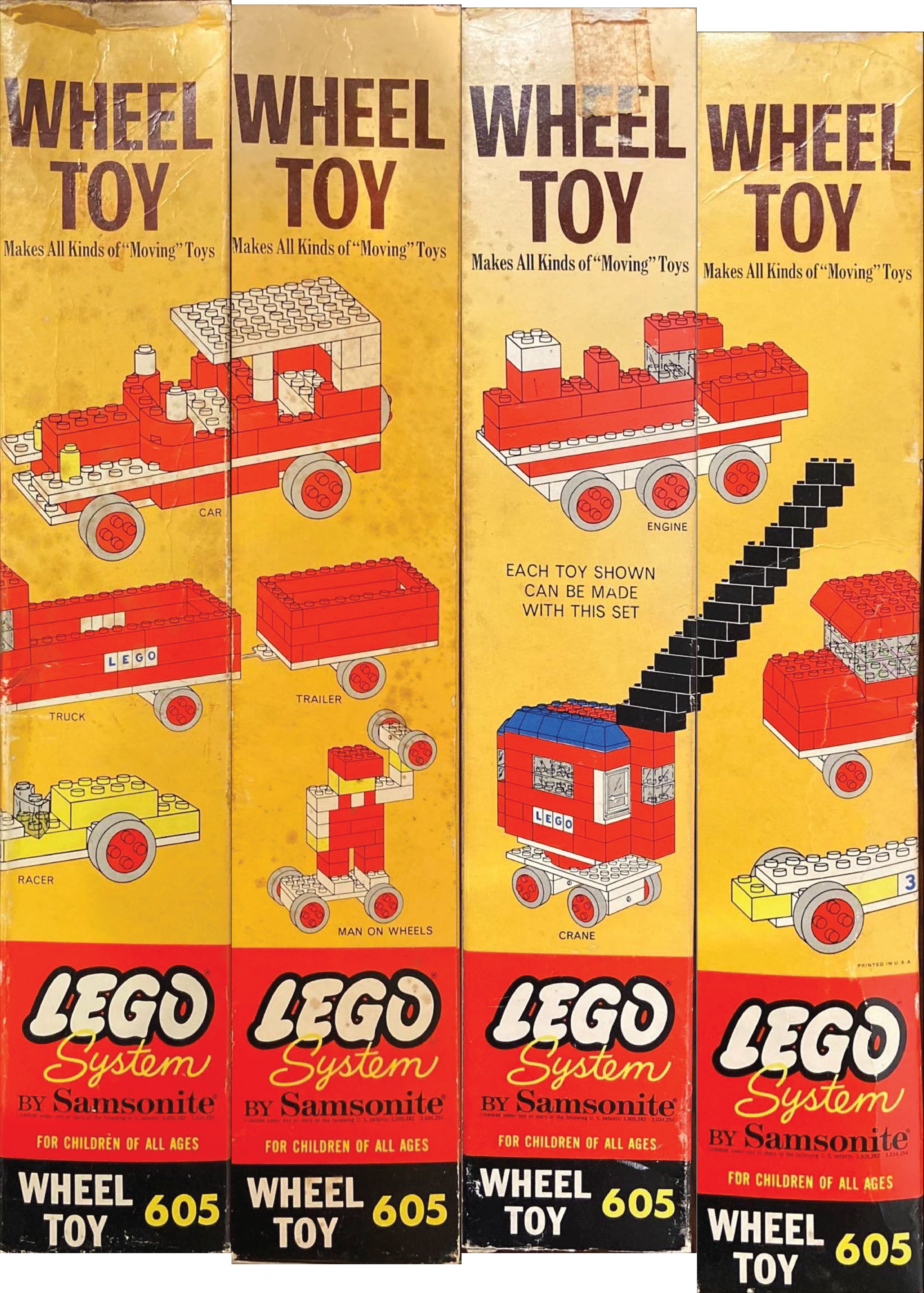
The 605 Wheel Toy, 905 Doll Set, and 610 Super Wheel Toy all feature this unique text: "FOR CHILDREN OF ALL AGES". The only set to deviate from this is the 105 Beginner's Set, which obviously says "FOR PRESCHOOL CHILDREN".
1963 was also the first year US sets did not include a price on the box. Some sets like the 705 or 708 have surviving variants without the price, though it is unknown when those boxes updated. Generally, it should be expected to have been 1963 or 1964. All images I have from 1964 still show the version with the price, the exception is the 1965 image of the 708 below:
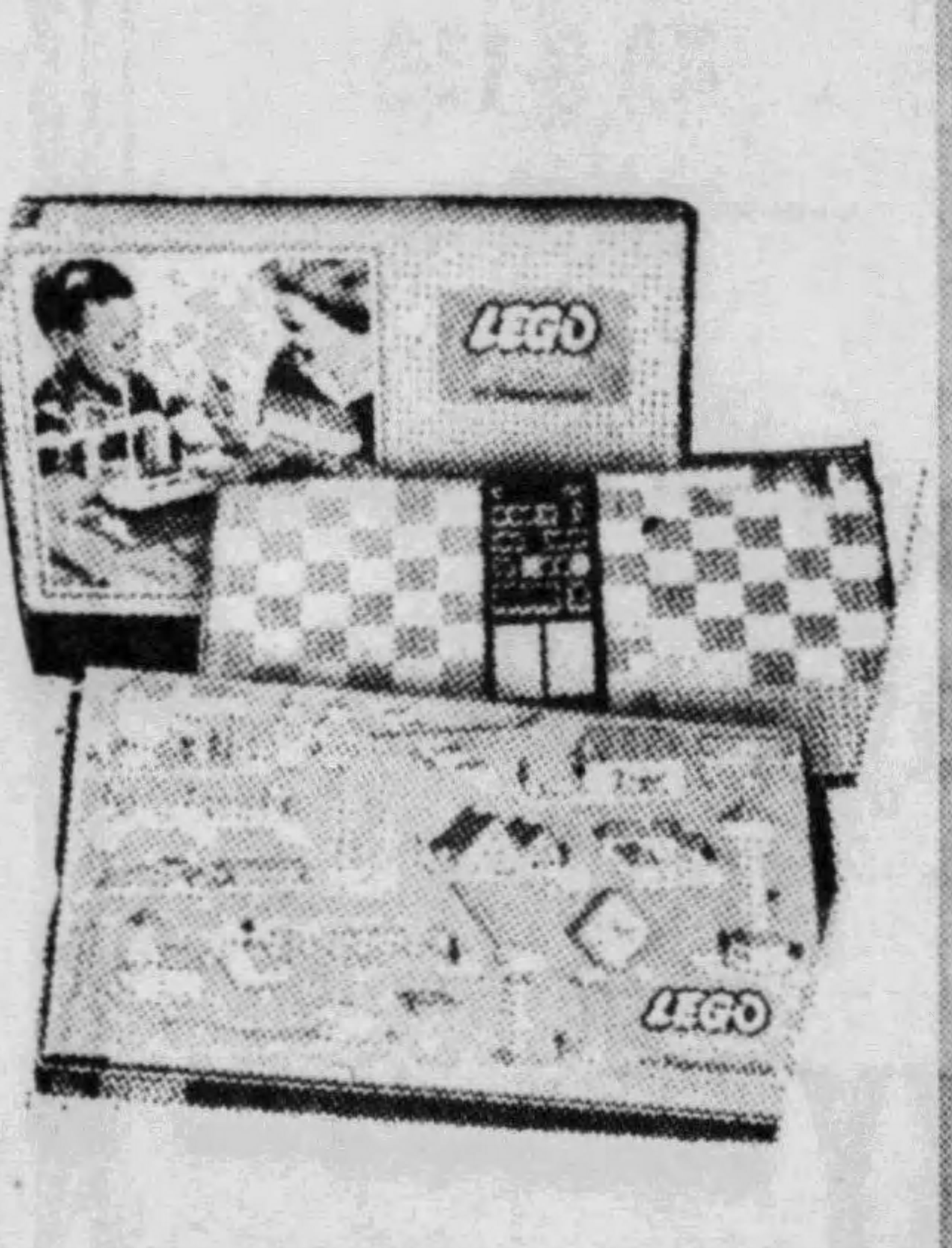
As production was preoccupied in 1965 with the new line of sets, it leaves 1964 as the most likely date for that change. It could very well have been from a short run of sets in early 1965 (as remember Loveland did not open until April), but what makes me question that is that 708's without a price are decently common, versus sets like the tall box 705, which only has one known example without a price. So the 705 could've had the price removed in an early 1965 run while the 708 had the same done in 1964, which is possible considering Samsonite's staggered updates for some sets/materials but not all within the same season. To add to the confusion, the 702 or 703 never had their prices removed (or at least no surviving examples to corroborate such).
The exception are the 1964 98c Model Maker Sets that came in blister packs, those are the only sets to release in 1963-64 and have their listed price printed on the package. But those may be a deliberate exception, as they were US only.
See what I mean about confusing?
USA: 1965-71 Basic Sets
Before we begin, we need to further emphasize the important distinction between a new set releasing in a particular year and when existing sets were updated to follow that revision. What is true for a set released is not correct for the prior.
As an example, if it has two patents, it released in 1967 or earlier. If it has eight, it released in 1968 or later. However, existing sets prior to 1968 did not evidently receive the same update in 1968. I'll show you exactly how we can know that, though it will require some tangents.
1965-71 USA basic sets will have several markers to determine exactly when something was released, albeit requiring some deeper knowledge:
USA 1965-66 Sets
Sets released in 1965-66 will have only two patents listed along with an age range. The ages are the same as in this 1966 idea book:
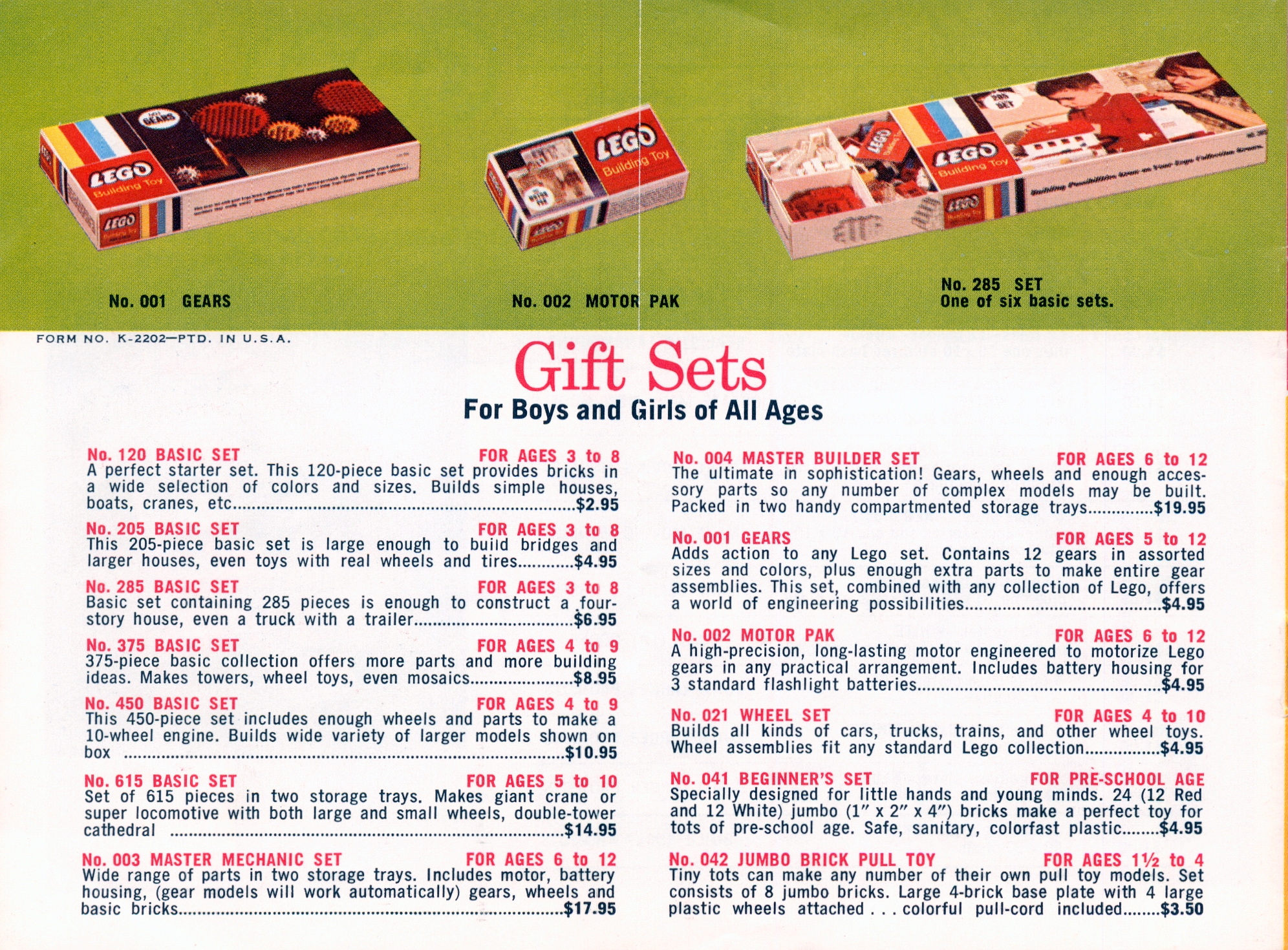
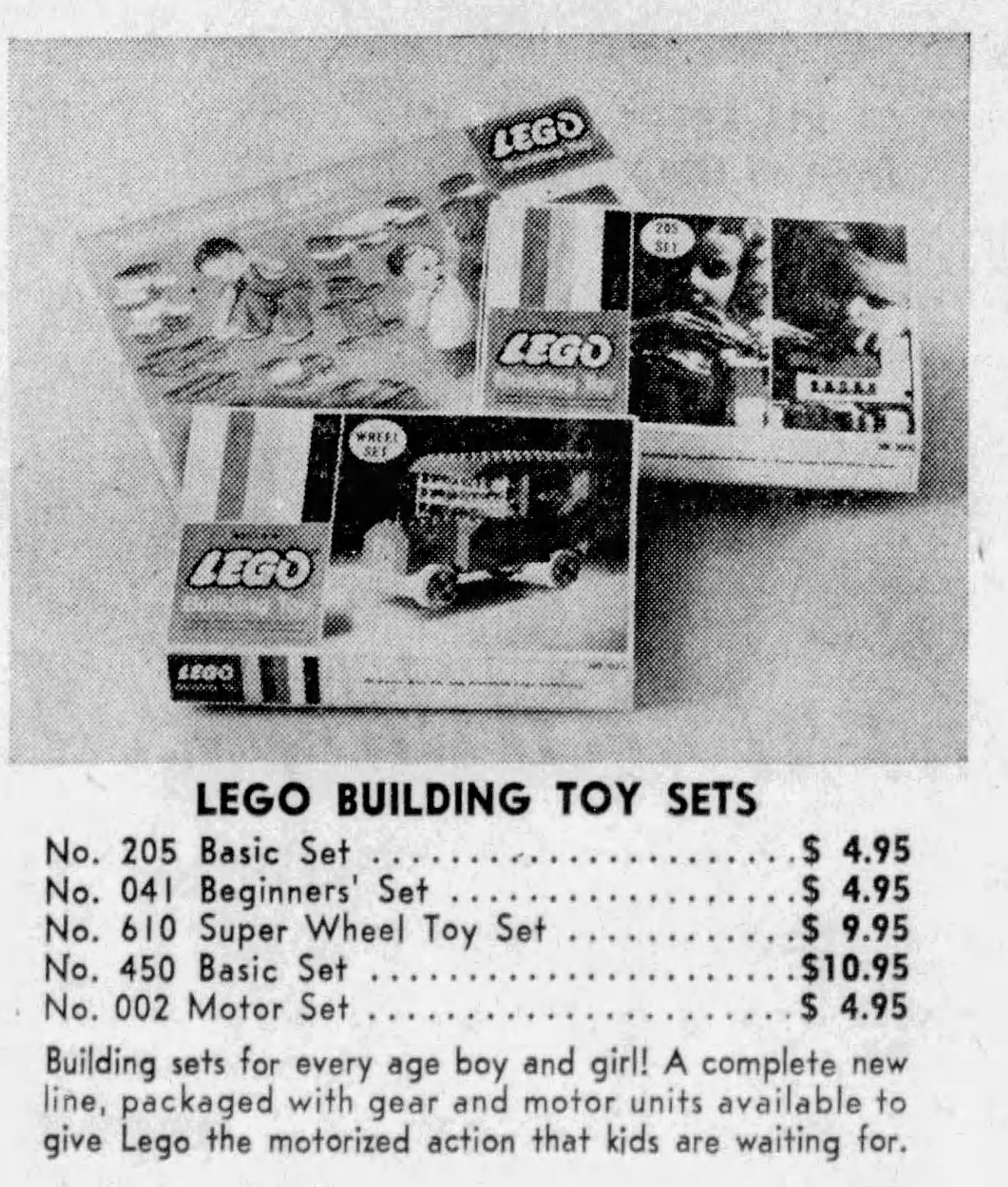
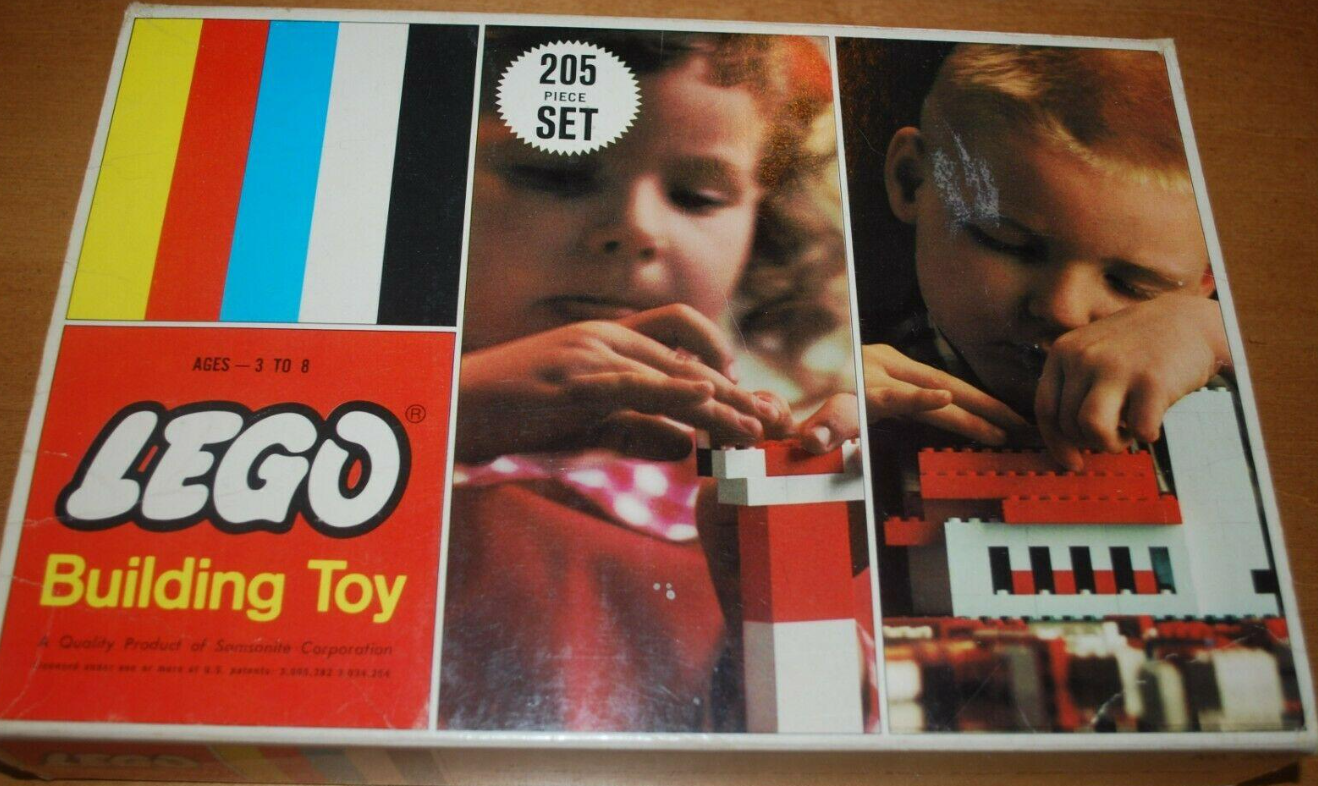
We'll use the 205 Basic Set as our example, as it has an exception that is important to make. Some sets that released in 1965, such as the 001 Gears, did not have an age range on the front of the box upon release.
The 205 is a good example of both worlds, as if it has an age range on the side, but it is missing from the front, the box dates to 1965 (we know this as images of the 205 from 1965 are missing the age range):


The important distinction here is that the above example has the age range on the side of the box. If it lacked that, the absence implies a later date (1967+).
The 205's box was updated in 1966 to match other sets. This is the format most other sets used when released in 1965-66:
At some point around 1966, Samsonite stopped gluing the inner trays to the box.
USA 1967 Sets
Sets released in 1967 have two main distinctions: all feature two patents and no longer include an age range. Some, mostly basic sets, replaced the age range with "FOR ALL AGES". Others never mention it.
The 1967 date is corroborated with the 1967 idea book omitting age ranges, as well as all 1967 release boxes (Model Makers, the 244 Explorer Set, and even the 1967 promo 110 Chevron Station) either using "FOR ALL AGES" or not including any age declaration.
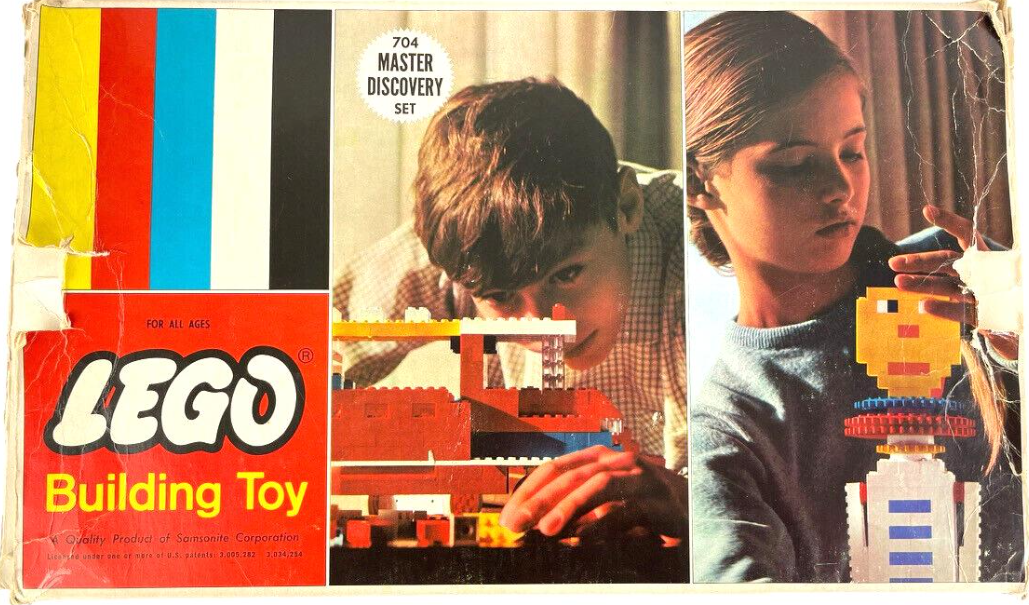
The biggest indication for this change happening in 1967 is the 704 Master Discovery Set. Its prototype, shown below, has the age range(lower left corner of the box or on the box top):
However the set, releasing in mid to late 1967, featured "FOR ALL AGES" and has no variant with the age range. That to me is clear evidence that the change happened in 1967:
Now the issue becomes... what about the existing sets for 1967? Were they updated?
By my best estimates, yes and no. And we have some compelling reasons to believe that. Unfortunately it's not as simple as pulling up the newspapers or catalogs we have, as most images are not in good enough quality to confidently discern what fine print was on the photographed examples, nor is it really fair to take a newspaper ad of an existing product and assume it to be the most up to date version. If a FOR ALL AGES version of an existing set appeared in a 1967 newspaper, then that would be different as it would prove an update for that year, but we just don't have access to anything in that regard. All 1967 appearances of existing sets that are legible show age ranges, but reuses are deceptive in newspapers.
The reason why I say yes and no is due to three main examples.
Three 1965 sets last appeared in US catalogs in 1968: the 615 Basic Set, 003 Master Mechanic Set, and the 021 Wheel Set. Two of those have variants with "FOR ALL AGES", the 003 and the 615. The 021 Wheel Set does not. They all make their final appearance in the subsequent 1968 idea book.
So why does the 021 not have a "FOR ALL AGES" variant while the other two do, especially if they all retired around the same time? While many ideas are possible, including the set being missed in the update (similar to how the 205 lacked the age range on the front at launch) or the set being decidedly retired earlier than the others, I think it moreso demonstrates the haphazard nature of Samsonite's production. They updated some, but evidently not all.
I suspect some sets like the 003 Master Mechanic were updated in 1967, as even though it was retired in 1968, surviving examples of the "FOR ALL AGES" version are just about as common as the older 1965-66 version. Which would match a 1967 update, though that assumption is privy to survivorship bias. But in that vein, the 003's updated box is far more common than the 615's.
The 205 is a good direct example as because the 244 uses the 205's box, so it's very possible the 205 used the updated box as early as 1967:
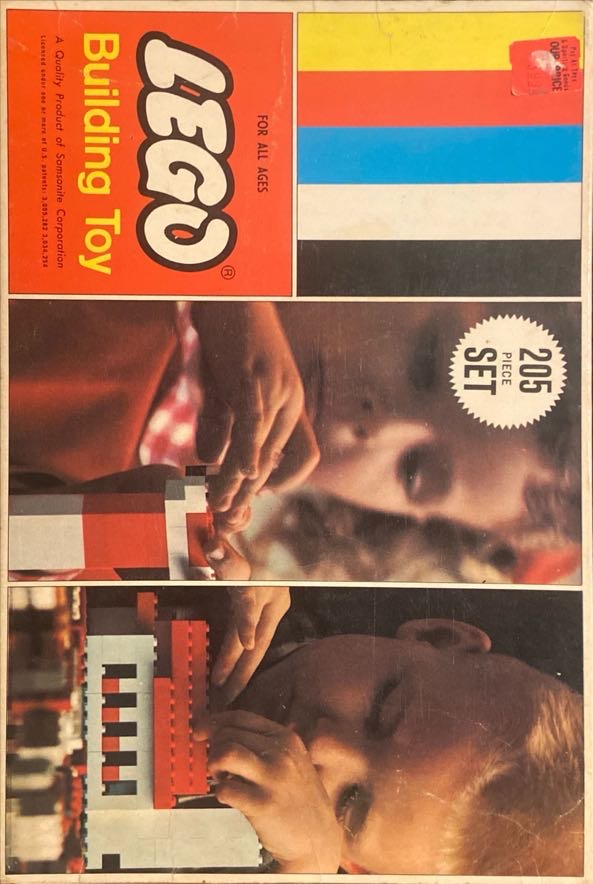

The same would go for the 004 Master Builder Set, as the 704 Master Discovery Set also released in 1967 and shares its box with the 004.
There are also the 285 Basic Set and 001 Gears, both feature the Denver Colorado address on its updated box—a distinct feature of 1968+ sets. However, both only have two patents, which would place those examples sometime between late 1967 (as no new-for-1967 set has this variant) and early 1968 (as it would not make sense to add the address and not go ahead and update the patents).
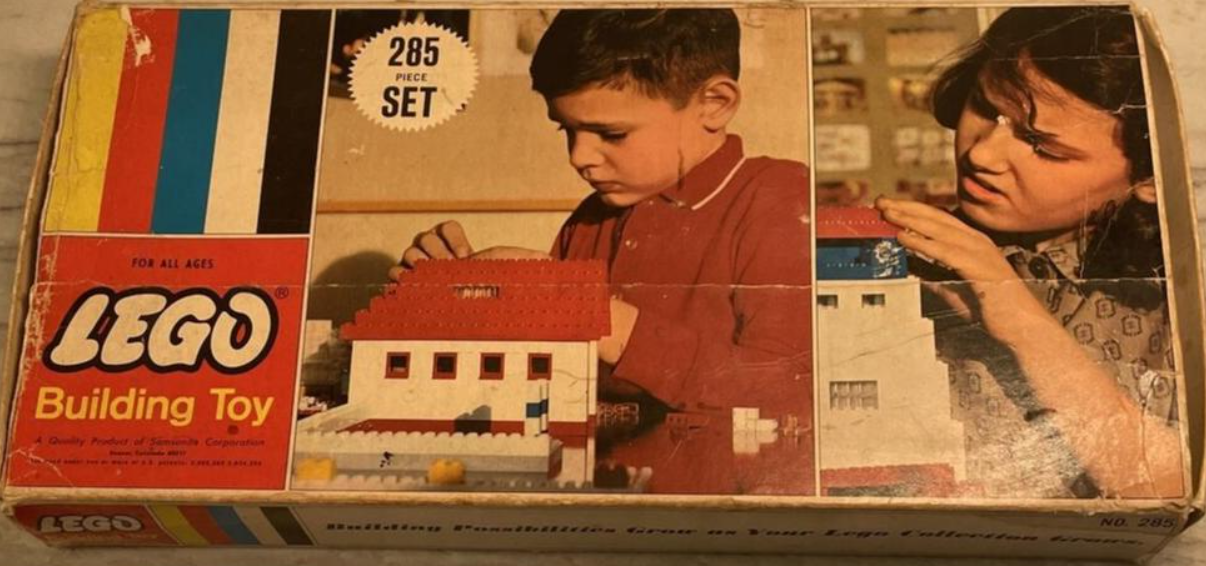
In short, the "FOR ALL AGES" update was 1967 and most existing sets transitioned into it by 1968.
USA 1968 Sets
1968 is home to a massive change: eight patents displayed on the fronts of sets instead of just two. I know, I know. There was also the continued addition of "Denver Colorado".
Sets released in 1968 will have piece counts in place of "FOR ALL AGES" and eight patents:
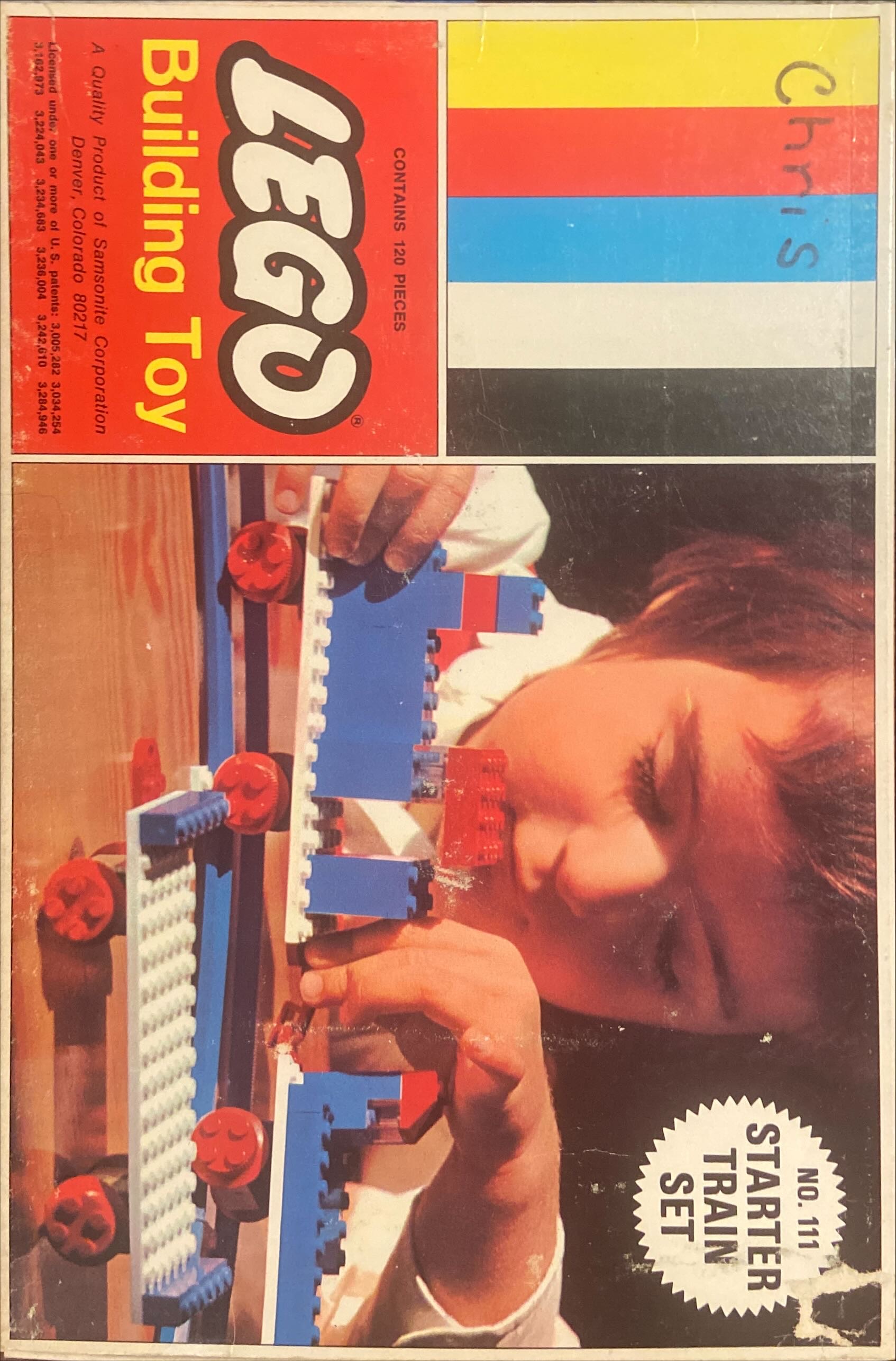
This is also when sets began to have their names on the sides along with more images. Note that this does not apply to all 1968 sets:

All 1965+ basic sets (that didn't retire in 1968) have updated boxes. As shown above, the update likely happened throughout 1968-69:
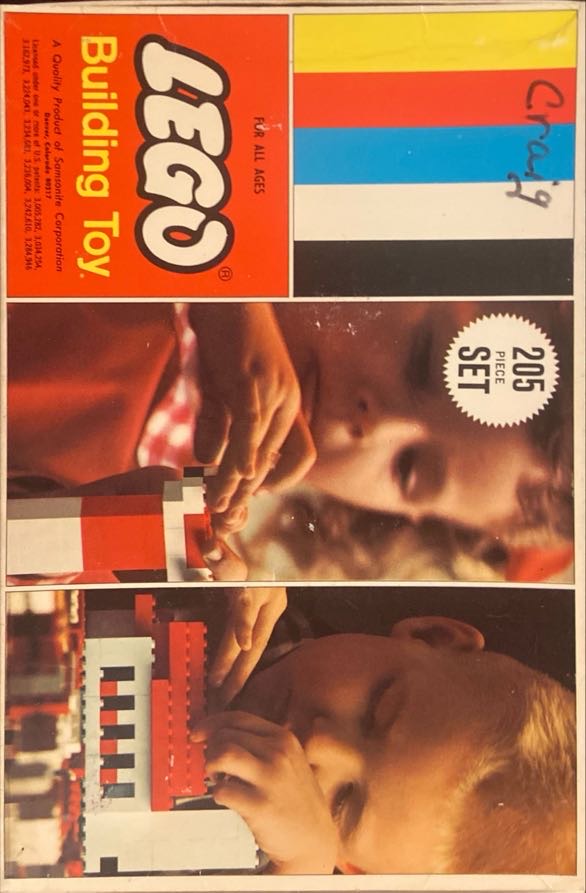
The reason why I say updates were as late as 1969 is twofold. For one, all the work we did above showing the inconsistency in updates. But two, the more hefty point, 1967 Model Makers have two different boxes: drawer/sleeve boxes(two patents) and tabbed boxes(eight patents):
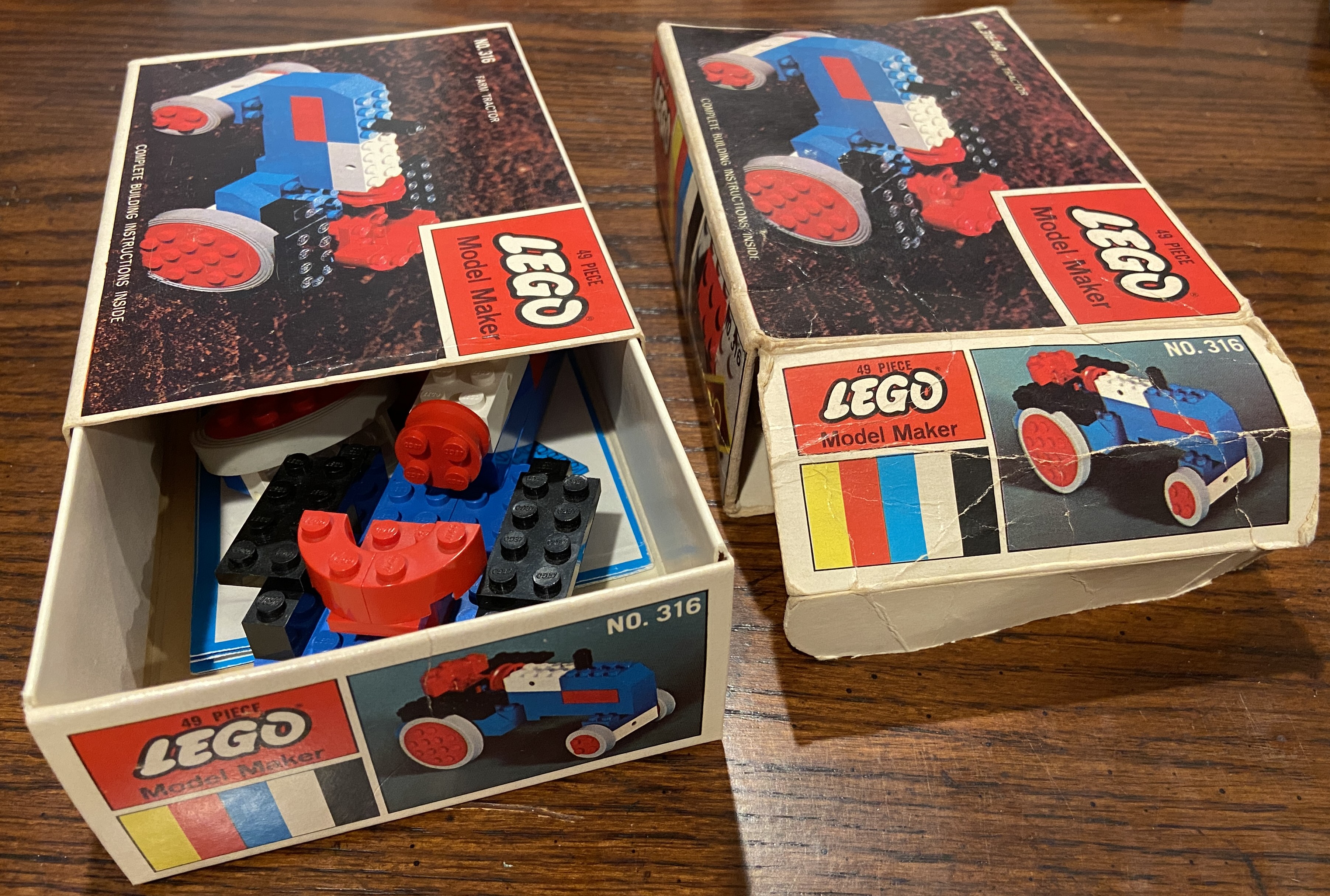
As all 1968+ Model Makers used tabbed boxes, as well as noting the 1967 sets were retired before the 1970 season, as well as considering the 315 European Taxie has no tabbed box variant and was retired before the 1969 season(discussed in its own article), the update for those sets happened for the 1969 season. Those have eight patents.
To review before moving on, sets released in 1968 will have eight patents and Denver Colorado. Existing sets were updated by 1969.
USA 1969 Sets
1969 was the first year the single-piece plastic tray reached the US, as it was the year the 066 Governor Set released in the US:
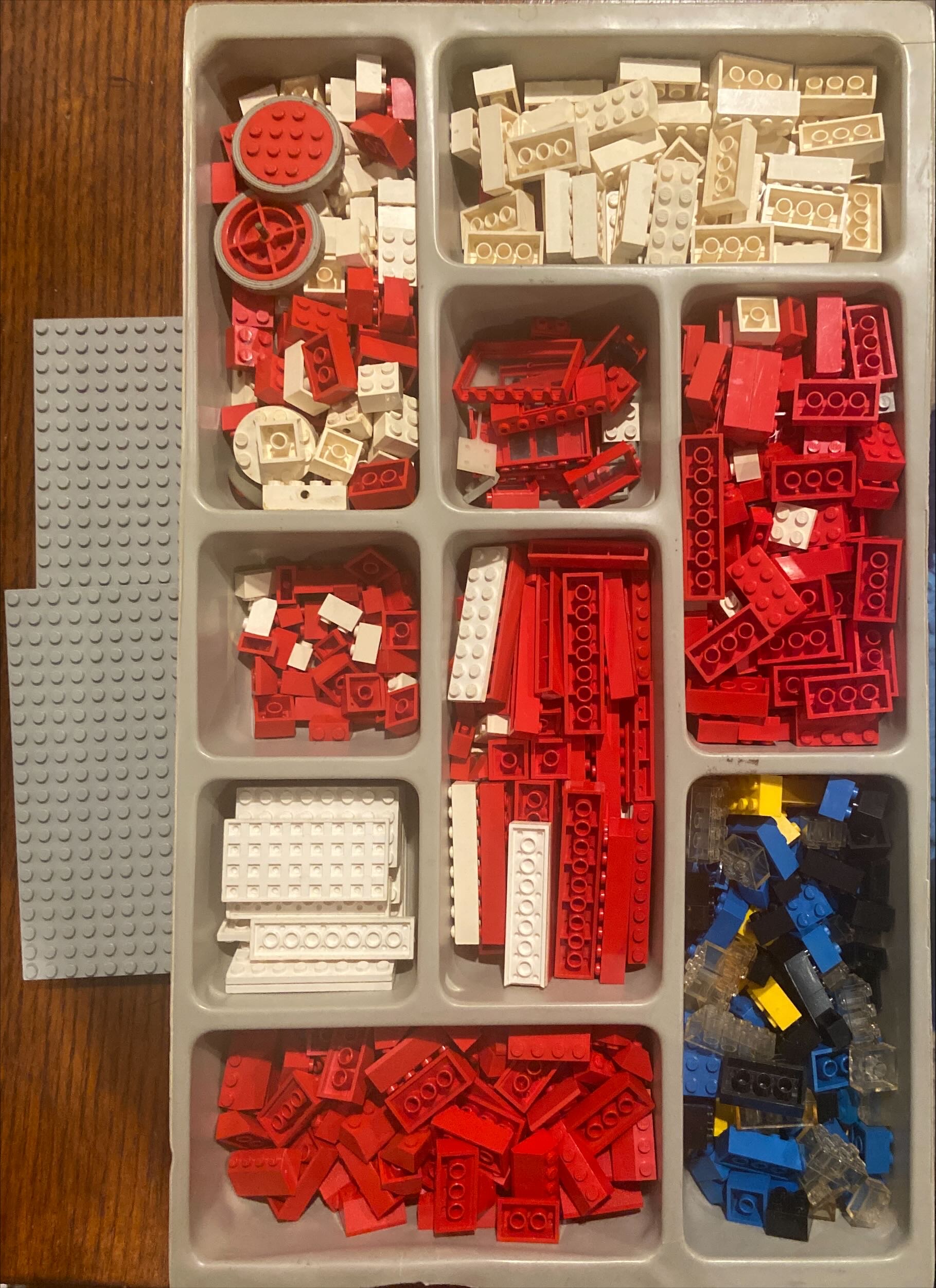
With it was also the continued transition to all sets having designated names along with tabbed boxes. That does not mean, however, that I'm saying all sets suddenly switched over in 1969. Basic sets eventually switched over to a single-piece tray and redesigned sides, the issue is exactly when this transition occurred:
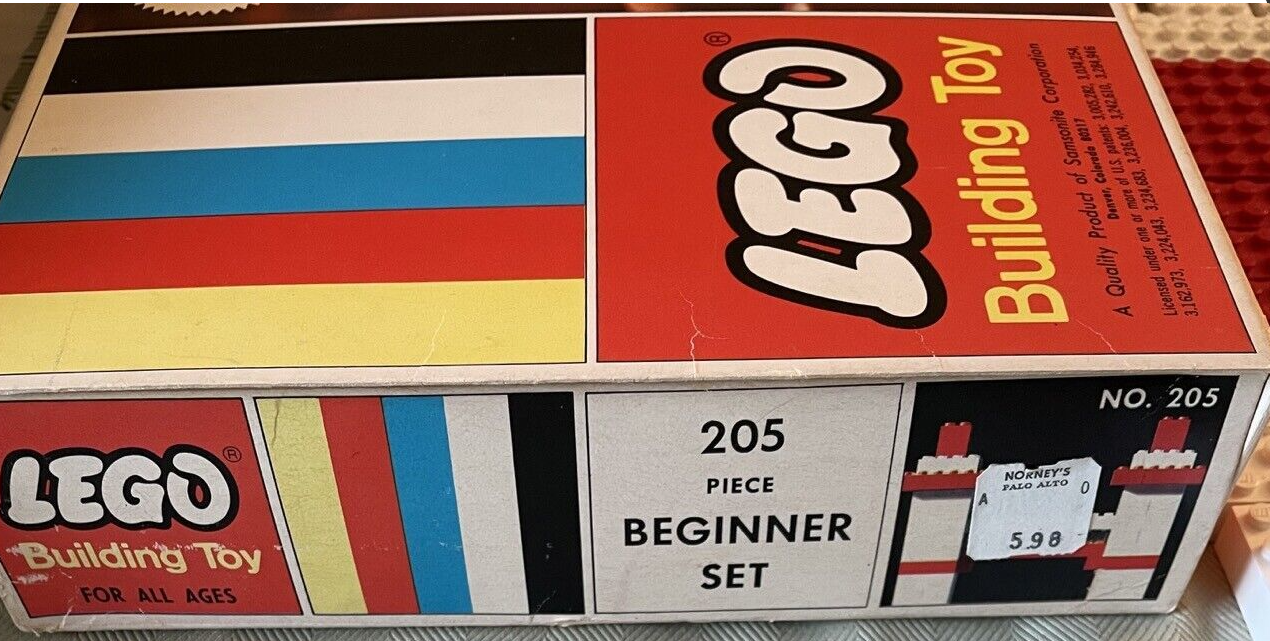
A 1969 date for the redesign is corroborated by the sets being referred to by the names on the sides as the 1969 newspaper below shows (newspapers reused earlier marketing images, so the set boxes are not a complete deal breaker):

Versus 1968 materials, which generally just refer to them as basic sets:
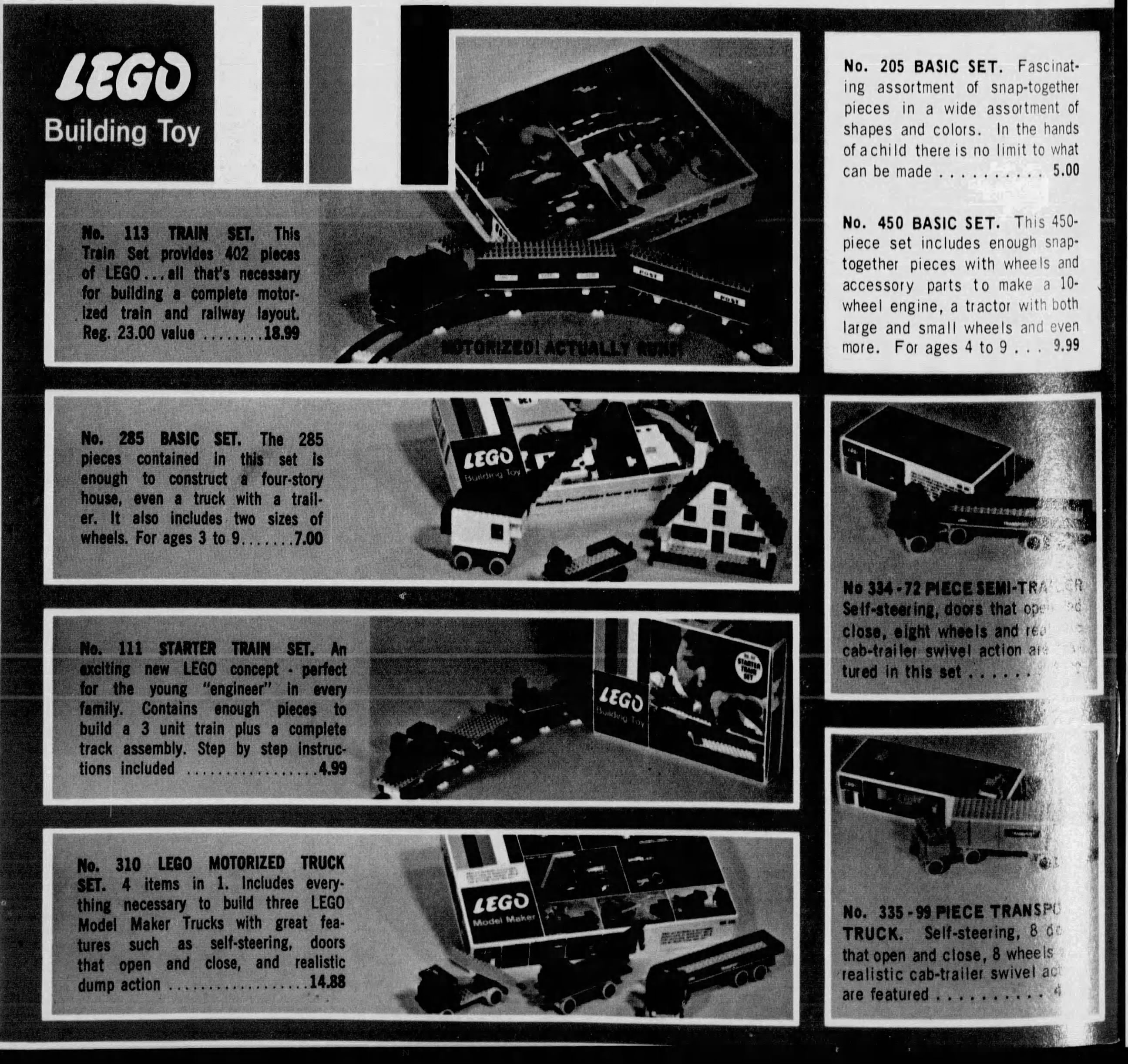
But that doesn't necessarily mean the redesigned boxes were in stores by that point. The retailer could simply be referring to the set's name via Samsonite's internal dealer catalogs. These names also appear in the 1969 idea book.
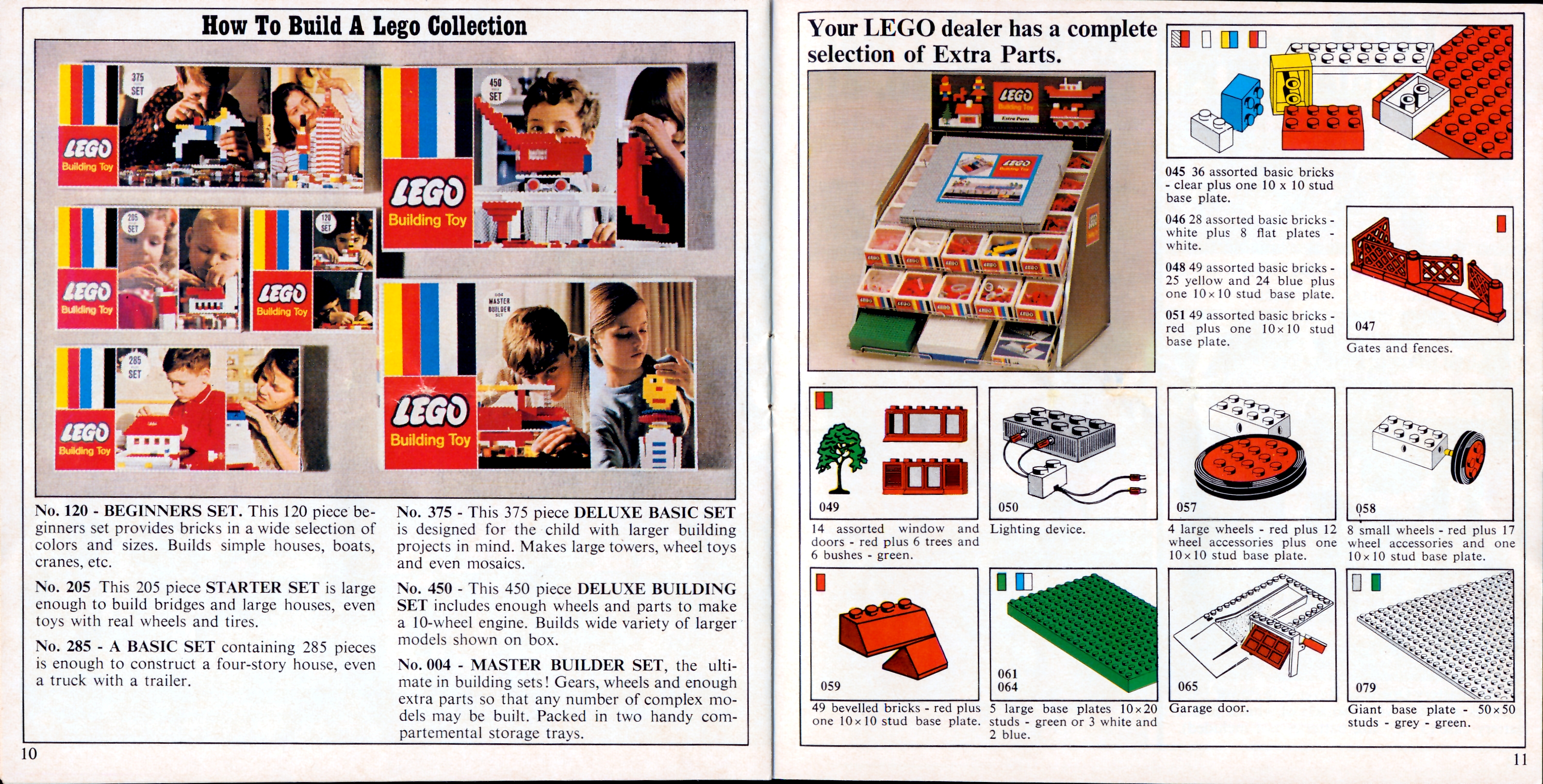
Instead, a very compelling observation can be made which dates them to 1969-1970, but it requires looking ahead a little.
USA 1970-71 Sets
Sets that released in 1970-71 printed the disclaimer "Some parts in the LEGO System are manufactured in Denmark" directly on all boxes:

This change evidently belongs to 1970 as all new-for-1970 sets are pictured in the 1970 dealer catalog without the printed disclaimer:
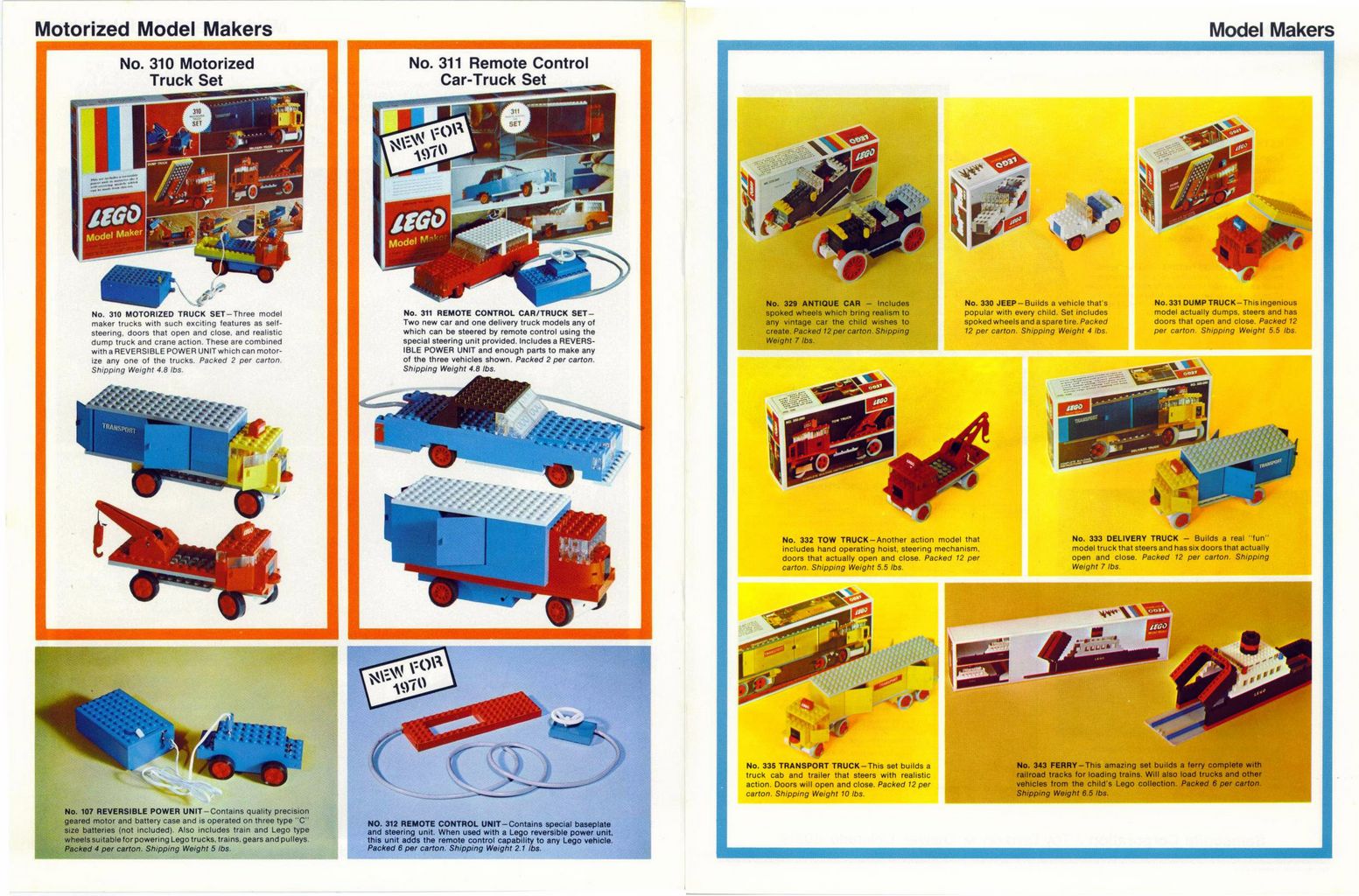
That's plain and simple, but the issue is again exactly when the rest were updated. What's interesting is that the printed disclaimer was not initially printed on all sets. Some boxes were evidently updated to the tabbed version but have the disclaimer stickered on the box:
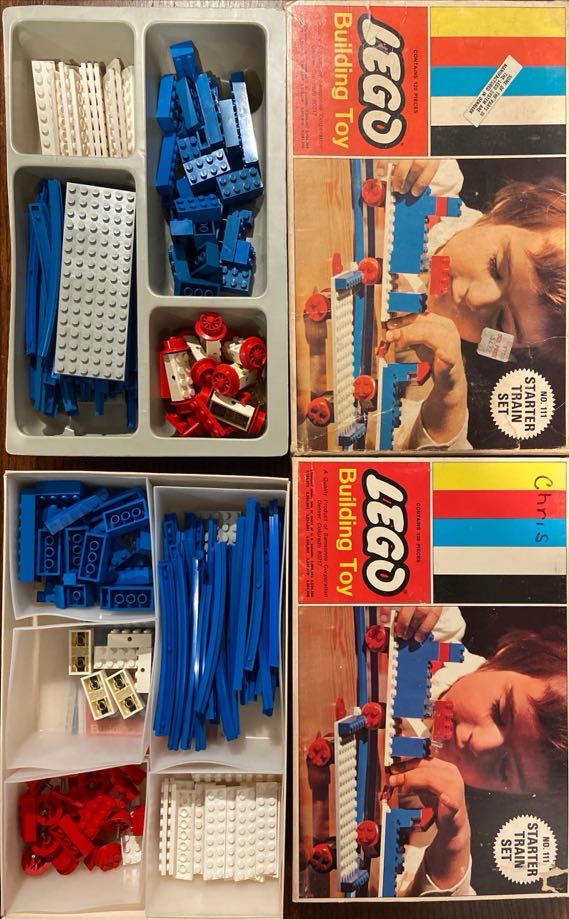
So take into account that the updated-for 1969 Model Makers do never feature this sticker as well as the 334 Semi-Trailer Truck (which retired in 1969). Also consider that the 111 Starter Set retired in 1970, and we do have a tabbed box version consistently with a sticker but not one with the printed disclaimer. Also consider why a sticker would be created in the first place: because it was too late to update all boxes. Only boxes that had not been finalized, as the sets were new for 1970, were able to avoid the sticker.
Thus, we have two things we can conclude.
One, most existing sets were updated to tabbed boxes (as well as given a stickered disclaimer) by the 1970 season. Some may have been in tabbed boxes as early as 1969, but we just don't have evidence to definitively say one way or another. The sticker on the other hand, can be clearly dated. If the 1970 sets were not initially designed with the disclaimer in mind (as seen in the above 1970 dealer catalog), that makes me confident in placing the sticker at 1970. The boxes were not yet finalized, and thus were available for that to be added in.
Even basic sets in tabbed boxes have the sticker, which means the parts inside were not necessarily indicative as to whether a set would be stickered or not (as the 450 contained no parts that needed to be imported). All sets (including supplements) were stickered in 1970:
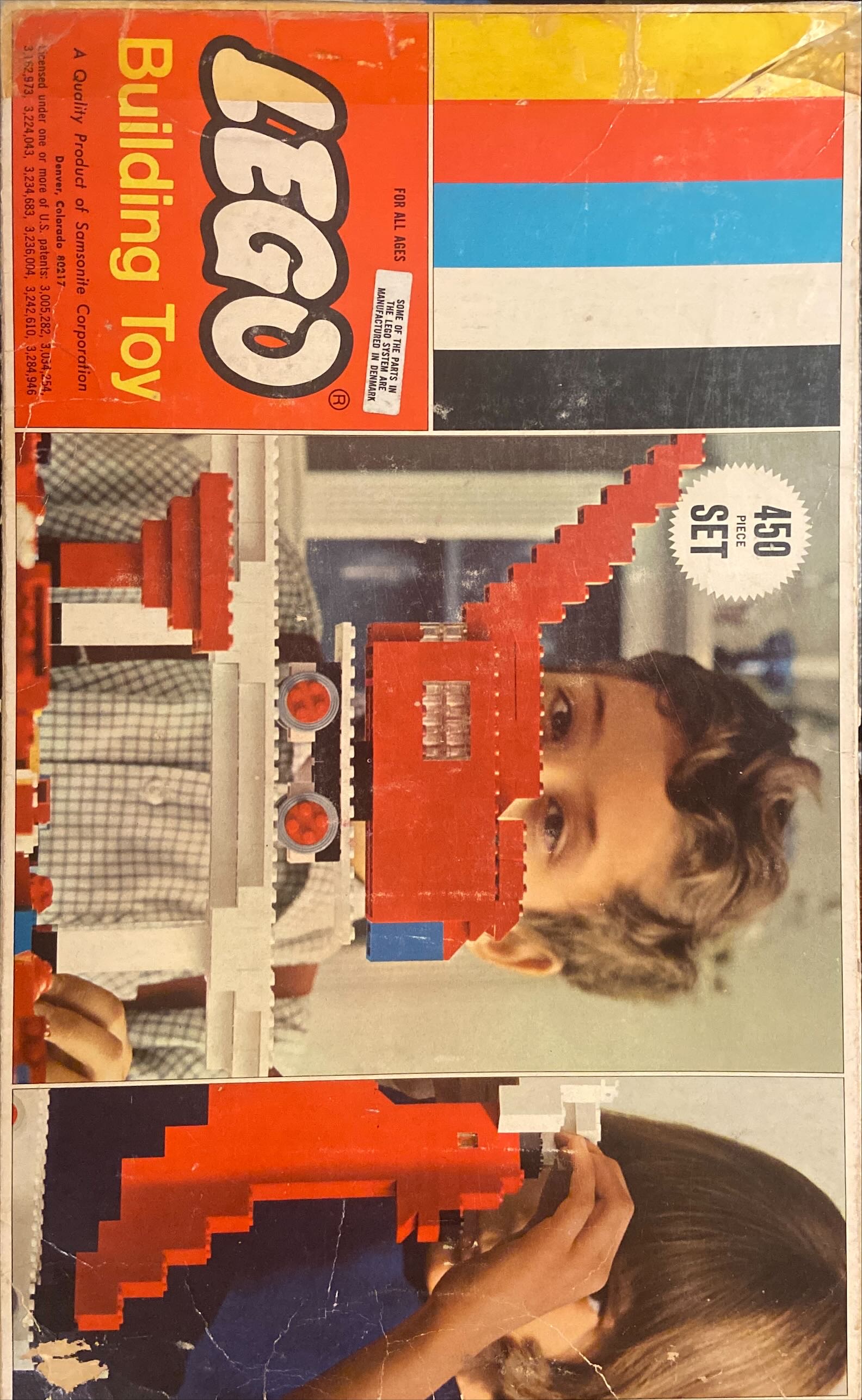
And finally, most existing boxes were updated in 1971 to have the disclaimer directly printed:
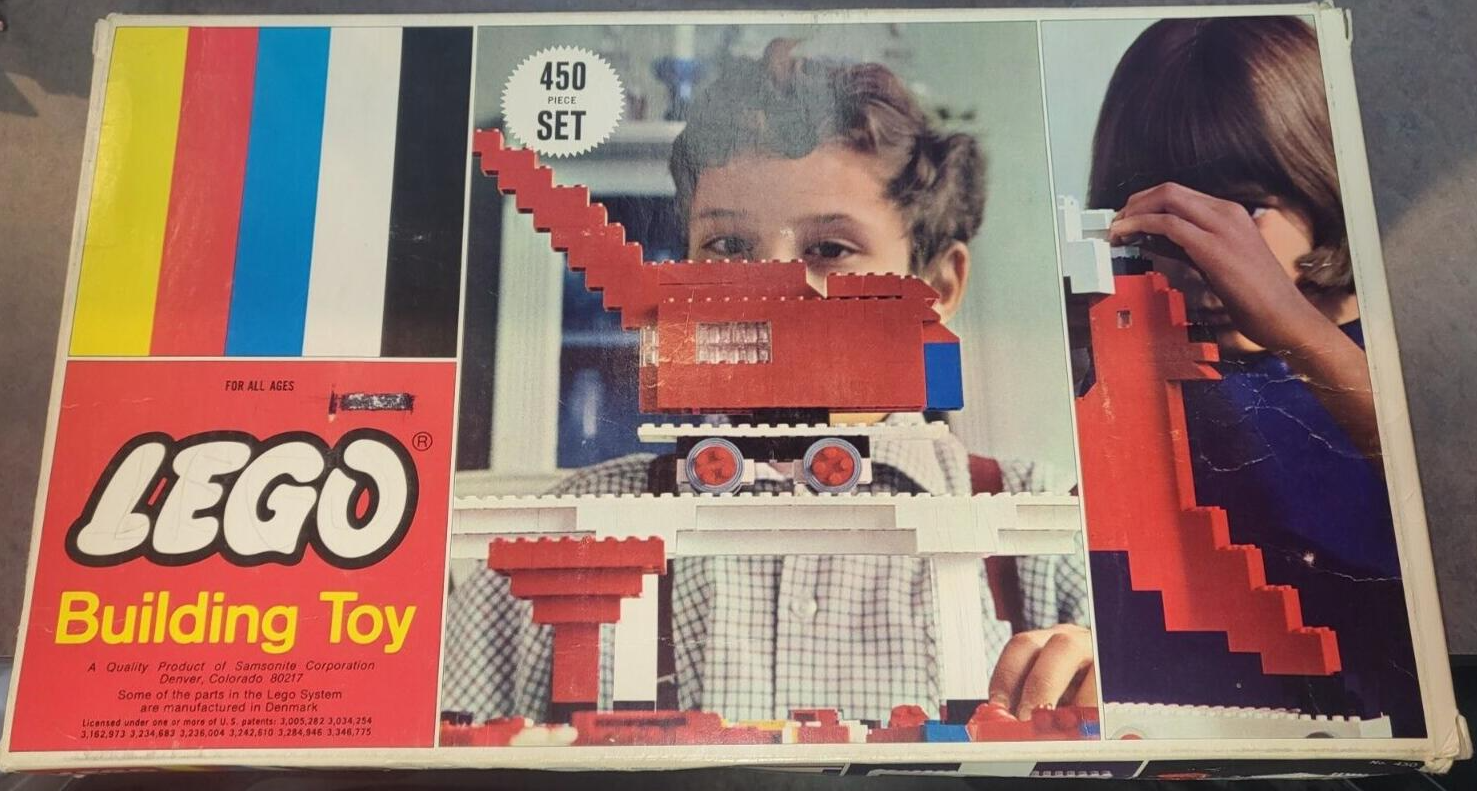
Why "by 1971" for this change, why not all in 1971?
Three things.
One, the first dateable materials I have that show the change legibly is from 1971. Not definitive evidence, but definitely interesting.
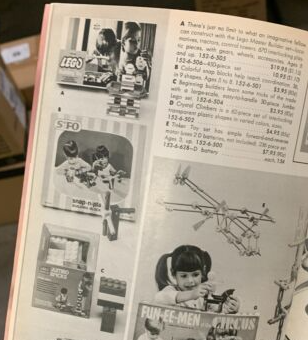
Two, if the stickered disclaimer existed prior to 1970, we would see that reflected in the 1970 prototype boxes in the dealer catalog.
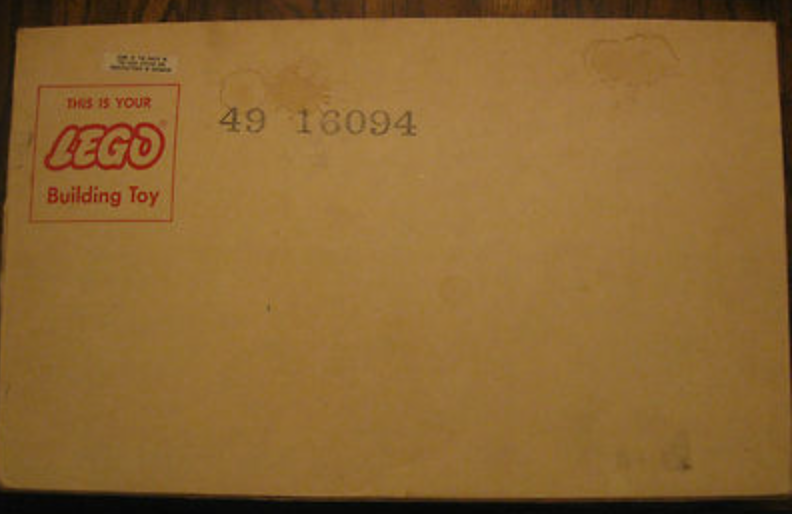
Three, boxes that definitively date to 1970 have a sticker. Take for example this 536 Designer Set, in which it has the new-for-1970 Sears catalog number stamped on it as well as the sticker added:
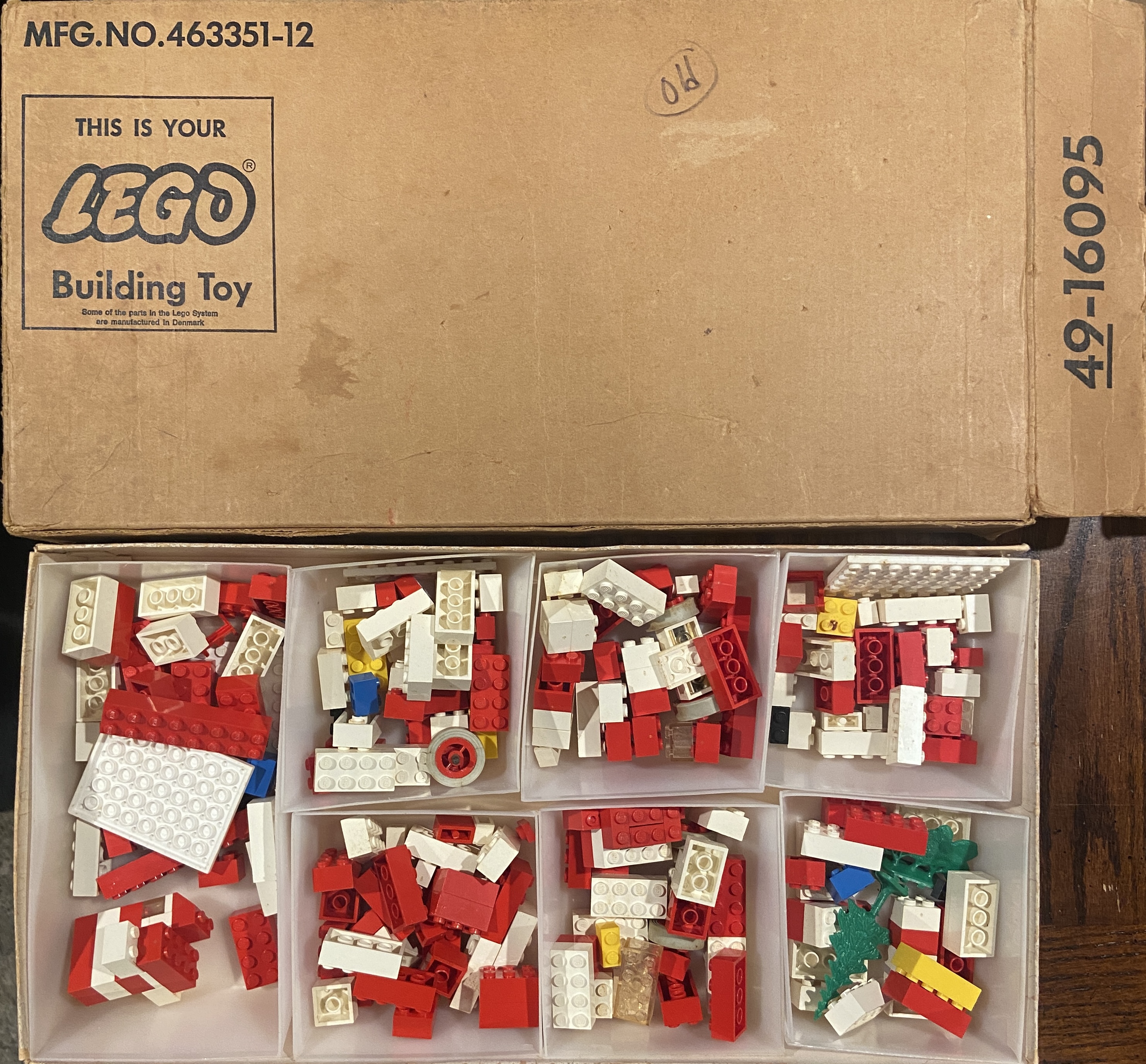
But boxes that were updated in 1970, evidently have the disclaimer added. Below is a beautiful example as it cannot predate 1970 (before the catalog number was updated) nor can it belong to 1971, as then the 335's number was changed to 835 in 1971 with the release of the 835 Advanced Builders Set:
And four, a sticker disclaimer is a very last minute addition, and it is clear that it was mandated in some way. It is much easier to see a world in which Samsonite was required to have that disclaimer for the 1970 season, thus updated any boxes not yet finalized and stickered the existing sets. Then the decision was made to print it directly for the foreseeable future(1971+). Some sets that were retired in 1970(say the two trains the 113 Motorized Train Set or the 116 Deluxe Motorized Train Set) do not have a known variant with the printed disclaimer, but some do.
At least the 223 Adventure Set, which has no evidence of production beyond 1970 (the last year it was seen in catalogs), has a printed disclaimer variant in a tabbed box. I take this as a good example of some sets being updated as early as 1970, thus you wouldn't expect all sets that released prior to 1970 to have a stickered variant:
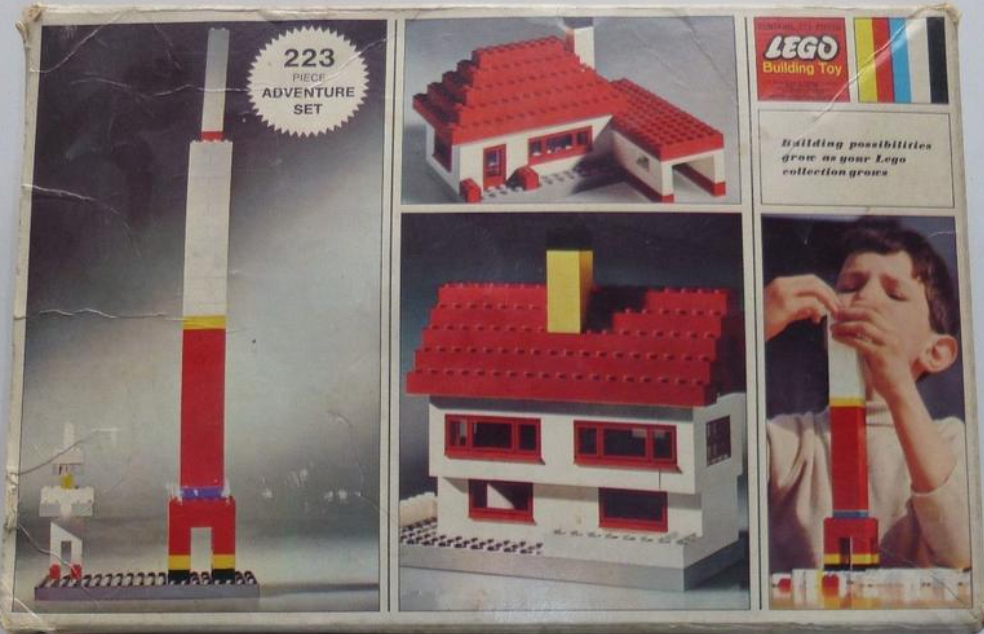
And four, as a bonus, if for all previous years we have a consistent pattern of dissociation in design between newly released sets and existing sets, there is no reason to assume a universal 1970 or 1971 date for either change. I give this as even anecdotally, surviving "Some parts...produced in Denmark" printed variants of some sets' boxes are far too common to have only been produced in 1971, so a tentative date for the update is earned.
USA 1965-71 Box Review
So to review:
1965-66 sets have a drawer/sleeve style box, two patents, and an assigned age range.
1967 sets have a drawer/sleeve style box, two patents, and no age range/"FOR ALL AGES". Some have "Denver, Colorado". Existing sets were updated to reflect this through 1967-1968.
1968 sets have a drawer/sleeve style box, eight patents, and "Denver Colorado". Existing sets were updated to reflect this through 1968-1969.
1969 sets have a tabbed box, eight patents, and a single-piece gray tray. Existing sets were updated to reflect this through 1969-1970.
1970+ sets have a tabbed box, eight patents, a single-piece gray tray, and "Some parts...produced in Denmark" printed directly on the box. Existing sets were updated to reflect this through 1970-1971.
USA Set Numbers (1965+)
Not only can boxes be used to identify a production date, but also the set numbers themselves. There were two systems in place in 1965: a set number based on piece count and a set number based on "specialty" sets. The piece count one is relatively easy to identify, though some later sets have special deviations due to occupied numbers(say the 835 Advanced Builders Set). Specialty numbers included 001, 002, 003, etc.
If the set shares a number with a European counterpart, and is not a supplemental pack, it released in 1967 or later. The European release date is a bit more subjective here, as I have not gathered the means by which to prove this next point, but generally, it was not until 1970 that European releases coincided with North American releases(say the 345 Mini-Wheel House). So if the set was released in 1970 in Europe, and there is a Samsonite version of that set, it released in the USA in 1970. Prior to that, if for example a set released in 1966 (say the 113 Motorized Train), it likely released for the US in 1967. If the European set predates 1967 (say the 315 European Taxie), 1967 is the earliest possible date of release.
There are of course exemptions from this system, such as case sets. So it really isn't too useful, but worthy of note.
Canada: 1961-66
I know, I know. This article is already long enough. The reason I've not yet split the two is that the above USA section has useful context when examining the Canadian side of things. As we're outright lacking with sources here, having the above all laid out will inform us. The absence of sources also means this section will be much shorter.
For one, while US sets lacked the patent text and registered trademark symbols in only 1961, that rule straight up doesn't apply to Canada. Why? I have no idea, but both were still missing into 1963, evident by this 605 Wheel Toy, which released in Canada in 1963:
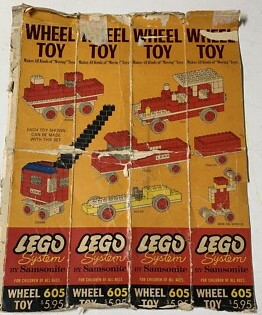
Instead, Canadian sets from 1961-66 are most readily identifiable from their US sisters via the slightly higher prices. So using the set number system outlined earlier, if the price is slightly off (605 -> $5.95, 702 -> $2.50), chances are its a Canadian set.
It isn't until sometime between 1964-66 that patent text is added, the best example being the 610 Super Wheel Toy, but it's a bit different from the US version. Rather, it reads "Licensed under Canadian Patent 1961 629,732". But it does not appear the existing boxes were updated to also add that disclaimer, at least I'm not aware of any.
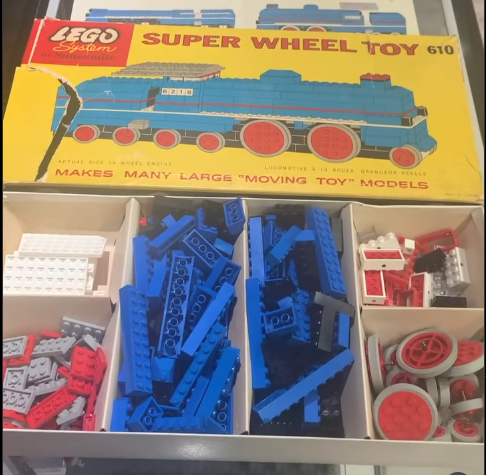
So to review, your best bet at dating a Canadian 1961-66 Samsonite set would be to guess, as it does not appear boxes changed between seasons. The included pamphlets would be a better indication, but this site does not currently house many Canadian pamphlets nor are many archived online, so I'm not confident in touting anything in that regard.
It should also be noted that the above example, the 605 Wheel Toy, was produced in Canada up to 1969, yet doesn't seem to ever have been updated.
Canada: 1967-70
The observant would notice that the US subsidiary of Samsonite performed their refresh for the 1965 season while Canada strangely lagged behind, waiting until 1967 to refresh their own line.
Sets produced during 1967-70 in Canada are in a very distinct transition, wherein smaller sets like the 205 were not yet ready to let go of the older tall box format. This particular example is from 1967:
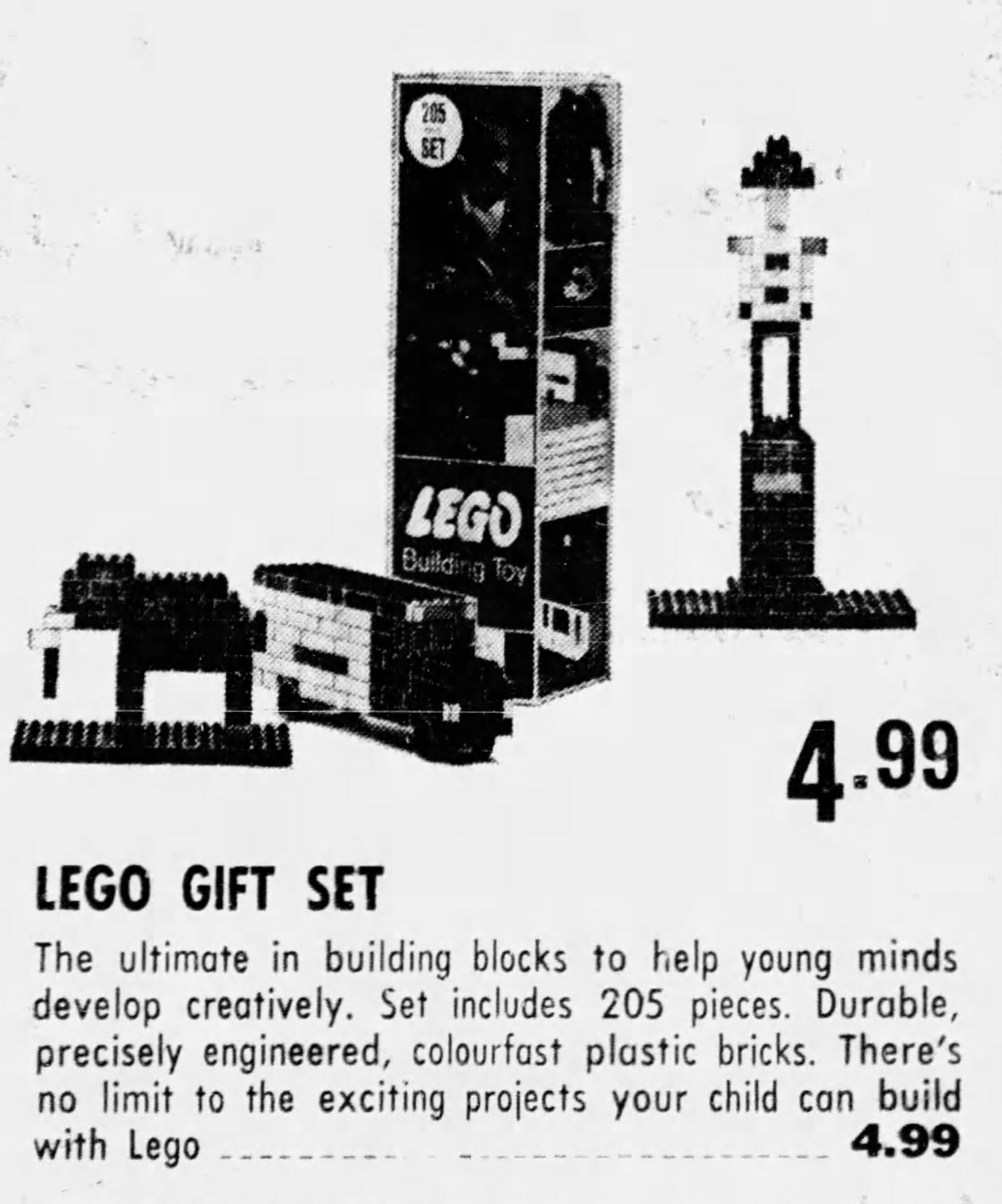
And that is a typical box design for the small sets(99, 125, and 205 Basic Sets). Larger sets, such as the 285 or 450 Basic Set, were in the drawer/sleeve format of their US sisters as can be seen in this 1967 newspaper:
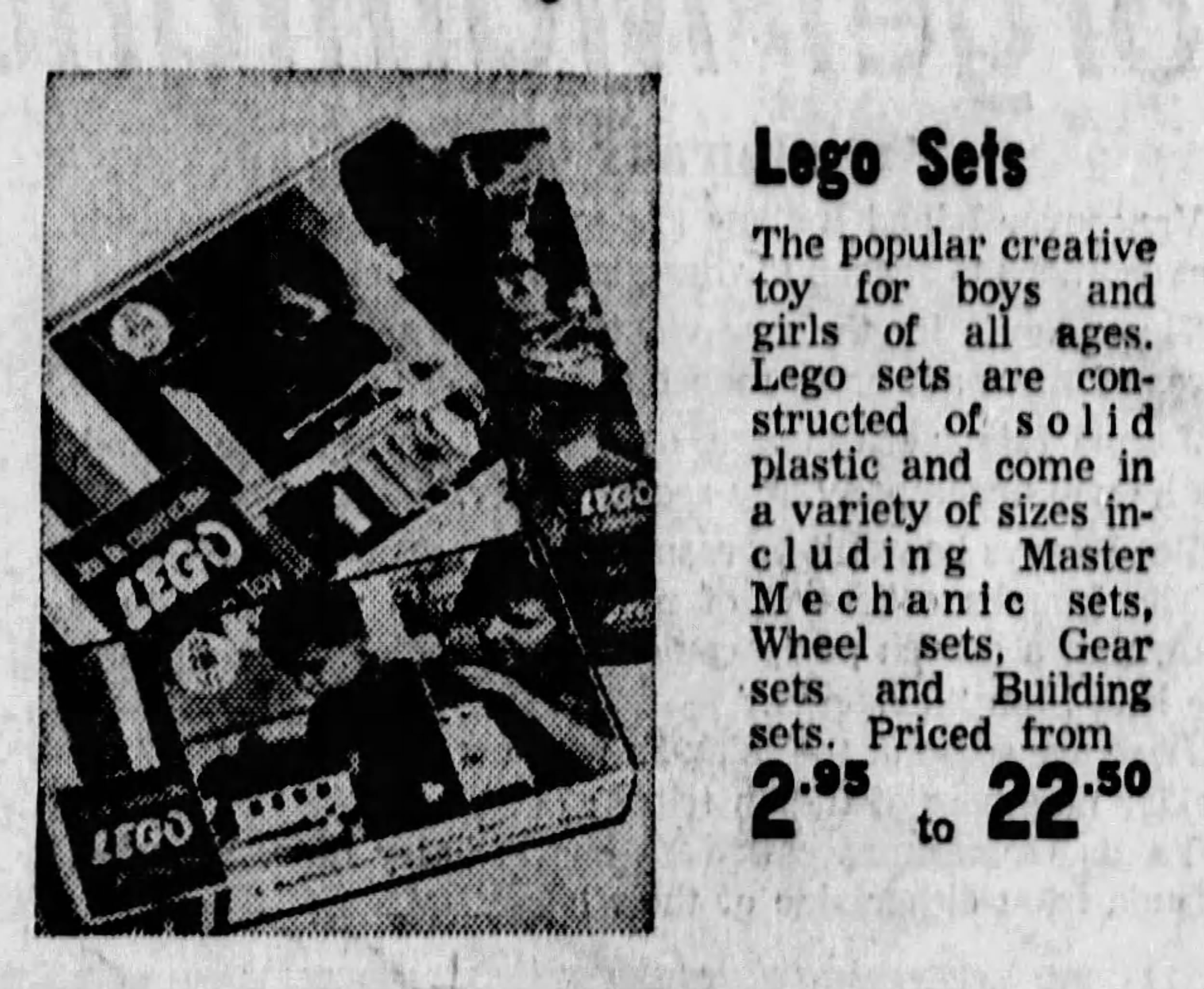
So if it has a bilingual drawer/sleeve box, and its larger than the 205, it could've been produced at any point from 1967-1970. The double stack exemption still applies here, wherein sets like the 615 Basic Set have a much longer window beyond 1970 because they could not switch away from having drawers.
Canada: 1971-72
Only tall box sets were seen in 1970, but 1971 marked the transition over to drawer/sleeve boxes and tabbed boxes. If it's Canadian, and it has a tabbed box, it is 1971-72 as this 1971 newspaper shows:
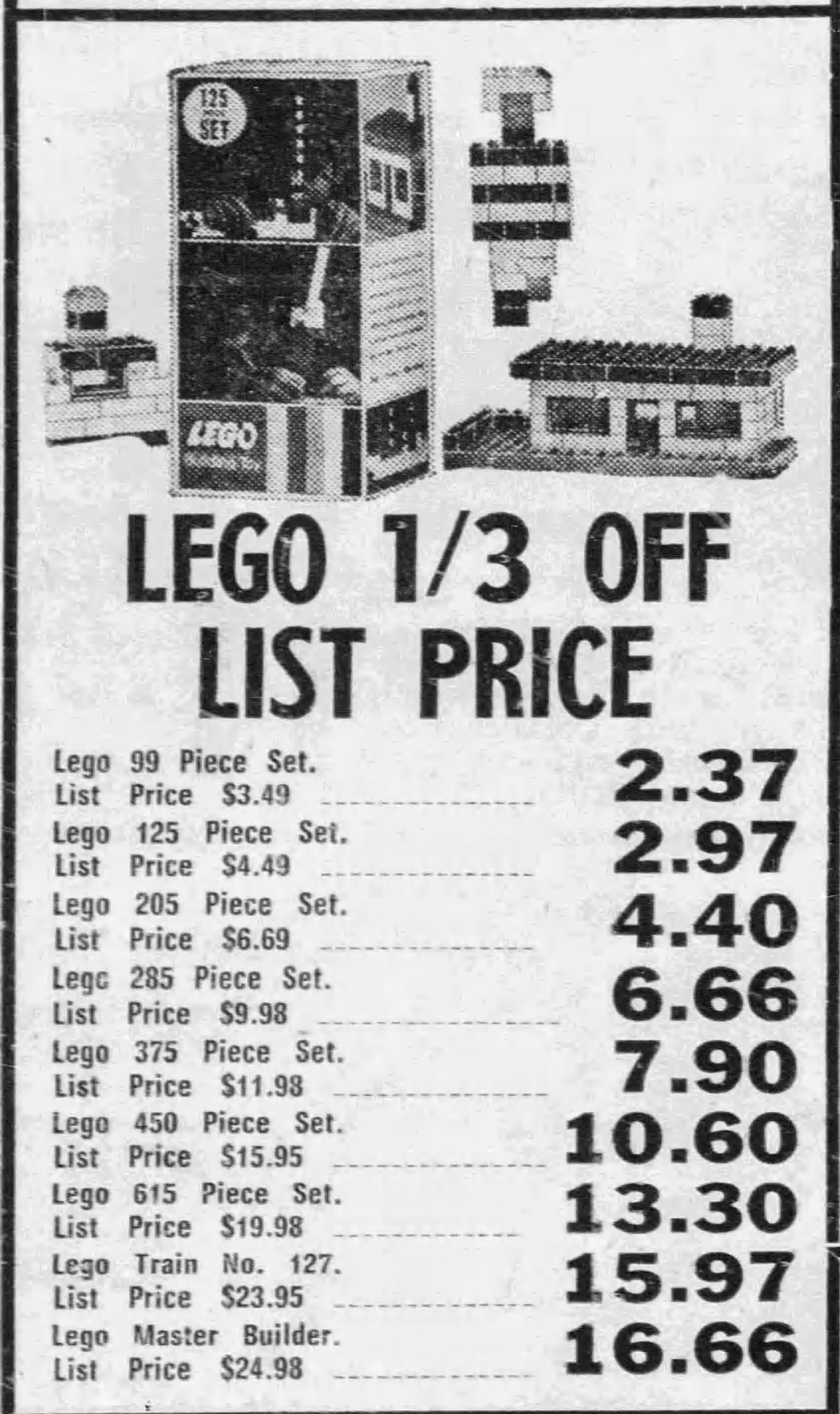
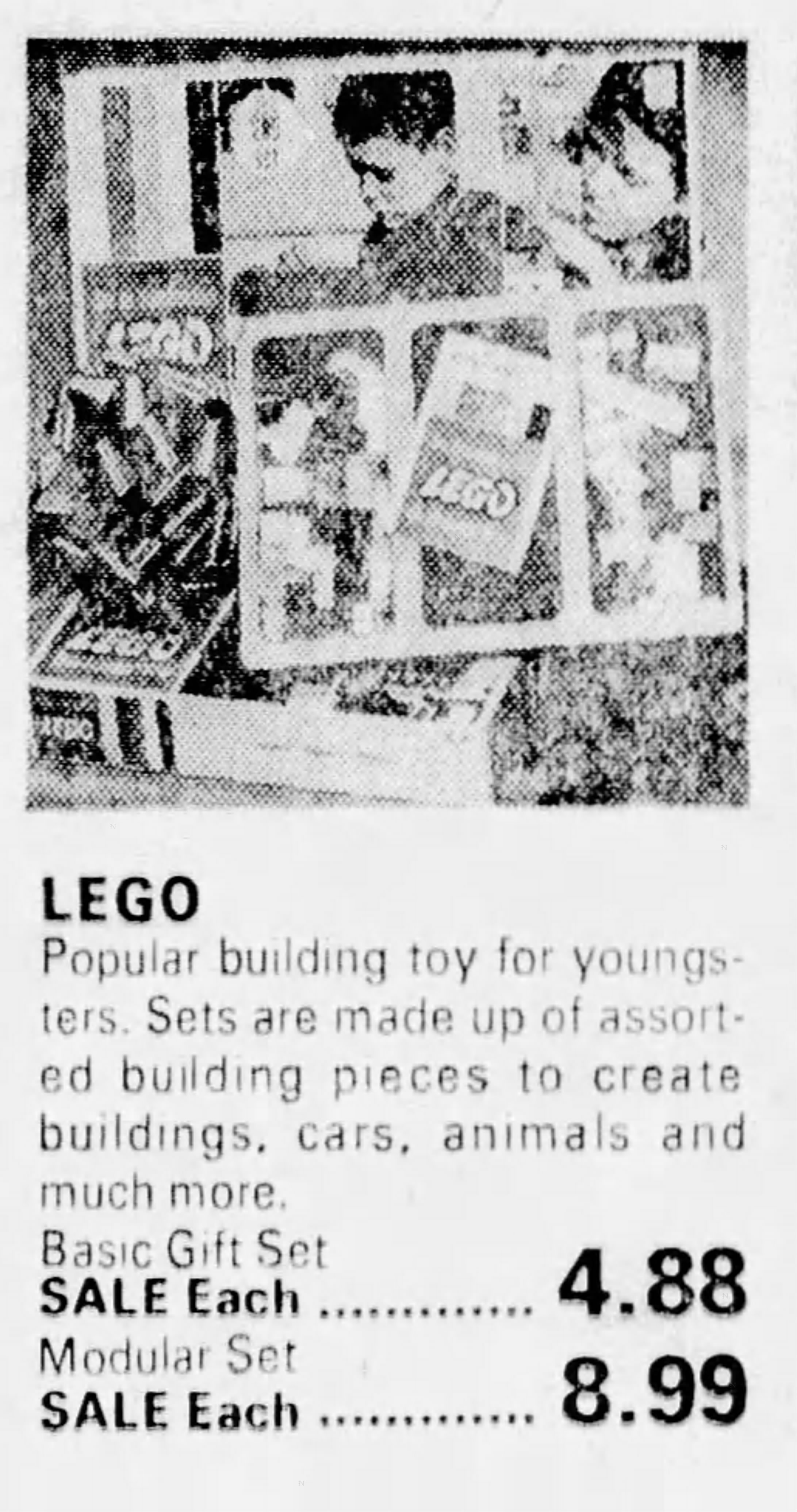
Some sets seem to have not switched over initially. For example, this sleeve of the 125 contradicts the above claim, as it appears to be a drawer/sleeve box that existed prior to 1971:
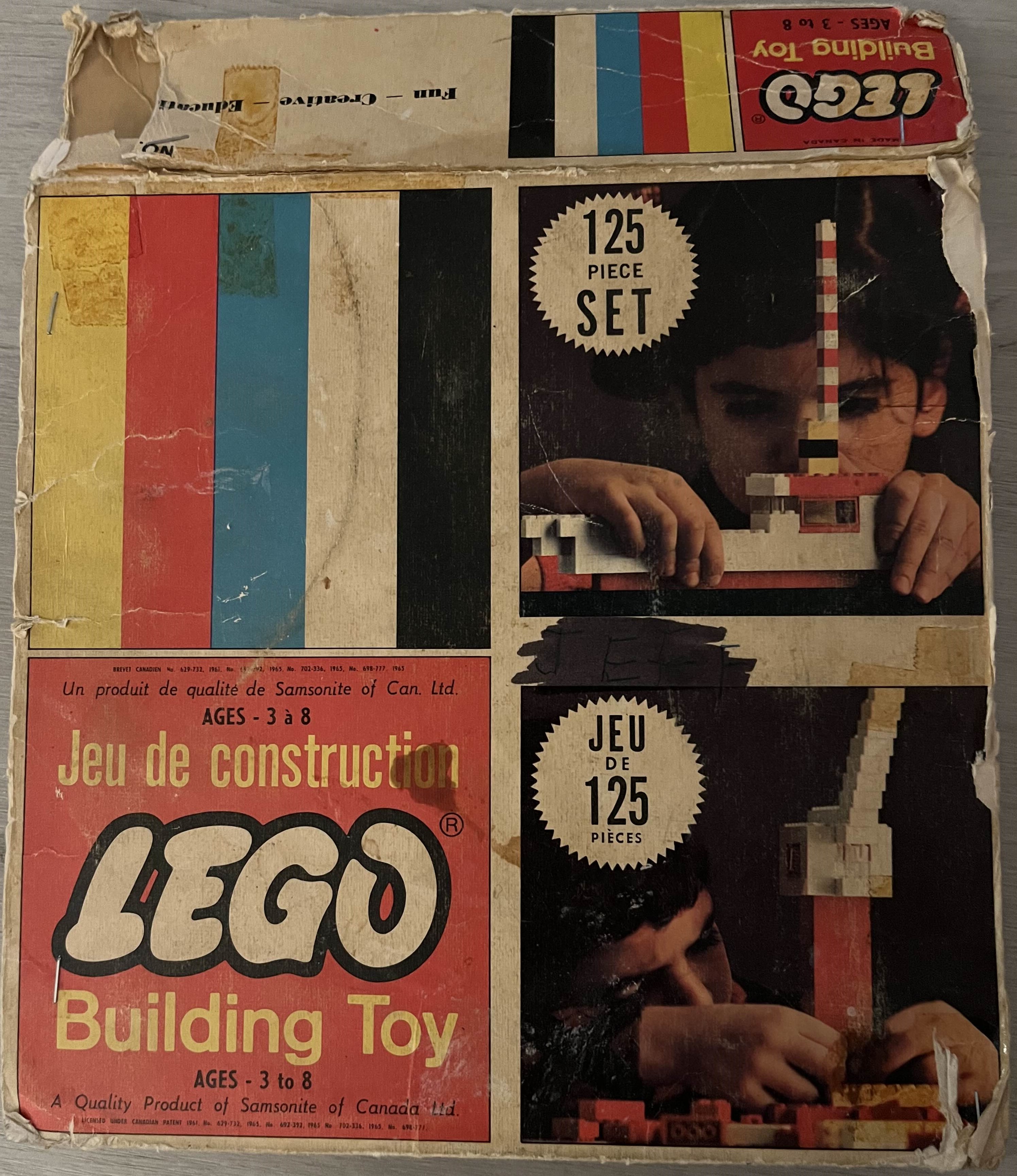
"Appears to be" as in it's possible the tabs were removed from this box.
As a result, I've suspected the change could've happened in 1970(which would account for why a possible drawer/sleeve variant exists), but I currently have no conclusive evidence for that. It could also very well be that each set was a case by case basis.