
Can We Talk About the 750 and 7100 Education Sets?
___
I'm sure you're already familiar with Samsonite's massive wooden box 7100 Educational Set. It's usually shown as one of the largest LEGO sets from the twentieth century, as it had over 3,000 pieces.
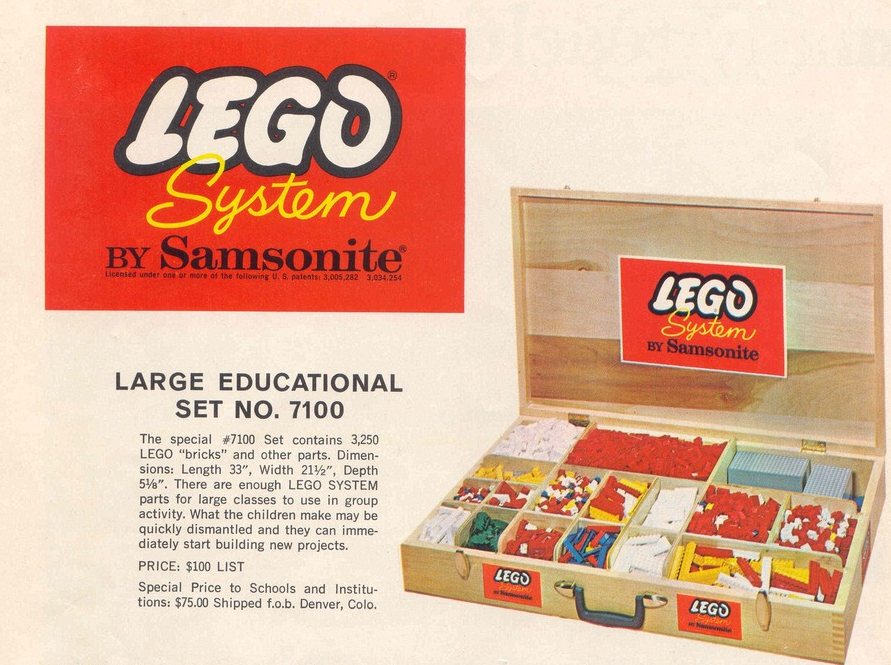
But not so commonly shown, as it is so incredibly rare, is its smaller sister set, the 750 Educational Set:
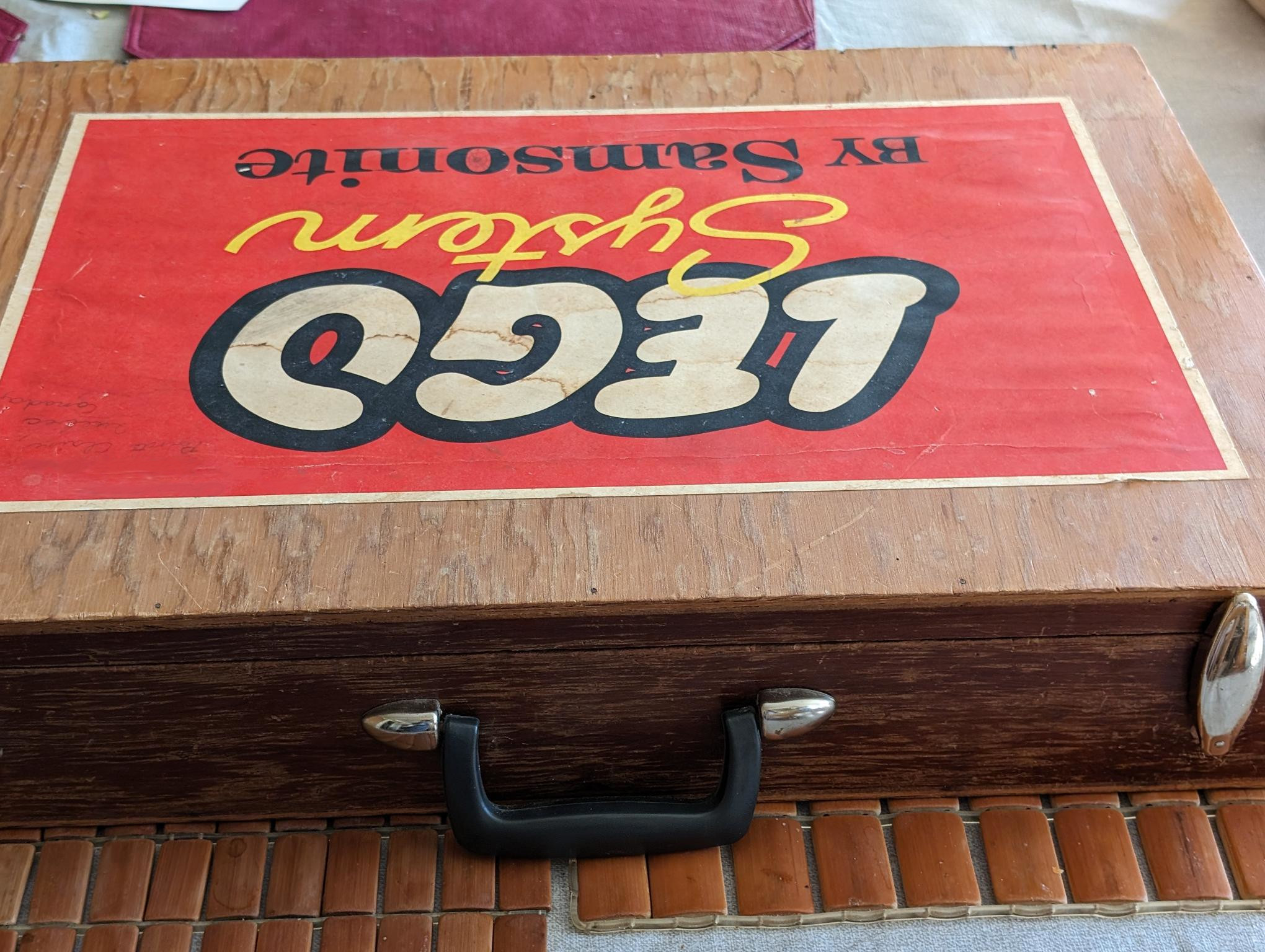
Regardless of the attention they receive, an air of mystery surrounds these sets. Granted they're institutional sets, so documentation was always bound to be incredibly sparse. They're not usually in the public eye but instead kept to internal pamphlets and magazines.
But since the compilation of this archive, new materials have come to light and we now know much more about the 750/7100 sets than we previously did. So that's what we will be going over today.
7100: When did it release?
If you're familiar with brickfetish's scans of the 7100's brochure, you'll know there is no date present. It could be approximately dated to 1963 via the form number, but that wouldn't necessarily date the 7100 set's release but instead the compilation of the brochure. So how do we know/show the 7100's release date?
The trail picks up in 1963, as Shwayder Brothers Inc. first attends the ASBO (Association of School Business Officials) Conference in Dallas, Texas early in 1963, with their name appearing alongside other companies. You can even see they've reserved two "booths":
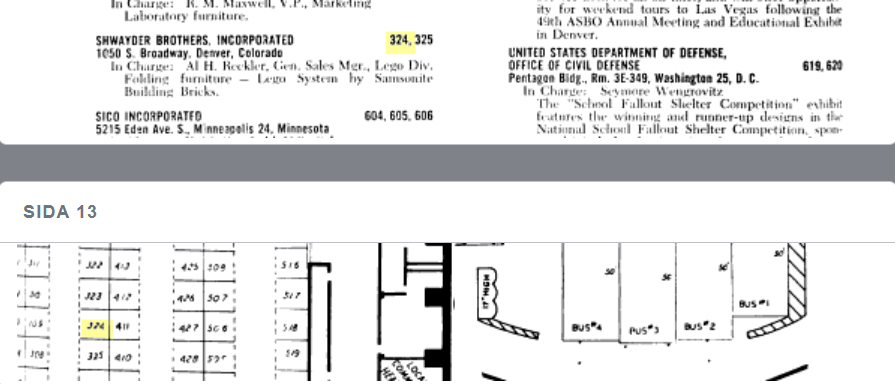
The assumption would be that one slot is for their folding furniture and the other is for at least the 7100 Educational Set (as that is the one we can confirm was available in 1963 based on the brochure).
Shwayder Brothers even reappear again and attend the 1964 conference:

Shwayder Brothers do not attend the 1965 conference, as least as far as I've been able to find. From that, I determined the 7100 likely released in 1963, based on their attendance at the above events. But that doesn't definitively disprove a 1962 release. However, according to a Playthings (1962), Shwayder Bros. had a different educational set available for 1962, a $200 set that may or may not have existed.
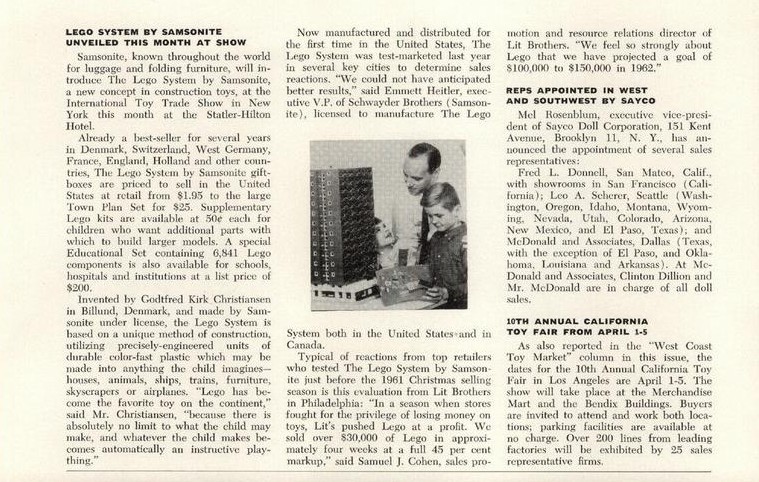
At the very least, a 1962 release for the 7100 is possible, but not evident and contradictory to what we currently have. The 7100 was last available to order from Samsonite in 1966.
Okay, so we've confirmed the timeline in which Samsonite was producing the wooden box 7100 Educational Set, 1963-1966. Now the issue becomes...
What about the 750 set?
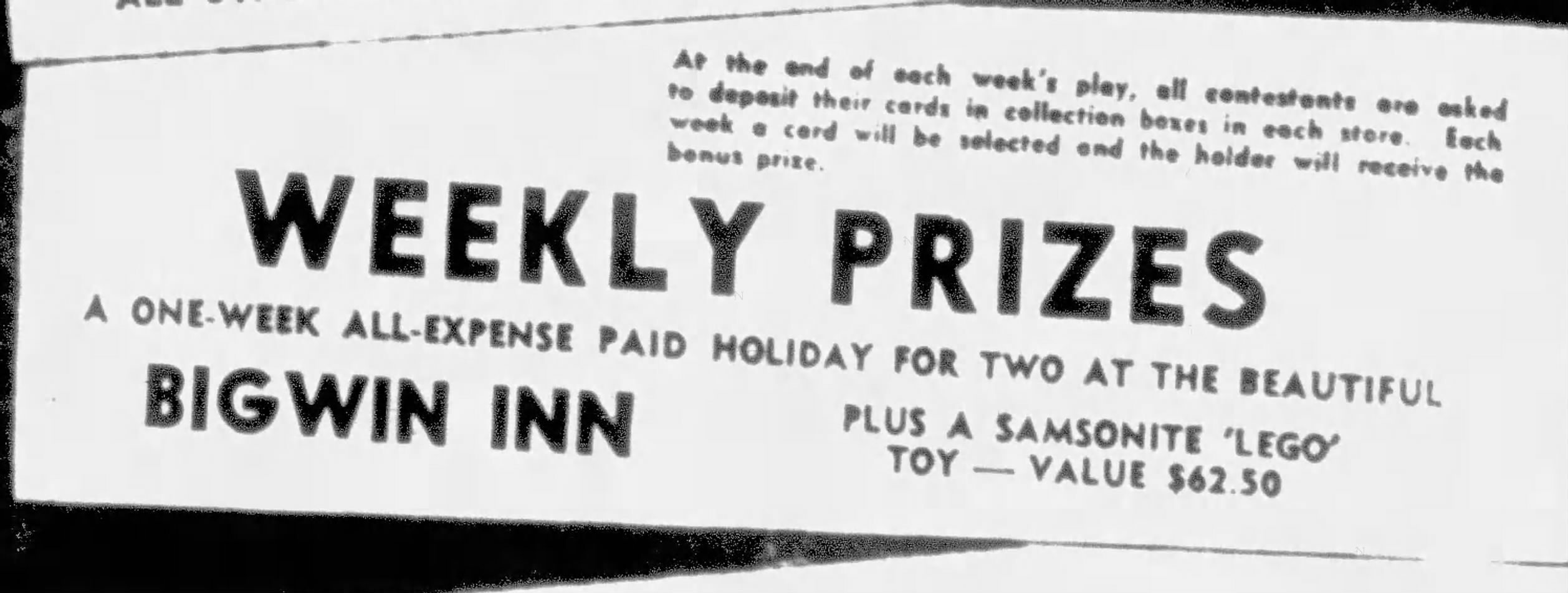
When I first started this archive, the 750 Educational Set was an engima. There was no documentation to point to, the set defied all identification. But when I began to puruse newspaper archives, I was surprised to find mentions of the 750 in Canadian newspapers.
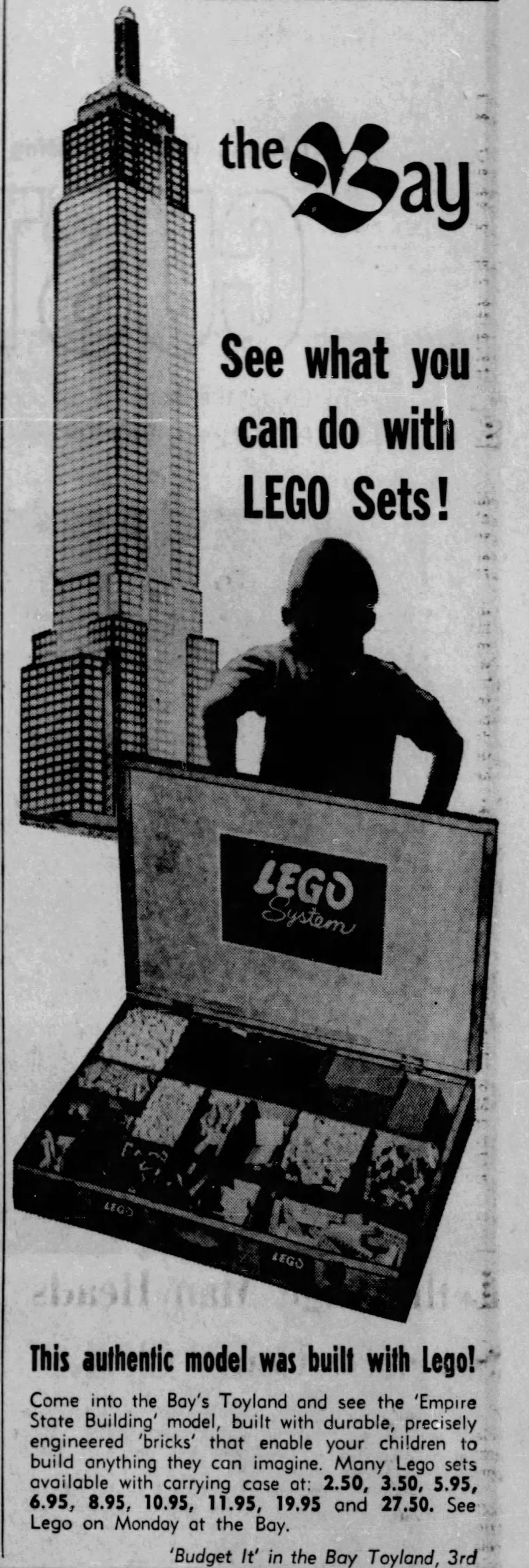
First, this clipping from 1964 which mentions a Samsonite 'LEGO' toy with a value of $62.50:
I have another from 1965 which has a similarly unnamed set also worth $62.50:
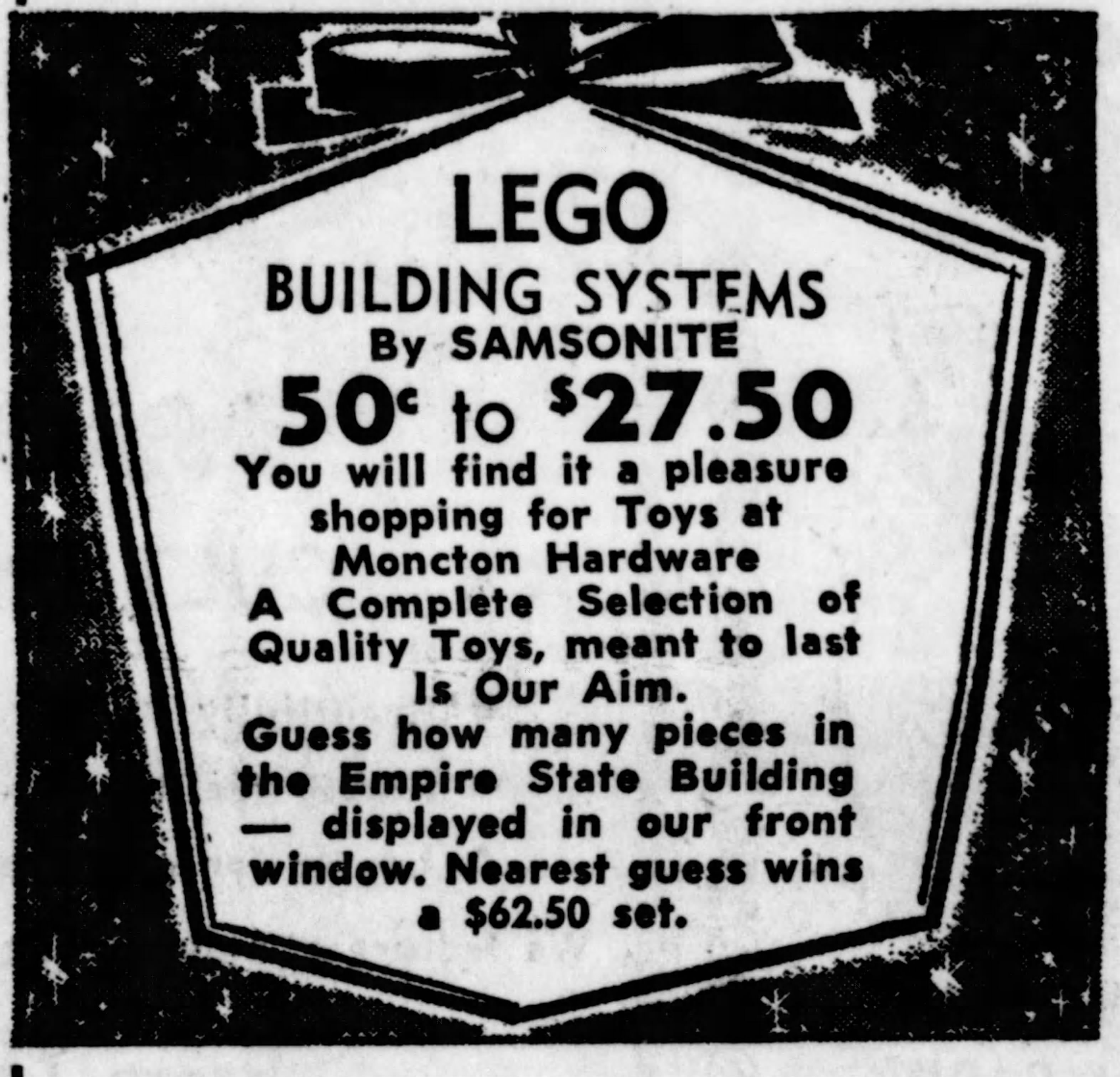
You may be thinking, how can we know this is the 750 set? Didn't it cost $50 (known via the set number being built by 7 & price)? Remember prices were higher in Canada, $62.50 is CAD. Also remember these were specialty sets and might've had some sort of extra cost for Canada (evident via price being ~$8 higher than it should be when fairly converted with 1963 data).
But we needn't go off speculative assumptions, as the 1965 contest with the 750 put out an image in the paper of the contest winners:
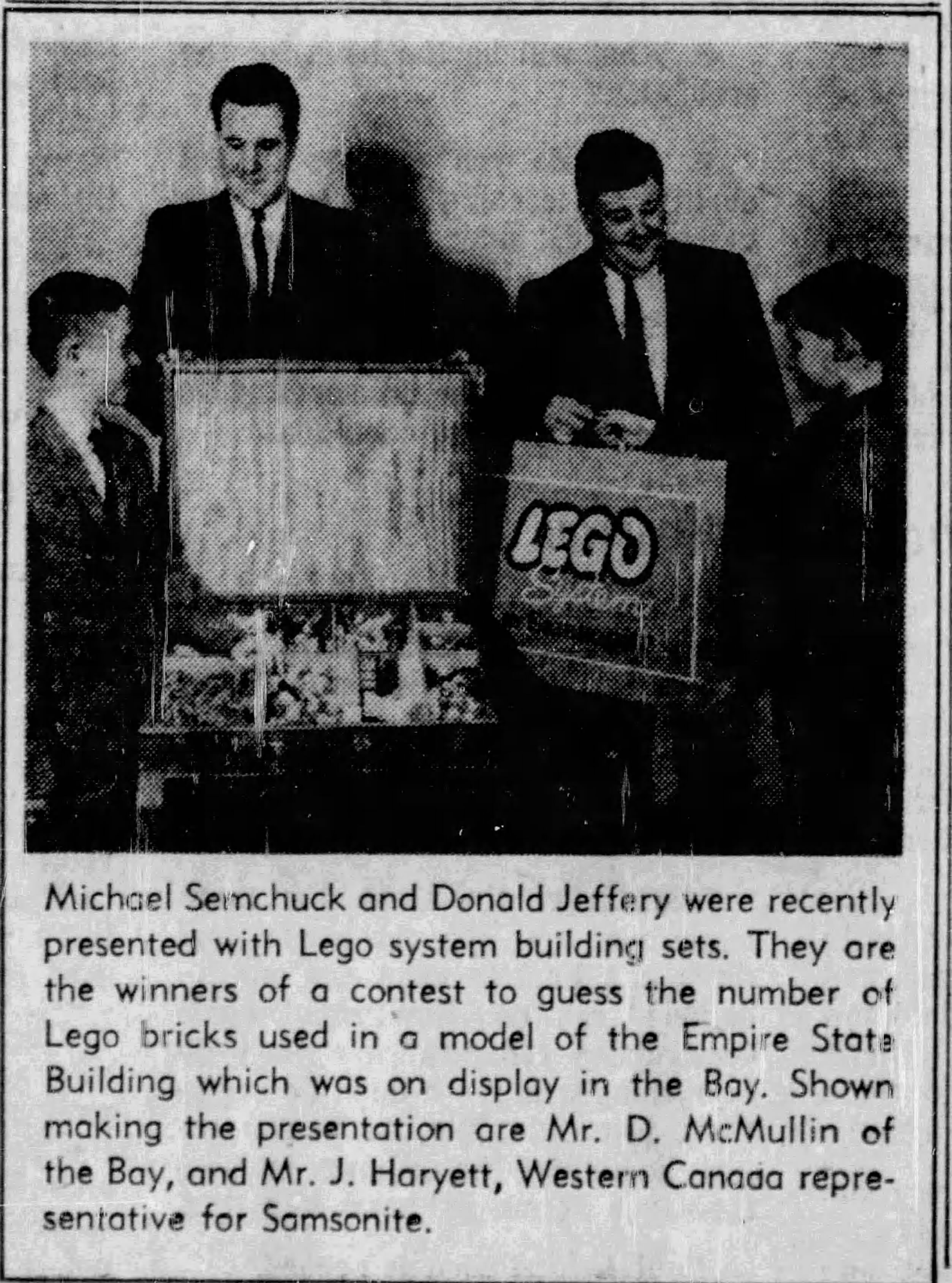
Not only does the outer box's sticker match the earlier Canadian brochure's image, but also it shows the inside, which also unmistakably matches the brochure.
So... when did the 750 set release?
Along with newspaper appearances in Canada starting in 1964, a 1964 article in Playthings announcing the 750's release makes this pretty open and shut:
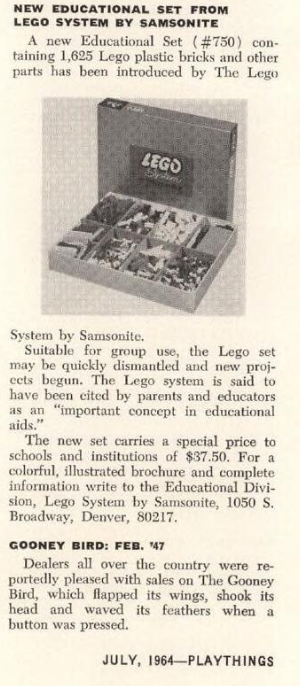
What surprised me when I came across this article was that it didn't show the wooden box 750, it showed the even rarer golden box 750:
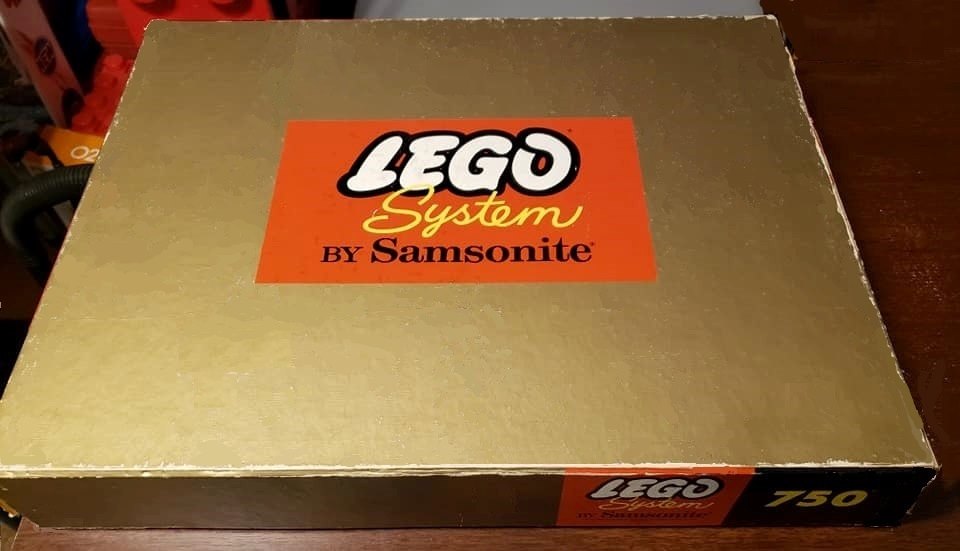
So based on all that we've found, in 1964, Shwayder Bros. released the golden 750 for the US market, while Canada made a wooden case for the Canadian market also in 1964 (which is corroborated by the original owner of one). The Canadian version saw production until 1966, the US version may have been retired as early as 1965. There may have been a wooden case 750 produced in the US, but none are known to date.
Wrapping Up
Overall, I think we've reached about all we can about these two sets, at least with the evidence I am currently aware of.
But don't get me wrong, I'm very satisfied with what we're walking away with. We've at least confirmed dates and the sequence of events, as well as informed ourselves for the coverage of the 321 School Set and the 060 Jumbo Bricks Set.
Predicting the 750's Release
I've preserved a rewritten portion of this article from before the Playthings article was found, wherein we were still able to accurately predict the release date of the 750 (similar to what we did with the 93-Piece Set). I think it desmonstrates that while we don't have explicit evidence for every claim onsite, there are things we can accurately approximate.
As we've laid out most everything, I'd like to talk about when exactly the 750 set released. As no print evidence has surfaced as of writing, we're left to make sense of what little remains.
What makes me hesitant to claim a 1963 release is that there is evidence to the contrary. For one, the 7100 is much more common (common comparatively, as we're comparing one to a dozen). If they released alongside each other, it doesn't exactly sit right that the larger, more expensive set (double the price at more than $1,000 in todays money!) has more surviving copies.
There's also the 7100's brochure, which mentions every single Samsonite set available at the time aside from the retailer exclusive canister sets, yet still lacks the 750 Educational Set:
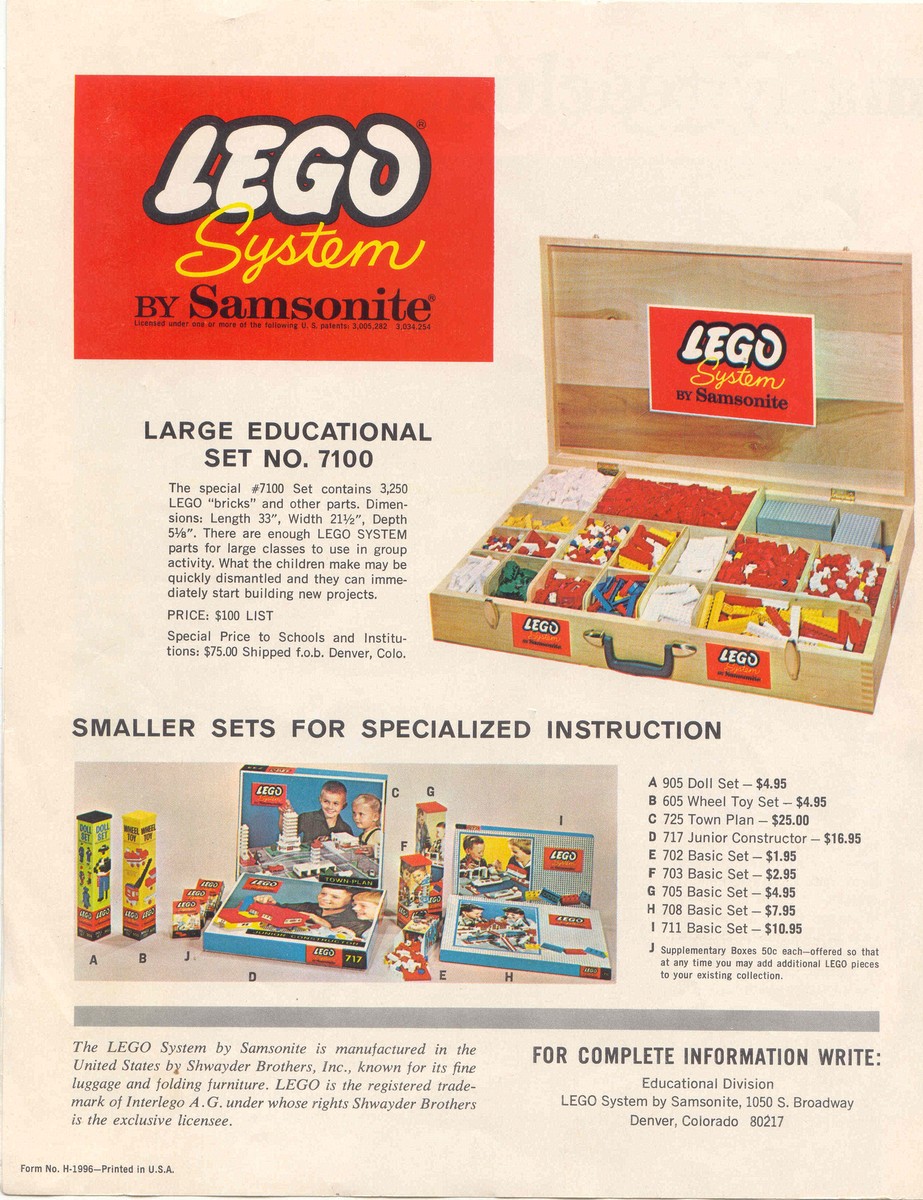
It even says "Smaller sets for specialized instruction", yet still doesn't list the 750. Given all that we've gathered above, I think we can figure out what happened.
Firstly, the 750 set could not have released alongside the 7100 set, as seen above where it is absent from the brochure for schools. Instead, my thought is that it was released in 1964 as a mid-range option for schools who did not want to spend $100. If you have a product that costs $100, and it is not selling enough to be sustainable, a logical step would be to introduce a smaller cost-effective version to convince consumers to purchase the large one, or at the very least salvage the market.
It could not have released in 1965, as Shwayder Brothers did not attend the 1965 conference. It first appeared as a contest prize in 1964 too. 1964 is the best one to fit the bill, but you can see the article is not over yet.
I've yet to cover the wrench in our clean explanation:
The Wrench (Deprecated)
And... while the above is a good example of predictive modeling working as intended, below is an example of predictive modeling not having enough to go off of to survive more information coming to light.
An important aspect of this archive is not just to record the contemporary information, but also to learn from mistakes or incorrect assumptions. While speculation can be useful, it is also not always a vehicle to truth, even when the evidence seems consistent. NOTE THAT THE BELOW SECTION IS MISLED AND DEPRECATED, IT IS ONLY LEFT FOR PRESERVATION AND STUDY OF THE ORIGINAL ARGUMENT:
The top of the box is printed in a gold color with the LEGO Samsonite logo(without visible patents, interestingly) prominently displayed on top:
From the inside of the box, it appears to be a 717 Junior Constructor's box repurposed into a 750 set:
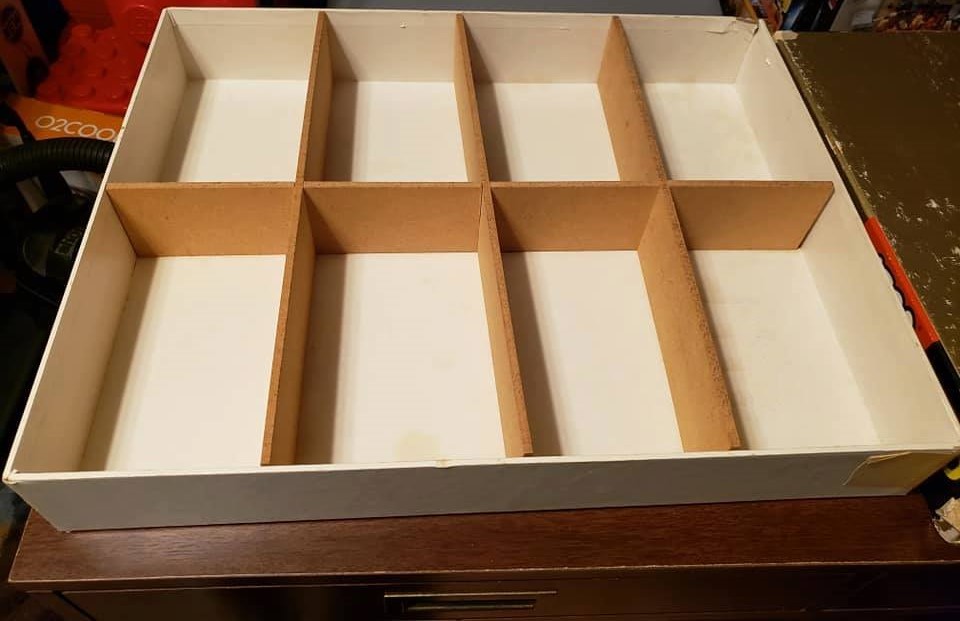
So why would this box version exist, especially if we've seen three 750 examples so far and all have wooden cases?
I see two options, but you're welcome to think as you'd like.
They ran out.
Very simple idea, plausible as well. After all, you have an order for a 750, you run out of wooden cases and for whatever reason more cannot be made—what do you do?
The inserts not having the white paper and instead being bare would be strange in this scenario, but not a deal breaker.
Instead, there's another explanation that I like much more that accounts for everything:
The contest prize!
Yes, there is also potential this version was created to fulfill contest prizes. Why, you may ask?
For one, the above Canadian contests are likely not the only ones held. Not every contest would've been published in the paper and its likely I've missed at least one (I've found one more appearance of a 7100 since the original compilation of this article).
Regardless, there are a few possibilities in this scenario. The simplest is rather than use up expensive wooden boxes in contests, they instead produced a short run of these "golden" 750 sets, which could still claim the 750's retail value without investing so much cost.
The gold printing of the box definitely seems to be a supporting clue, as it uniquely appears for this set and would fit in as a contest prize.
However, it's important to place this idea contextually within all other documents. For one, the Canadian Junior Designer's Club pamphlet, which shows the 750 wooden box and states "...your name will be included in monthly draws for the special giant Lego Building Set illustrated above."
So we have two known avenues for prizes with the 750: in store and via monthly drawings likely fulfilled via mail. It would not be very economical to mail out a very heavy wooden case, thus we have two potential channels for each variant.
In person contests used the wooden box version. Very easy, we already have evidence confirming that. Then, as in 1966 the 717 Junior Constructor retired in Canada, the monthly draws would be an excellent candidate for the 750's cardboard box variant. Uses up remaining 717 boxes, explains why the inner dividers are missing the white lining, explains the gold coloring, and would also line up with cost effectiveness, as it would be much cheaper to ship the 717 variant than the wooden box.
It's also much more likely for a prize to a contest, especially one valued at $62.50 in the 1960s, to have survived because it'd be much more special to the owner than if the cardboard variant was used in schools. Hence the survival of the golden 750.
However, now that we know the golden 750 is from the US, and the patent text on the box supports that, all the above work is null and void, unless somewhere out there there is a Canadian golden box 750, but it'd be much harder to prove the distribution for that set, between LEGO Club and institutions.
Case Study
This is just a small portion of the article to reflect my mindset when approaching articles such as this, especially when correcting.
I find the evolution of my understanding of these sets as an excellent case study as to how correction is to be handled. We thought one way previously, this is why it was incorrect and this is the data to support such. It'd be much easier to simply erase the board and start over, but it would lose a level of viability, in terms of demonstrating the experience with the question being asked. I didn't get it completely right on the first try, and that's okay. I signposted everything that was speculation or assumption as such, which is equally important.
This archive is not meant as a static "this is the way everything happened", corrections and rewrites are more than welcome and transparency on that is one of my upmost priorities.
It is to take a step further than encyclopedic reconstructions and retellings, it is to teach primary source reliance, to question that which isn't supported and build ideas on what is left. Challenging ideas both in the archive and elsewhere with good evidence and logic. While not every source is wholly a source of truth, it is through the continual compilation of them that we can continue to reassemble this story accurately. If we stopped yesterday, it wouldn't have met those standards.
A simple way I think of it is that I may have been wrong before, but at least I'm not still wrong.