
The Case for a 1962 Release of LEGO in North America
___
I know a 1962 release for LEGO in the USA sounds impossible given all that we know, so let's start with a simple question:
"When did LEGO release in North America?"
Hobbyists, historians, as well as LEGO themselves are very cut and dry. Their answer is that sales of LEGO in the USA started in late 1961 and Canada started in early 1962. Simple.
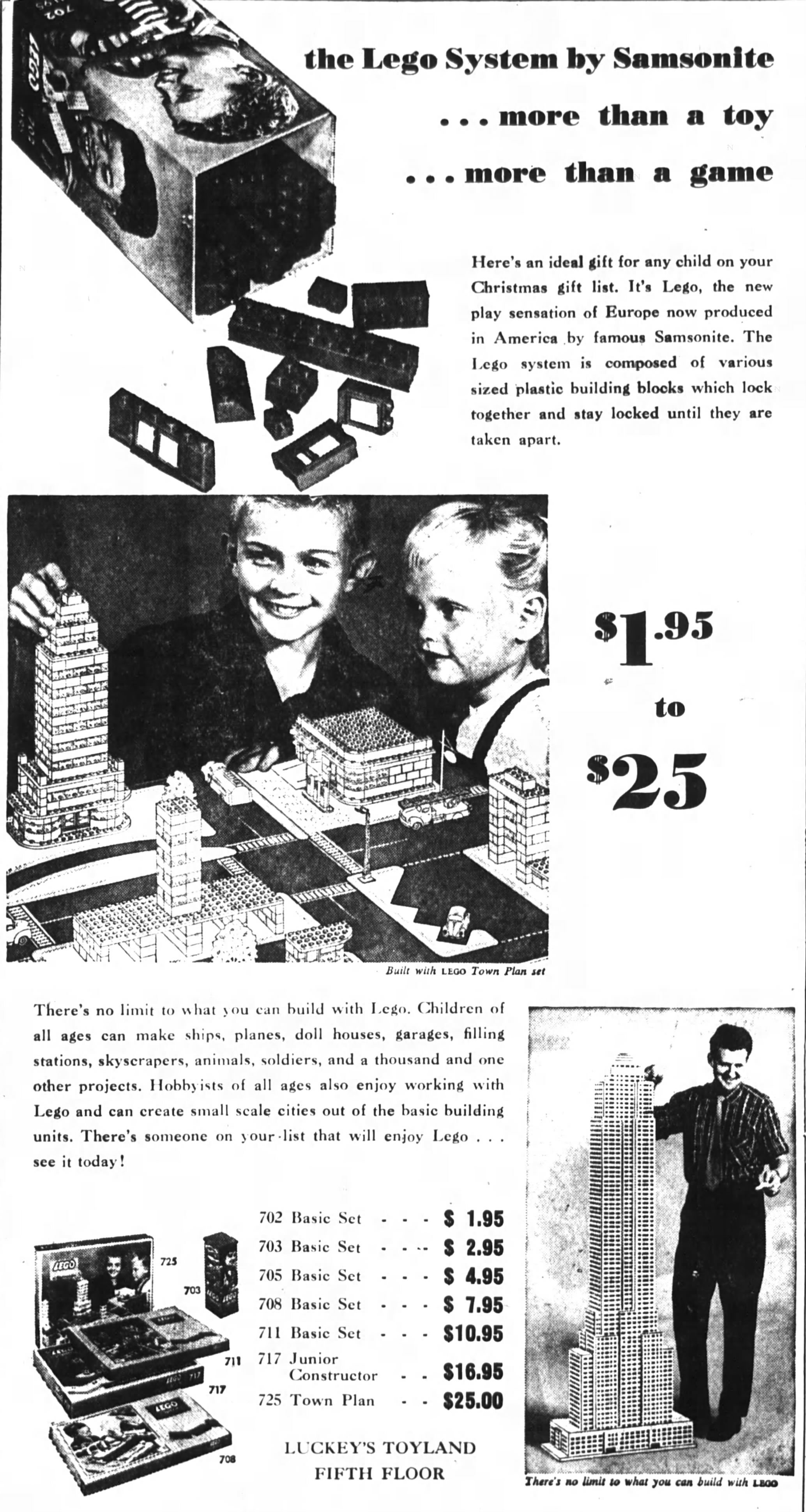
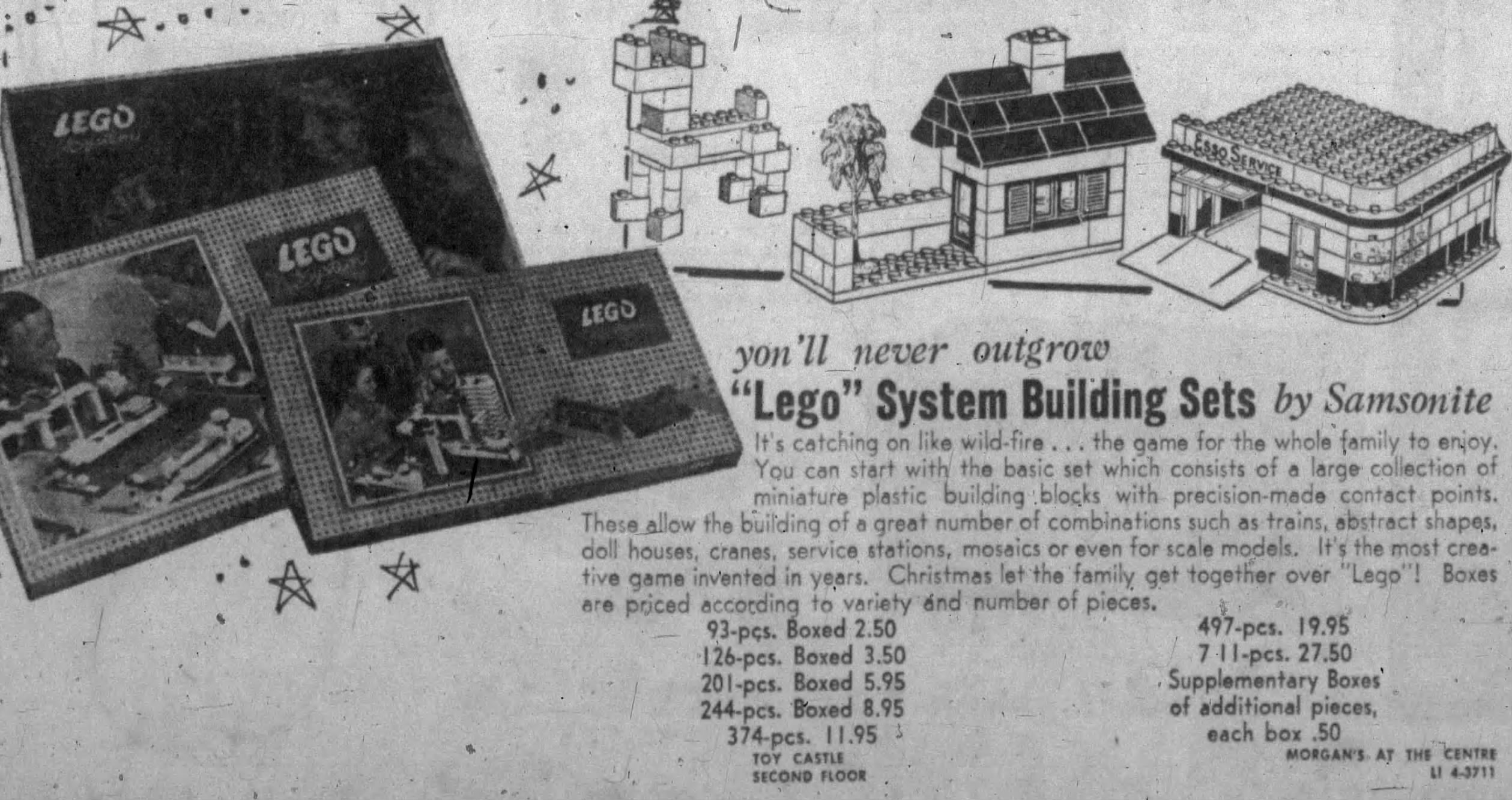
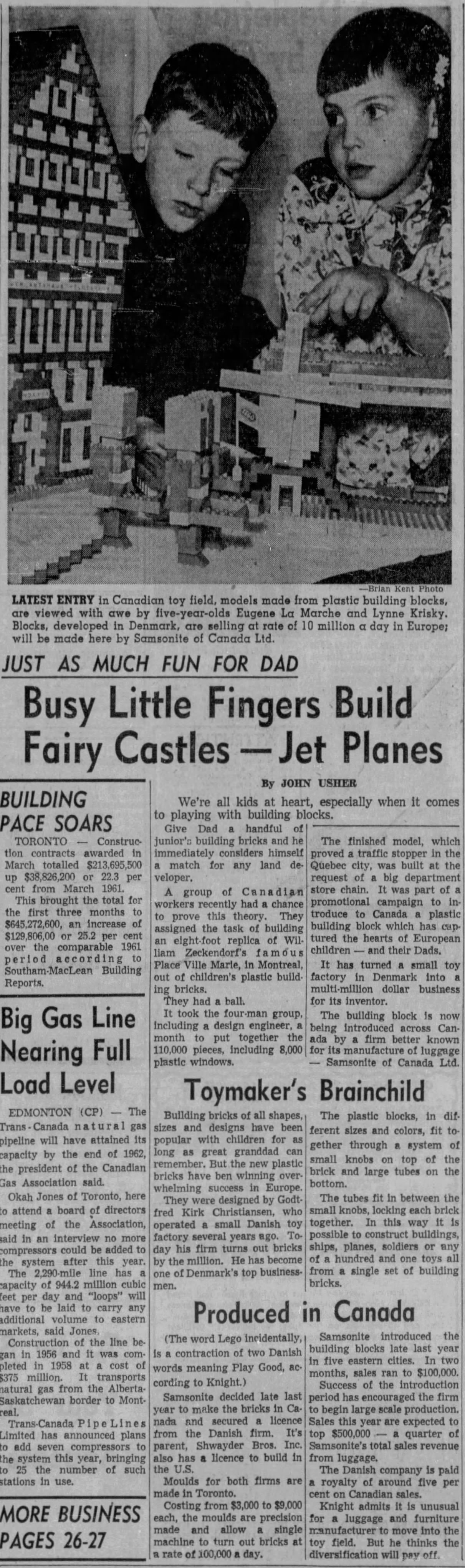
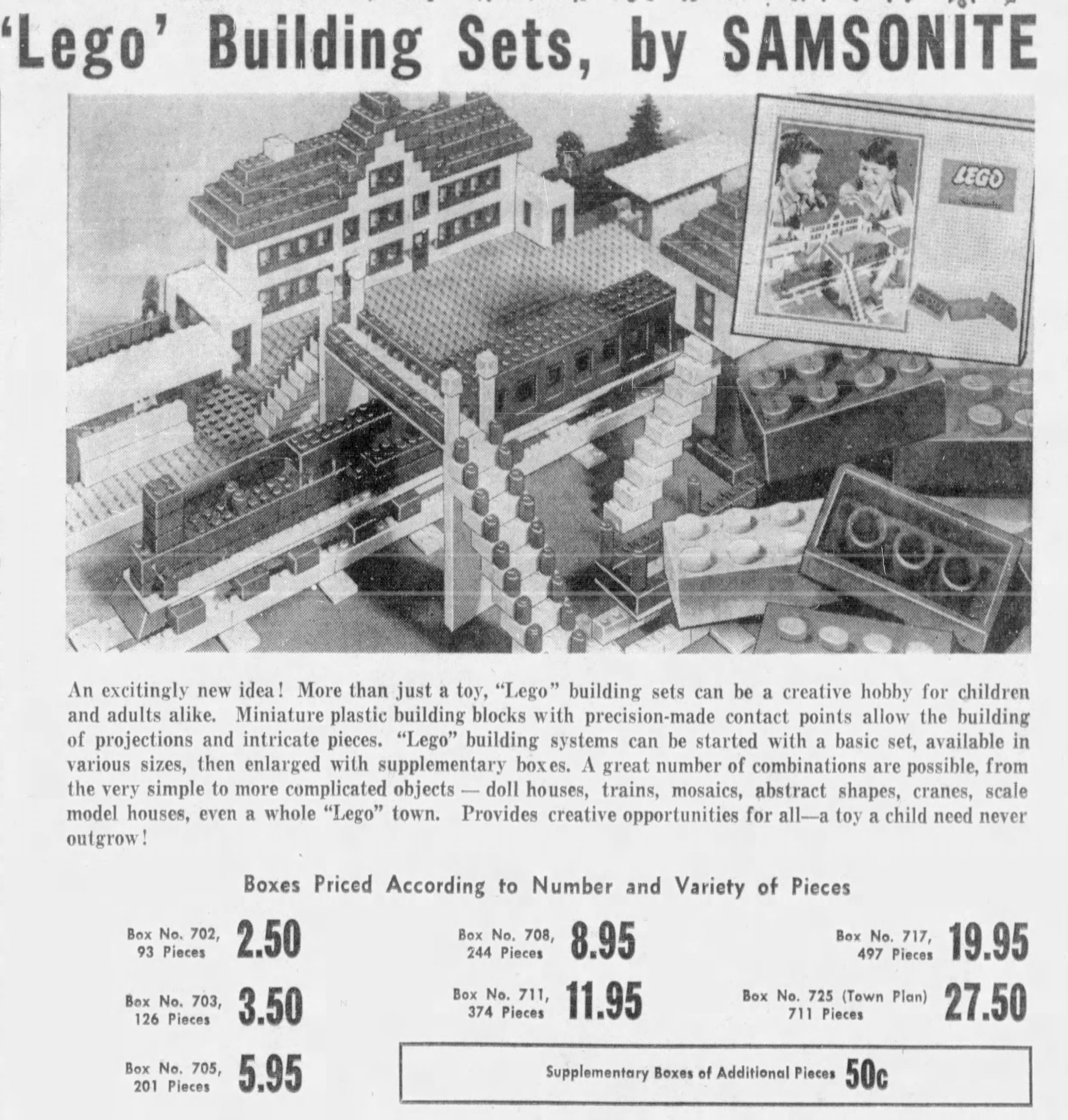
For this archive, it's 1961 for both countries. There's no reason to reject 1961 for the USA, as we have bountiful late-1961 USA newspaper ads. For Canada, most are unaware that there are late 1961 Canadian newspaper ads, testimony that Samsonite of Canada released to five eastern cities as test markets, and even a late 1961 Eaton's advert:
So... what's the case for 1962 for both countries?
There's reasonable justification for the cited 1962 release in Canada as the "official" release, to not count the limited Canadian sales from 1961. Which I somewhat agree with, we cannot immediately count the test market of any product as the official release as they are often small and invisible.
But here's the thing—if that's where you draw the line, sales in the US also began in 1962.
Why do I say this?
Two reasons.
Logistics and Practicality
While LEGO themselves frontloaded a lot of work for Samsonite (then Shwayder Bros.) including photography, design of paperwork, supplying molds, and importing most specialty pieces, Samsonite only reportedly began production in October of 1961, with adverts in papers appearing no earlier than November 6th, 1961.
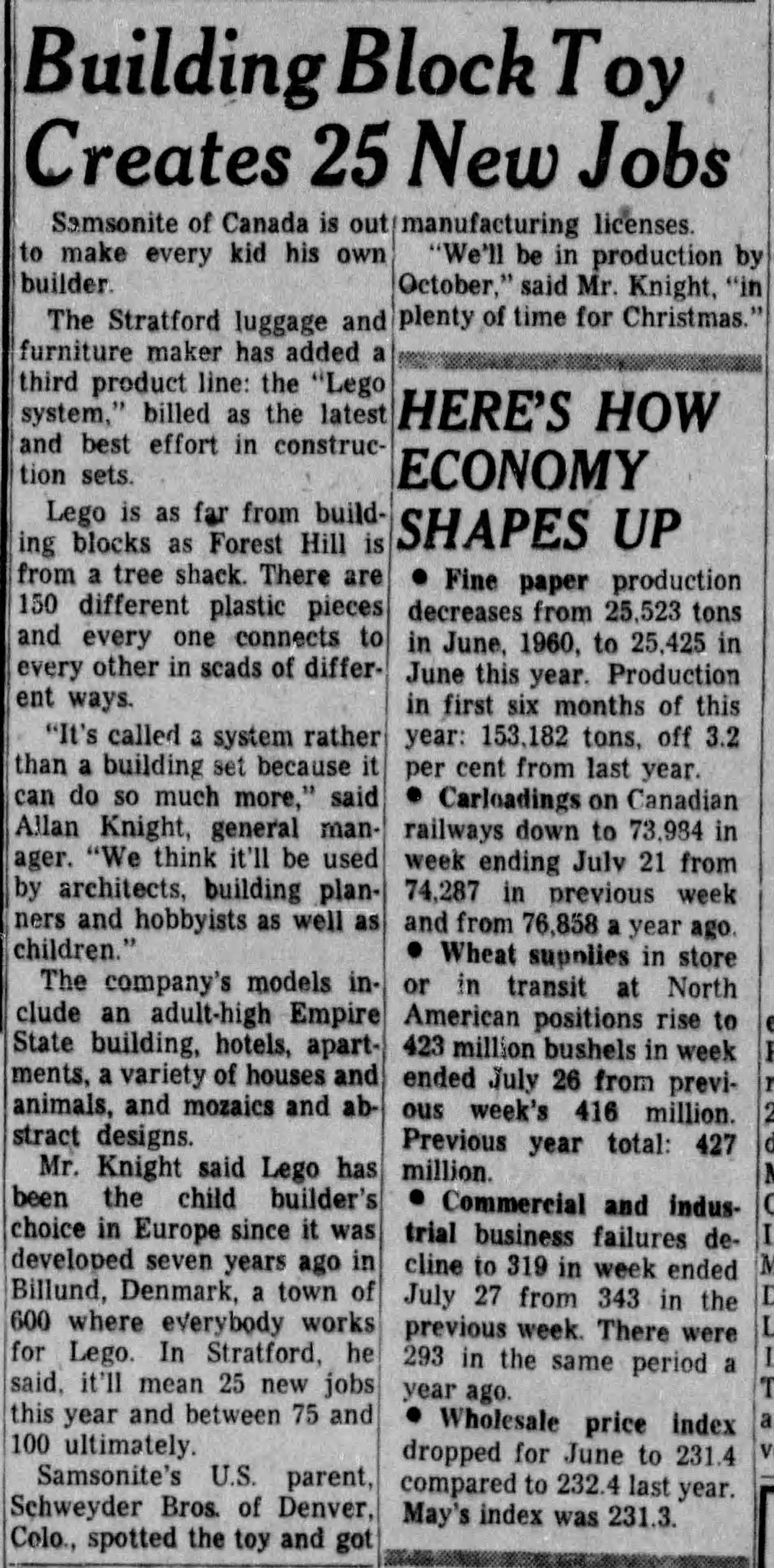
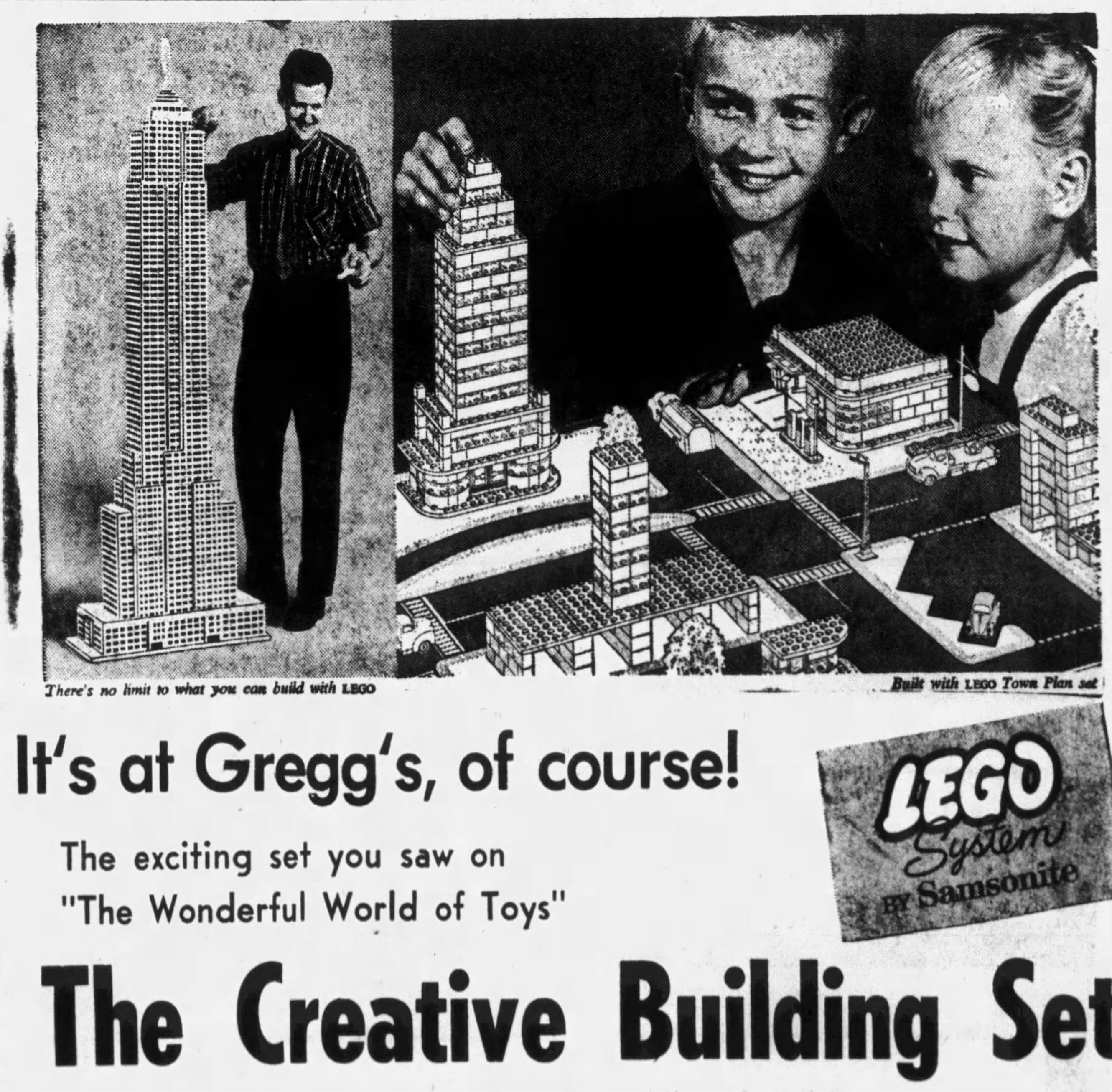
So while Shwayder Bros. began hiring salesmen for LEGO in late April of 1961, there simply wasn't enough time for production to meet a large demand across the United States, with only about two months of production time before Christmas. And also keep in mind, all LEGO production had to work with Samsonite's existing productions including folding chairs, card tables, and a plethora of styles of luggage.
This is interestingly also reflected in the spread of newspaper ads, in which only ten US states even have adverts posted in newspapers: Michigan, Colorado, Pennsylvania, Nebraska, New Jersey, Ohio, Wisconsin, New York, Maryland, and Connecticut. Even more interesting, these states are either coupled around Samsonite plants or high-population areas like New York City.
Keep that in mind.
Historical Accounts
The US based publication Editor & Publisher, specifically Volume 95 from 1962, stated "The Lego System by Samsonite, a system of creative play, introduced last year to fourteen test markets..."
Now that's a little interesting, that's a very specific number. But it's only one mention... except that number is corroborated by Broadcasting also from 1962:
"The Lego System by Samsonite, a toy item test-marketed in 14 cities last year, has bought participations in NBC-TV's Captain Gallant children's program. Agency: Grey Adv., New York"
This is where the fun begins.
Parallels
Remember our newspaper adverts, how we could only account for 10 states? What if we were to pin all those newspapers on a map?
Interestingly, we get pins in those states relatively centered around a major city. For example, Colorado's is Fort Collins, Wisconsin is Milwaukee, Ohio is Toledo, Connecticut is Hartford, Pennsylvania is both Pittsburgh and Philadelphia (with a bit more spread there), New York also has two (New York City and Syracuse), Nebraska is Omaha, and three for Michigan (Detroit, Sagninaw, and Lansing). And as a bonus: Washington DC.
When accounting for all 30-40 adverts that are readily available to me, that's only thirteen cities—very close to the cited fourteen test cities for the US. And they're all next to, or in the path of, a Samsonite plant if starting from Stratford Ontario. Aside from New York, but that makes sense as it is both a major city and the iconic home of FAO Schwarz, of which we have the LEGO listing in the 1961 catalog.
It is curious when contemporary evidence lines up with unrelated contemporary evidence, as well as practical considerations. And while there's also the argument of missing/lost media that has not been accounted for, or cities that never posted adverts, it would not immediately discount the idea, only the interpretation. It would take a city completely disconnected from the shown network, which is highly unlikely to appear at this point.
Closing Thoughts
So, if you wish to not include test markets, then you could very well make the claim that LEGO did not release until 1962 in North America. But while such a thing can be said, I'm not willing to accept it wholeheartedly. Instead, I much prefer to say that LEGO released in both countries in 1961, with welcoming arms to explain all that we've gone over so far.
Overall, I'm extremely convinced in the veracity of the claim that LEGO Samsonite released to test markets in both countries for 1961. I suspect overtime, as more materials are found, this will continue to be substantiated.
It just makes more sense anyways for the US release to have test marketed. Samsonite was new to the toy market as well as to being a licensee, and they had to hire plenty of new salesmen for LEGO specifically. Couple that with time constraints...
As a demonstrative example, at least one December 1961 newspaper was a job listing for a salesman in Missouri, a state that had no ads prior. Along with that, ads in Missouri began to appear in 1962:
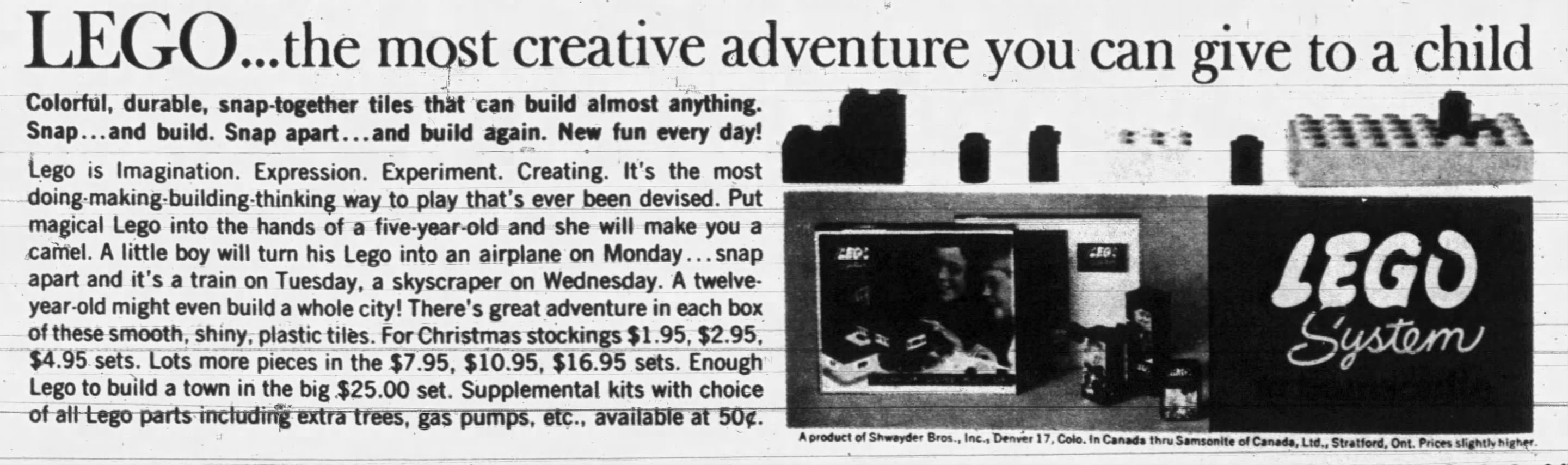
And this is a very common story, with so, so many newspaper adverts through 1962 touting that LEGO was finally in stock at retailers everywhere.
But rather than proclaim a newly discovered release date, I feel a universal 1961 date for North America is much more appropriate and necessary, especially for surface level coverage or quick reference. We can always clarify the indicated "test market" nuance in the US/Canada for deeper dives.
And so, with all that said, this is how I would answer the question proper:
Q: "When did LEGO release in North America?"
A: 1961, but there's a little more to it if you've got time...