
Introduction
___
Much of what we know about LEGO Samsonite comes from surviving paperwork: idea booklets, catalogs, promotional pamphlets, etc. That's the majority of what you'll see shown elsewhere, but what if I told you there is more to explore?
Advertising!
Online, you'll find a few surviving television commercials that are a fascinating peek into how LEGO was understood during the 1960s. While insightful in that regard, nothing else can really be concretely extrapolated from them.
However, another source has a plethora of opportunity to learn from: magazines.
It makes sense, as the 1960s are popularly cited to within the magazine golden era. While most LEGO related clippings posted online are 1965+, they are still incredibly valuable sources of information. Unfortunately, as online archival provenance for magazines is incredibly lackluster, we won't be able to explore them very well.
Fortunately, there's another thing that was widely produced and archived: newspapers!
It's not something I'd have thought of to check; they were long gone before I was even born so I was completely unfamiliar with their culture. But I stumbled upon an online listing for a clipping from November 11th, 1962 and I couldn't resist purchasing. If you're interested:
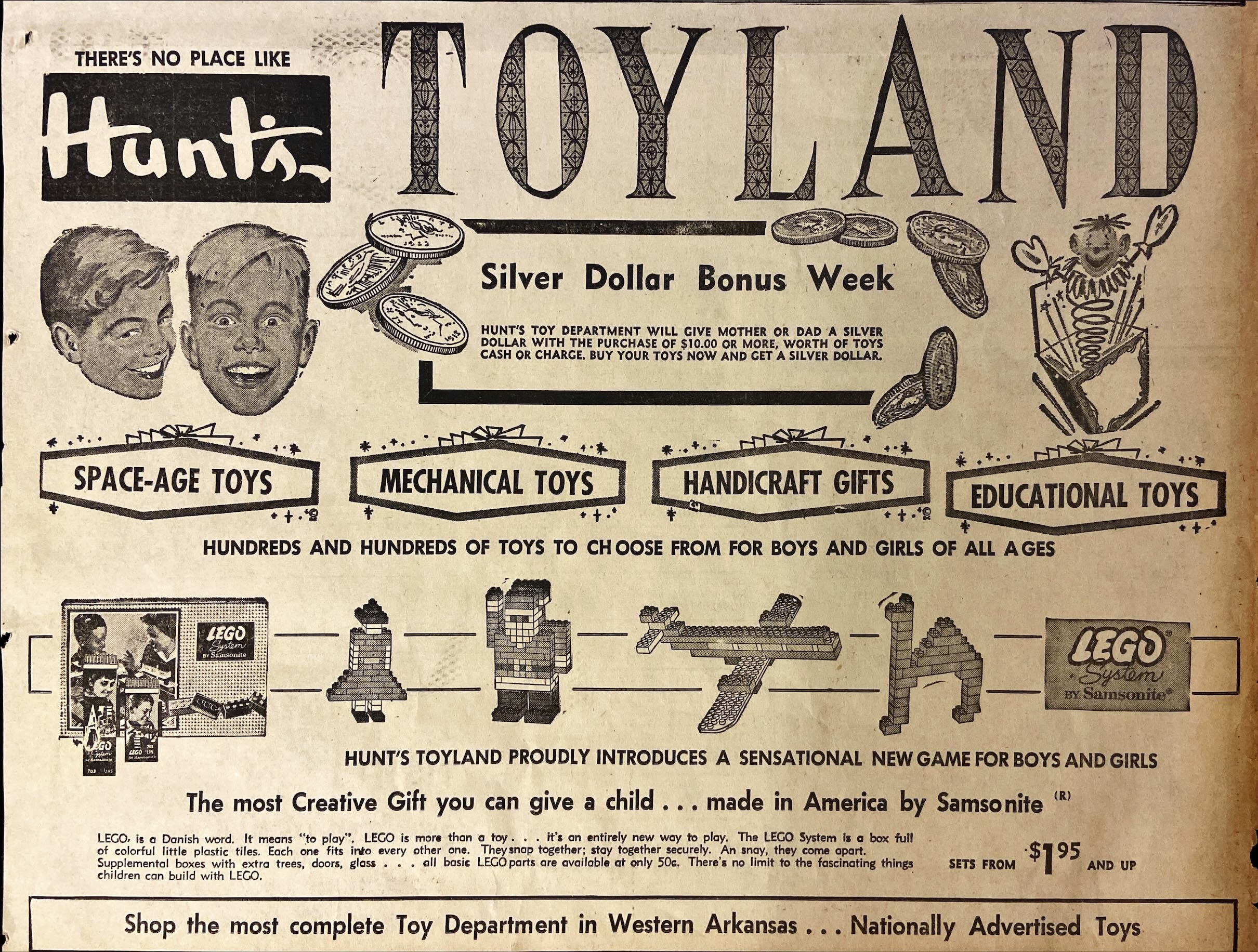
This is what it says(you can click images to view them closer):
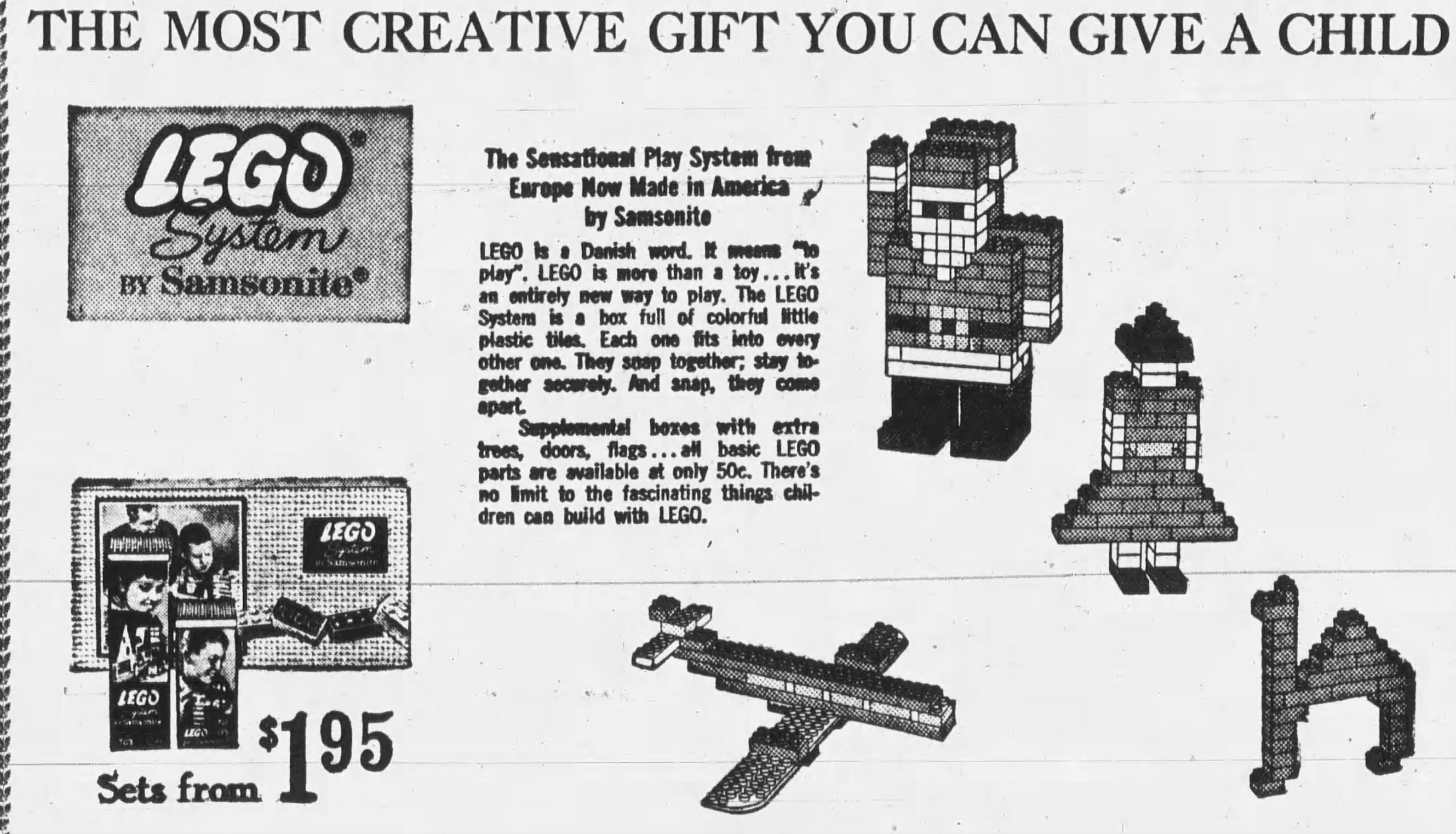
"HUNT'S TOYLAND PROUDLY INTRODUCES A SENSATIONAL NEW GAME FOR BOYS AND GIRLS
The most Creative Gift you can give a child ... made in America by Samsonite(R)
LEGO is a Danish word. It means "to play". LEGO is more than a toy ... it's an entirely new way to play. The LEGO System is a box full of colorful little plastic tiles. Each one fits into every other one. They snap together; stay together securely. An snay, they come apart. Supplemental boxes with extra trees, doors, glass ... all basic LEGO parts are available at only 50¢. There's no limit to the fascinating things children can build with LEGO. Sets from $1.95 and up."
I think we all know they got the translation wrong, "leg godt" means "play well" (I thought it was "lege", as I have an elementary understanding of the Scandinavian languages, but "leg" is what LEGO themselves uses). In hindsight, knowing about Samsonite's quality issues, I think it's funny they didn't specify the quality of the play. "It means 'to play', hopefully the play goes well."
But is there any real information we can extract or confirm with this? Well, not really. The only things we are privy to are tall box 702 and 703 sets in front of either a 705 or 708 flat box, hard to tell which and not really important.
It's interesting that the 702's box has been modified with Samsonite in a different place, pushing up the set number and the price. We should assume this to be an editorial decision rather than a prototype box, as the change is exclusive to 1962+ ads. Images of the 702's box from 1961 do not share this feature. It's also worth noting that staple jargon of LEGO is not yet standardized(i.e. "bricks", is replaced with "tiles"). It's people who are new to LEGO trying to describe it, fascinating.
But this got me thinking... can we find any other newspaper ads? If so, is there anything we can learn from them? Could we potentially date when LEGO reached certain parts of the US?
I started local, simply Fort Smith, Arkansas(where my newspaper came from). There were only two results. There is, of course, my digitized newspaper(external link). But shown below, is an odd one from 1966(just assume these are all external links):
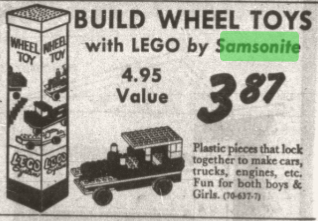
A 605 Wheel Toy, in late 1966!
Sure, it's common nowadays to find a years-retired LEGO set still on shelves, but finding this made me realize that newspapers could be a valuable source in determining not only when exactly a set released, but also different boxes, assortments, where it was sold, or when it left store shelves. These are all local dates of course(and we cannot always assume that the box shown is the one for sale), but informative nonetheless.
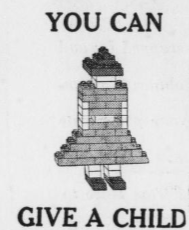
Instead of searching in this one town, let's broaden our scope. I did a quick search on a Library of Congress site(limited to search as late as 1963), again giving two relevant results. One was the same ad from my newspaper printed vertically. It is from North Carolina, December 12th, 1962. Not worth showing, but I do like the consequence of the chosen format:
The other is a small ad in a newspaper from Washington D.C., November 30th, 1962.
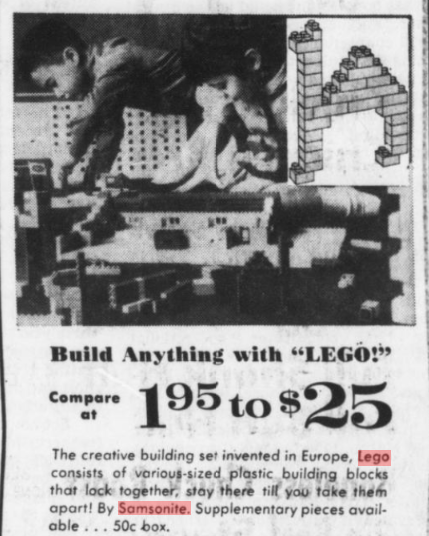
Hm. So far it's curious the three ads we've seen are from late 1962. Granted this search did not include 1964+, but why not earlier?
I went to a different site and got my answer. I searched only "LEGO" and "Samsonite" from 1962: 731 results. And what about 1961? 92. Ah, so that's why it was so easy for me to find ones from 1962. For the sake of the record, these are the newspaper mentions for each year(categorized by region):
| Years | 1961 | 1962 | 1963 | 1964 | 1965 | 1966 | 1967 | 1968 | 1969 | 1970 | 1971 | 1972 | 1973 | 1974 | 1975 |
|---|---|---|---|---|---|---|---|---|---|---|---|---|---|---|---|
| USA | 87 | 678 | 387 | 325 | 142 | 136 | 166 | 108 | 115 | 191 | 209 | 474 | 64 | 24 | 31 |
| Canada | 5 | 53 | 60 | 58 | 23 | 6 | 12 | 8 | 12 | 11 | 8 | 8 | 41 | 40 | 33 |
For both regions most ads were late in the year, which makes sense. No reason to advertise toys year-round, Christmas is only once a year. It's also interesting to see the sheer volume of ads in the US versus Canada, but there are a number of reasons why that could be and I'm not going to speculate.
All the site's newspaper clippings are accessible via the Gallery, just search "newspapers". The next few articles covering the newspaper adverts by year provide a lot of important context, as I didn't save every single ad, but I definitely saw them all.
Each page features what I consider to be the most interesting, mysterious, informative, strange, or just plain common ads from that year. My goal is to give you the best understanding of what is out there (as well as anything interesting I find as well) without having to sift through thousands of newspapers.
That is not to imply, of course, that I regret the time I spent gathering these clippings, as what I have found has enabled me to make some amazing discoveries.
You'll see them cited throughout this site, and there are plenty more beyond what those articles show or have already been used elsewhere. I highly recommend you check them out.
___
Once again, I can't help myself. Remember my newspaper, the quote on it? This slightly tangential, but humor me for a moment:
"They snap together; stay together securely. An snay, they come apart."
Have you ever heard the phrase "an snay"?
It's become a habit of mine to search up odd, archaic phrases I come across, either to use in my own writings or look at the etymology of it. But when I search up "an snay"... the only relevant results are from other archived newspapers.
I already know what you're thinking: "Ah, it's just a bit of extinct editorial slang. No big deal." Which, fair. But the larger phrase isn't unique to my newspaper.
Do you see it? Every other newspaper—and even Samsonite themselves on borchures and pamphlets—uses "and snap". Why is my newspaper the only one with this unique variation? It's not likely to be a typo, as I've found other unrelated newspapers using it, so I'm not sure.
I'm originally from the Midwest, and "an snay" inherently makes sense to me, as it seems a quippy way to say "on the other hand" or "conversely". No one says it in actual dialogue, nor do I remember ever reading anything with it, but it feels familiar enough. However, no dictionary or online resource I can find records this phrase as being a real thing.
Off topic, I know, but strange, isn't it?