
Samsonite Ultralite Luggage (1955-1959)
___
This article serves as a general overview of the Ultralite Luggage line produced from 1955-59 by Shwayder Bros. Inc., later renamed Samsonite Corporation. It is told primarily through magazine adverts, though many other contemporary sources were referenced in compiling this information.
For historical background regarding Samsonite luggage, Samsonite Streamlite Luggage (1938-1968) is a good place to start. A small overview will be given here.
The Samsonite Streamlite luggage line was home of many firsts for Shwayder Bros., and its popularization completely eclipsed and replaced all prior Shwayder luggage products. So for a period from the mid-1940s to 1954, Streamlite was the primary luggage Samsonite produced. It was the origin of the Samsonite name, being named for Streamlite's durable material.
Throughout that time, the line matured and established Streamlite's staple color palette (beige, blue, green, reddish brown, and brown) as well as the types and sizes of cases.
And so, when Ultralite Samsonite Luggage was introduced in 1955, it borrowed immensely from the existing Streamlite line, most notably its iconic tapered shape but also its colors and case styles. Ultralite's clasps were a squared shape instead of the ovoid shape of Streamlite's, and it also carried a different trim and sides. The most notable difference, however, was that Ultralite was made with vinyl clad magnesium sheets that were shaped with presses. Magnesium is an incredibly light metal, primarily used in aerospace applications, hence the name "Ultra Light":
For the 1955 introduction, it came in several styles that were not the same as Streamlite's, both in name and in appearance (though some were closer than others). Ultralite, using its airplane metal association, used aviation-related names for the colors: vapor white, flight blue, rocket brown, airline grey, jet grey, and pilot tan.
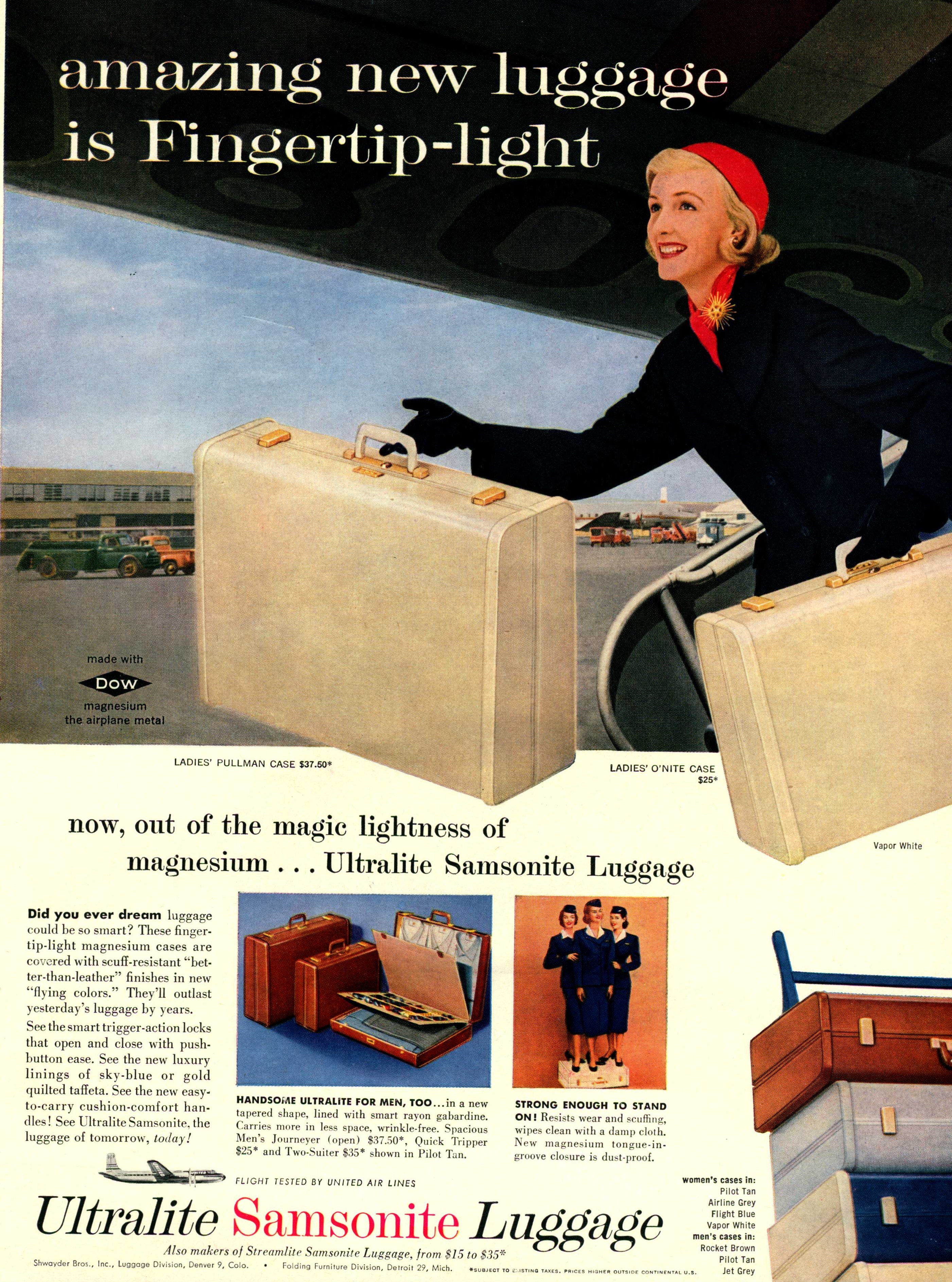
But what you'll notice below is that different than Streamlite, Ultralite suffered from something I've coined as chronic adjustment, in that nearly every season has discontinued several colors and introduced several more, only for the cycle to repeat in the next season. It not only makes it difficult to discern exactly what was being produced when, but also differentiating between a rename of a color and a complete swap, as without examples of all of these on hand it is difficult to conclusively say one way or another.
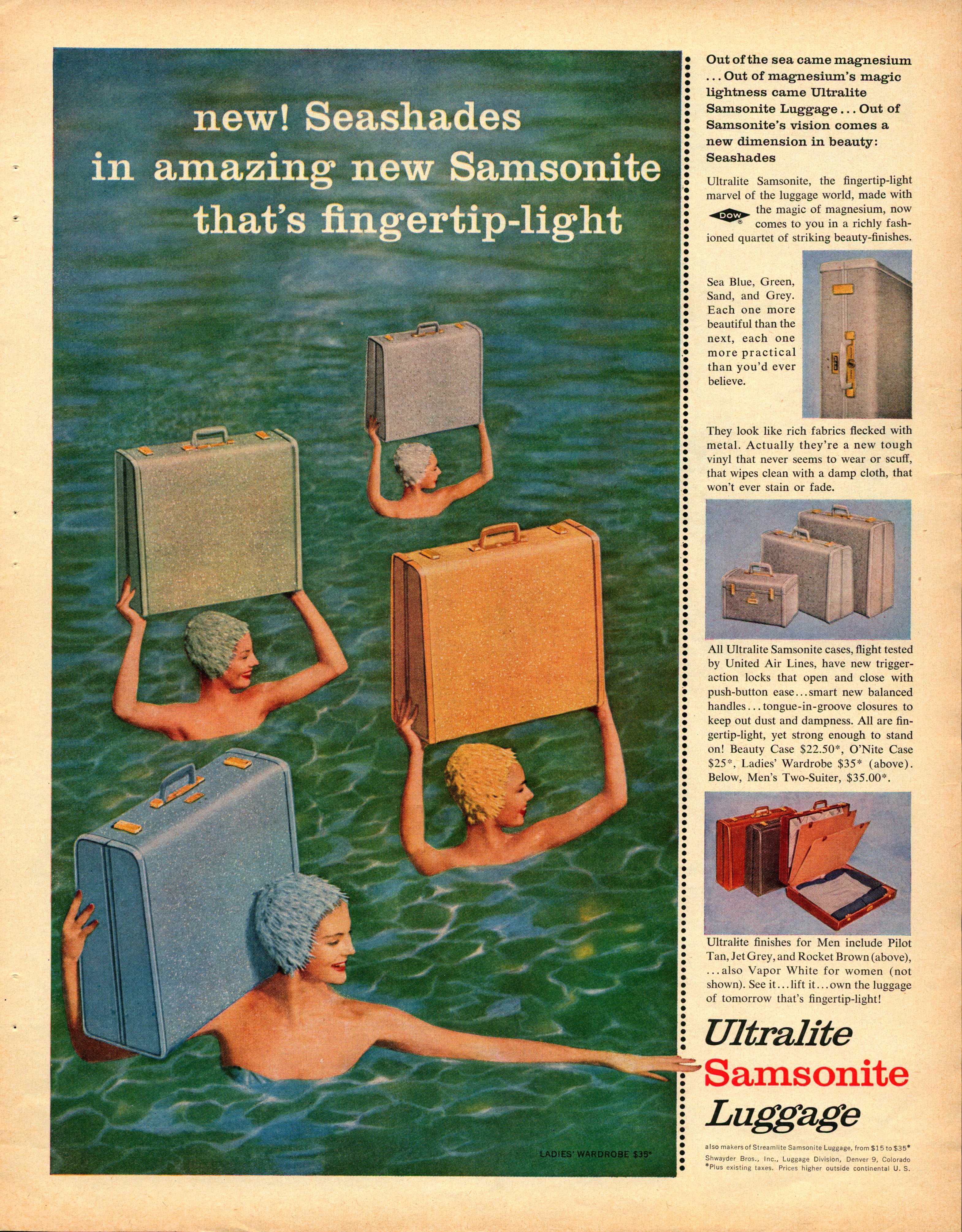
In 1956, Ultralite discontinued some of their original color palette in favor of a unique palette of 'sea-shades', keeping pilot tan, jet grey, rocket brown, and vapor white, but also introducing sea blue, green, sand, and grey. The new colors, at least for the women's colors, used a stylized vinyl to mimic fabric, rather than the original leather-like finish. While Ultralite always kept a line of men's styles in production, marketing in women's magazines primarily focused on many different options and colors for women's styles:
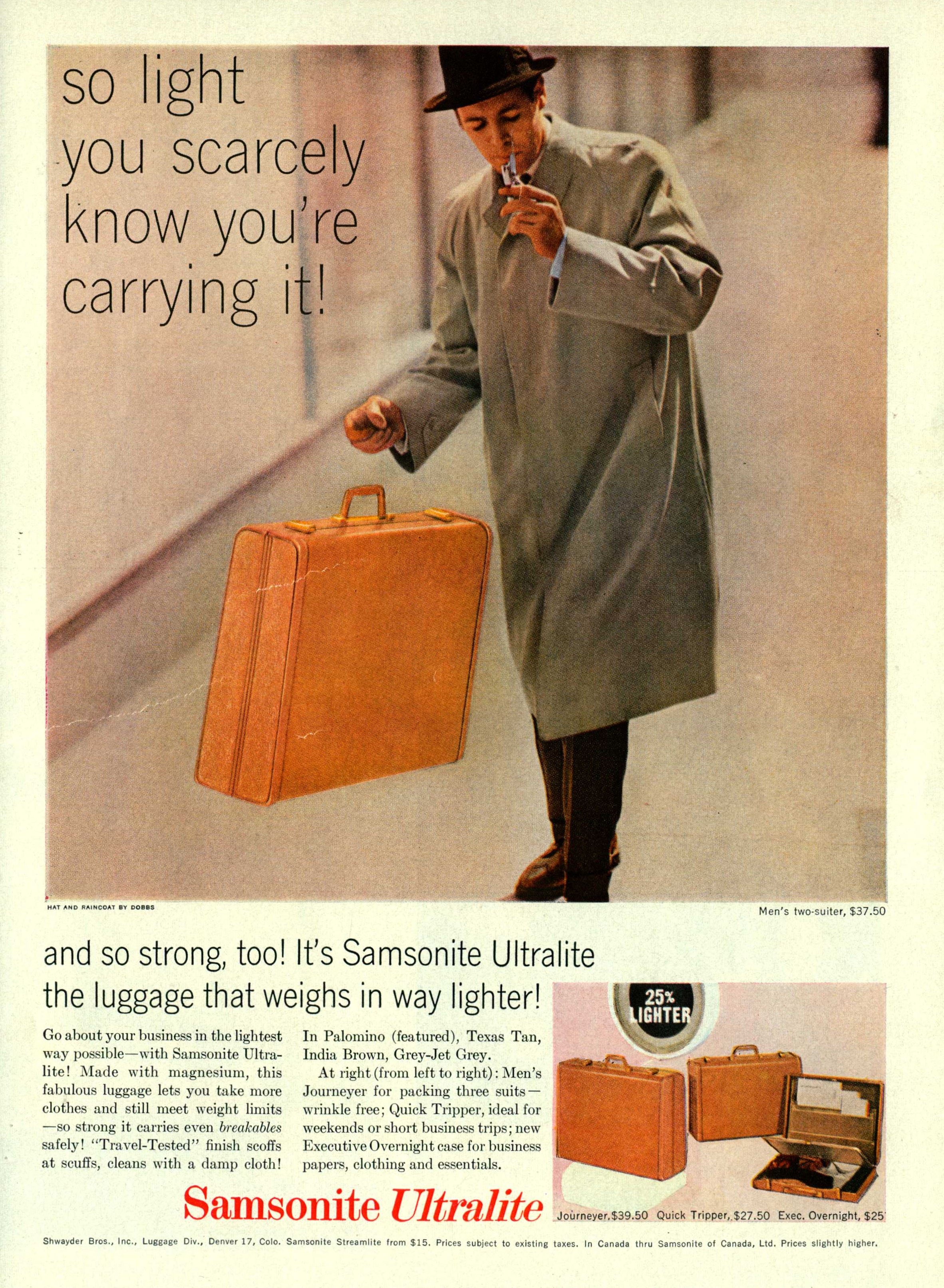
For men's magazines, such as Sport's Illustrated and Newsweek, men's Ultralite styles were advertised with several new colors for 1957 that completely replaced the original styles. They are palomino (featured below), texas tan, india brown, and grey-jet grey. The last example is notable in that 1957 was the first appearance of cases with more than one color on the sides, titled 'medallion luggage' from its unique medallion between the two colors.
Also in 1957, women's styles were updated yet again, with the removal of several sea-shades and the introduction of a women's medallion luggage case with sea blue and white.
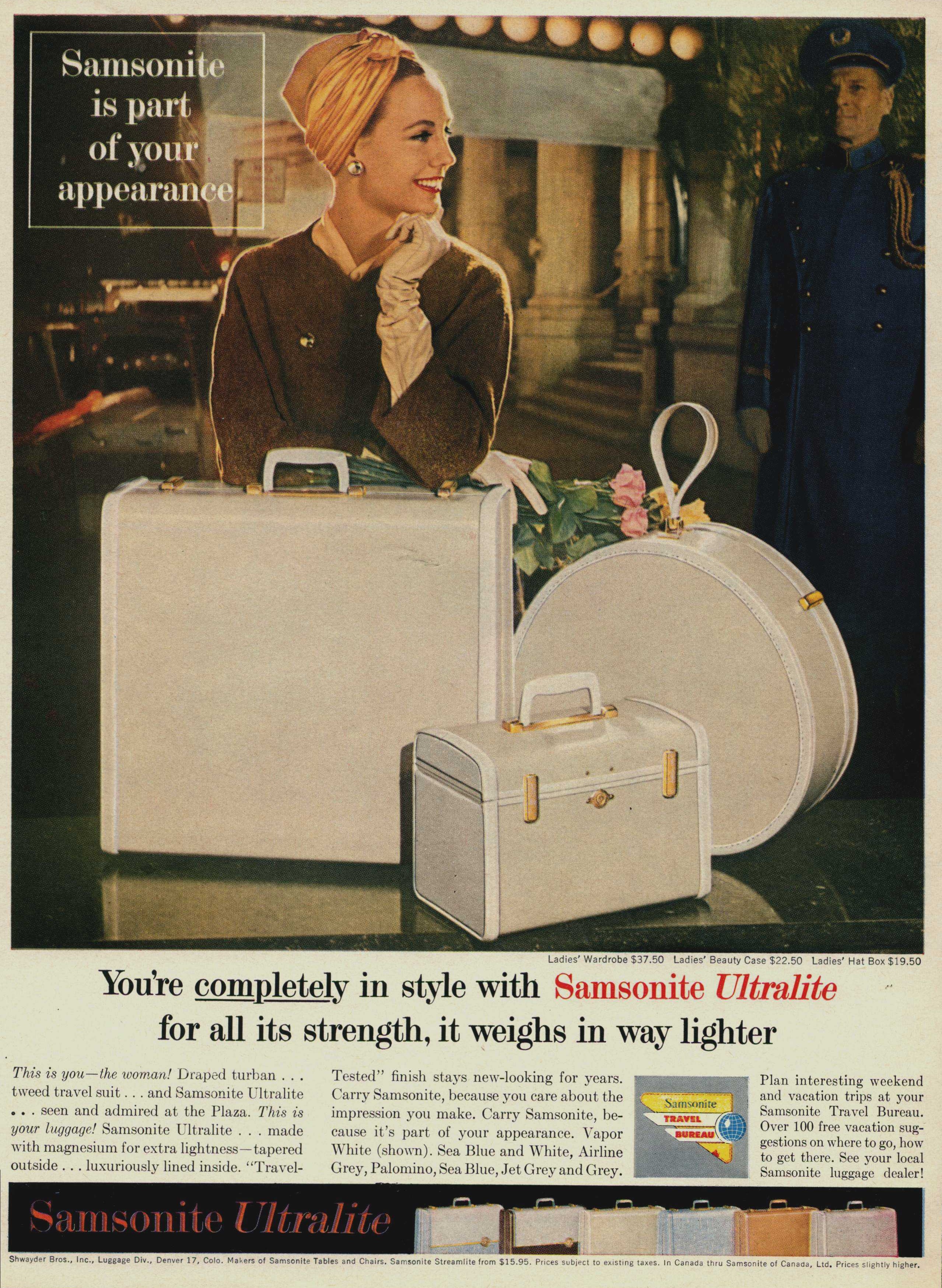
1958 was the last year Streamlite was nationally advertised, and the medallion luggage styles were discontinued. By January of 1959, Ultralite was no longer in production and began to be sold as discontinued at retailers. The end date of production could've been in 1958, but the 1959 date used in the article's title is to account for any holdover production that may or may not have occurred.
In 1958, Silhouette by Samsonite released. It was a completely different shape/design from Ultralite, but interestingly both were constructed with magnesium. Similarly, Silhouette was also heavily marketed as "jet-age" luggage, suggesting that Silhouette was a redesigned Ultralite, moving away from Streamlite's design.
This observation is also supported by an anecdote from Jesse Shwayder and The Golden Rule published in 1960, in which it is remarked that Shwayder Bros. wanted a case similar to Ultralite but with a more modern design.