

Known Box/Packing Variants
There are at least two versions of the box.
A 1961-62 box without patents/registered trademark symbols. There will be two versions, one with "Printed in USA" and another with "Printed in Canada":
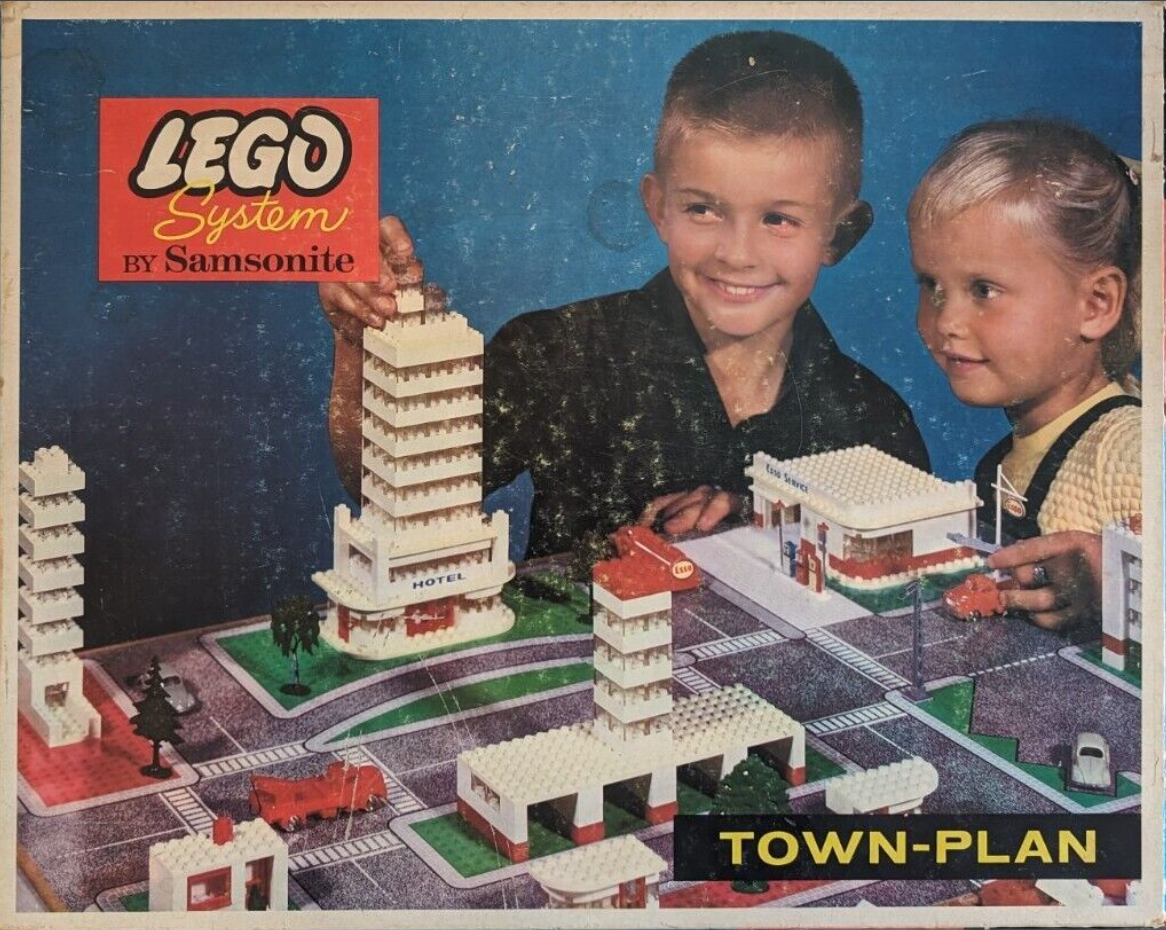
Sometime in 1962-63,the US version was updated with patents/registered trademark symbols;
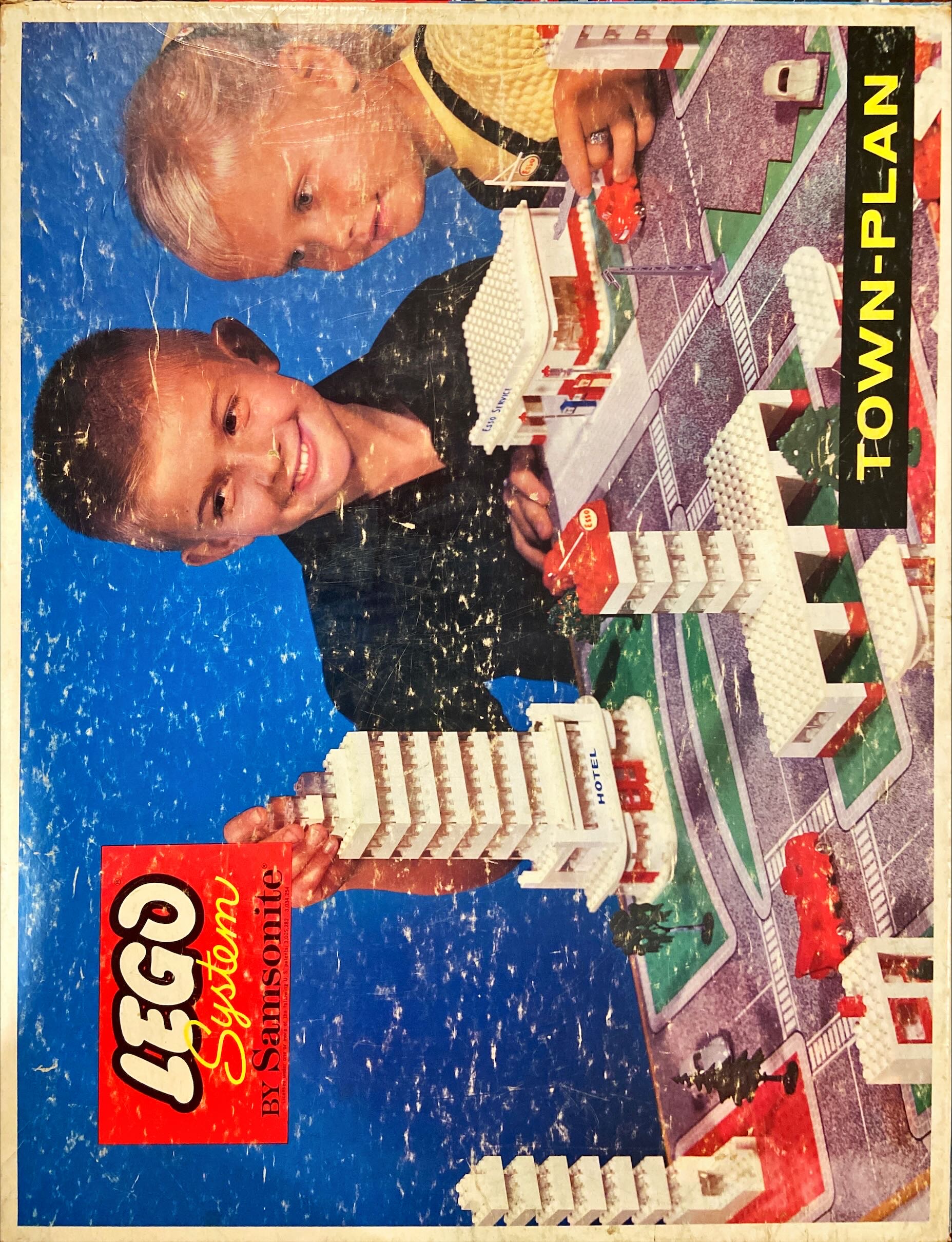
There are also at least two packing variations of this set, detailed in the Contents section.
Box/Overview
The 725 Town Plan was the flagship of Samsonite's 1961 release of LEGO. Not only was it by far the largest set of the wave, but it contained exclusive elements that its contemporary basic sets did not provide. For example, until 1964, it was the only source of LEGO's 1:87 Cars in North America. Along with that, while specialty elements such as the Esso accessories were sold as supplements, the classic trio of Esso vehicles were only ever available in this set and were never available separately (again, specifically regarding North America).
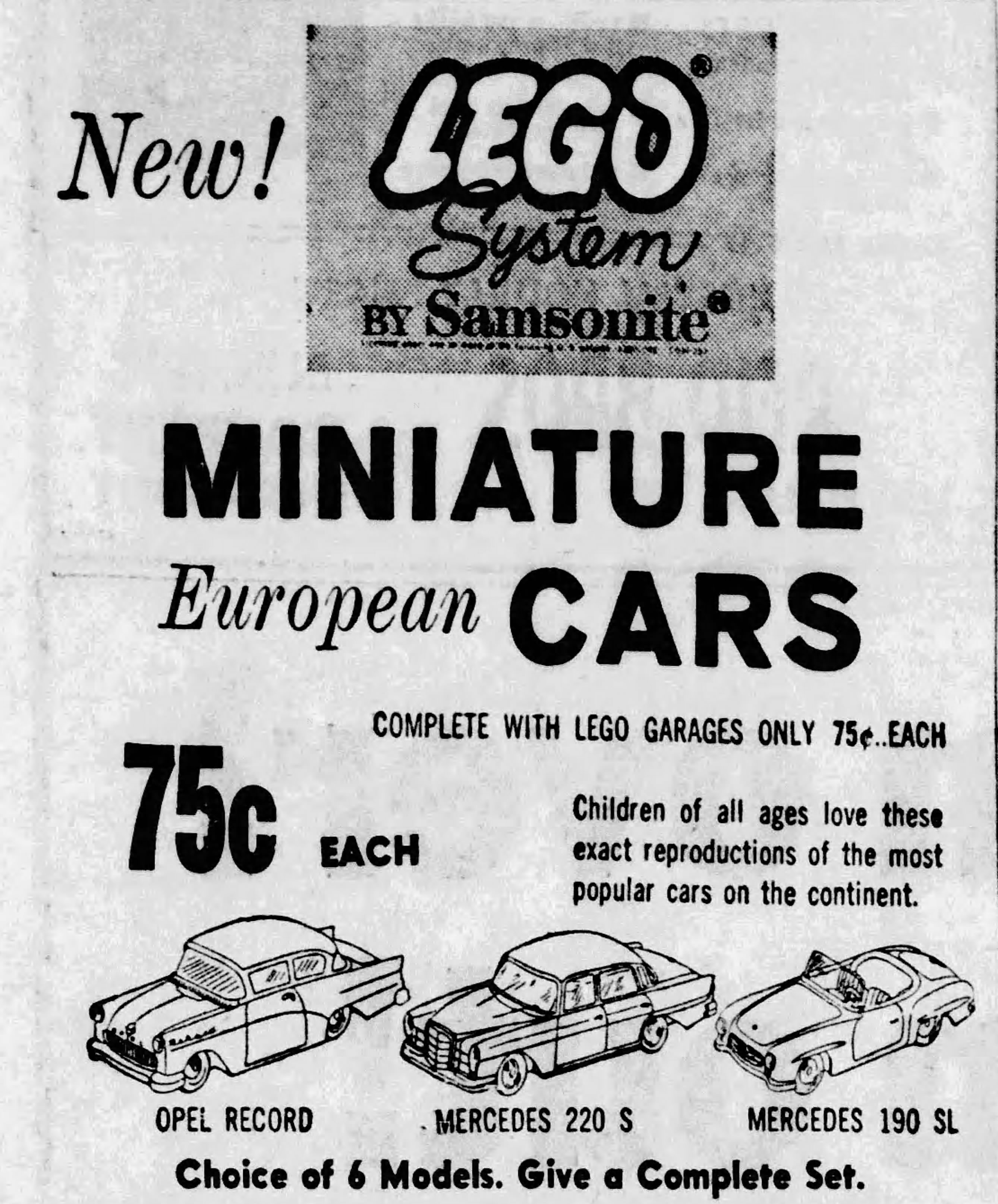
Sure it doesn't exactly stand up to the European 810 Town Plan's plethora of 1:87 accessories, but the 725 is such an interesting set.
As mentioned above, earlier copies will be missing the patent information and the registered trademark symbols. My copy is a later version and has suffered water damage, but I still quite love it for all its quirks:
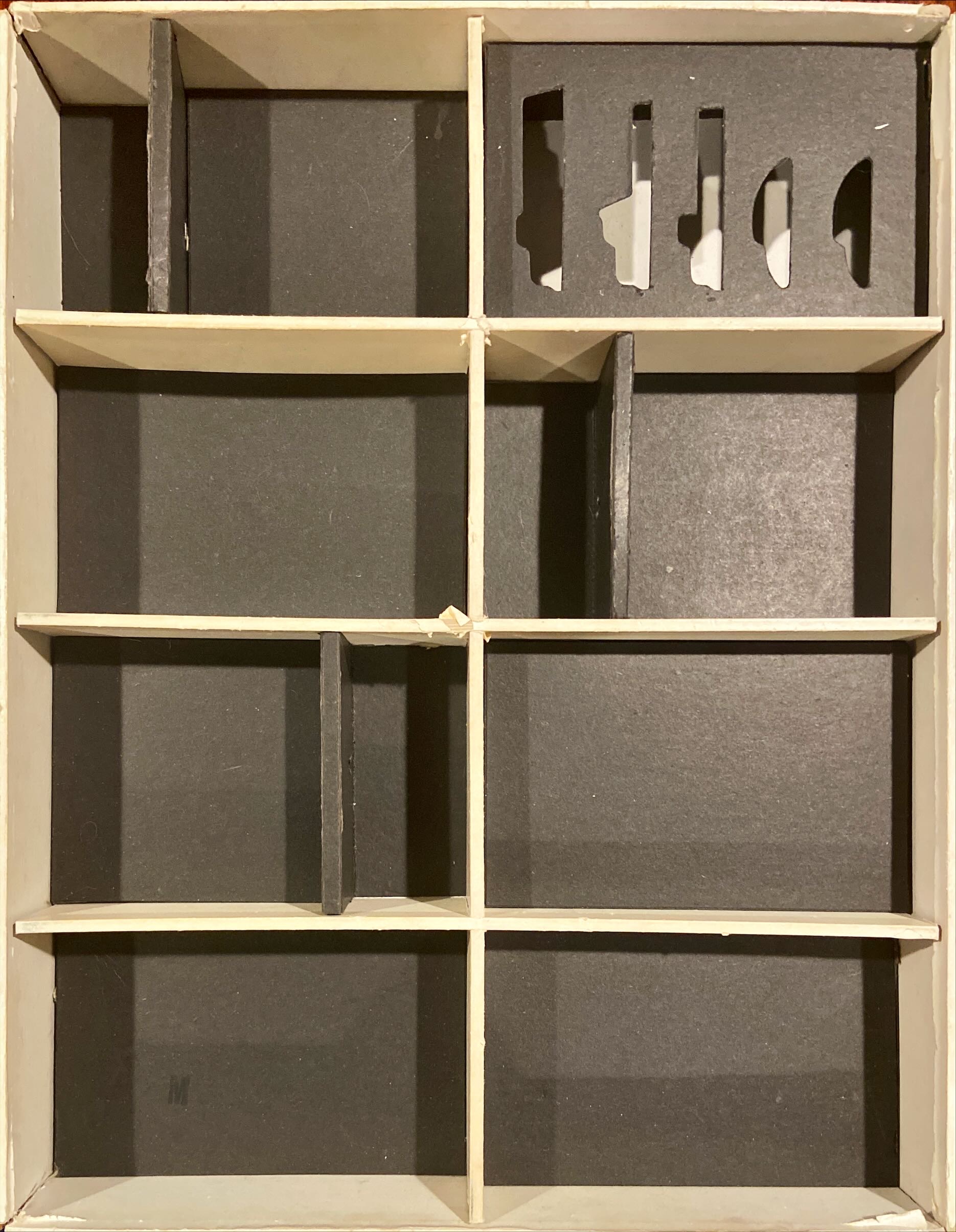
Opening the box (and removing the town plan board) leads to a striking view of its contents. We'll cover them closer later, just note that my box doesn't necessarily contain what would've originally came with the set:
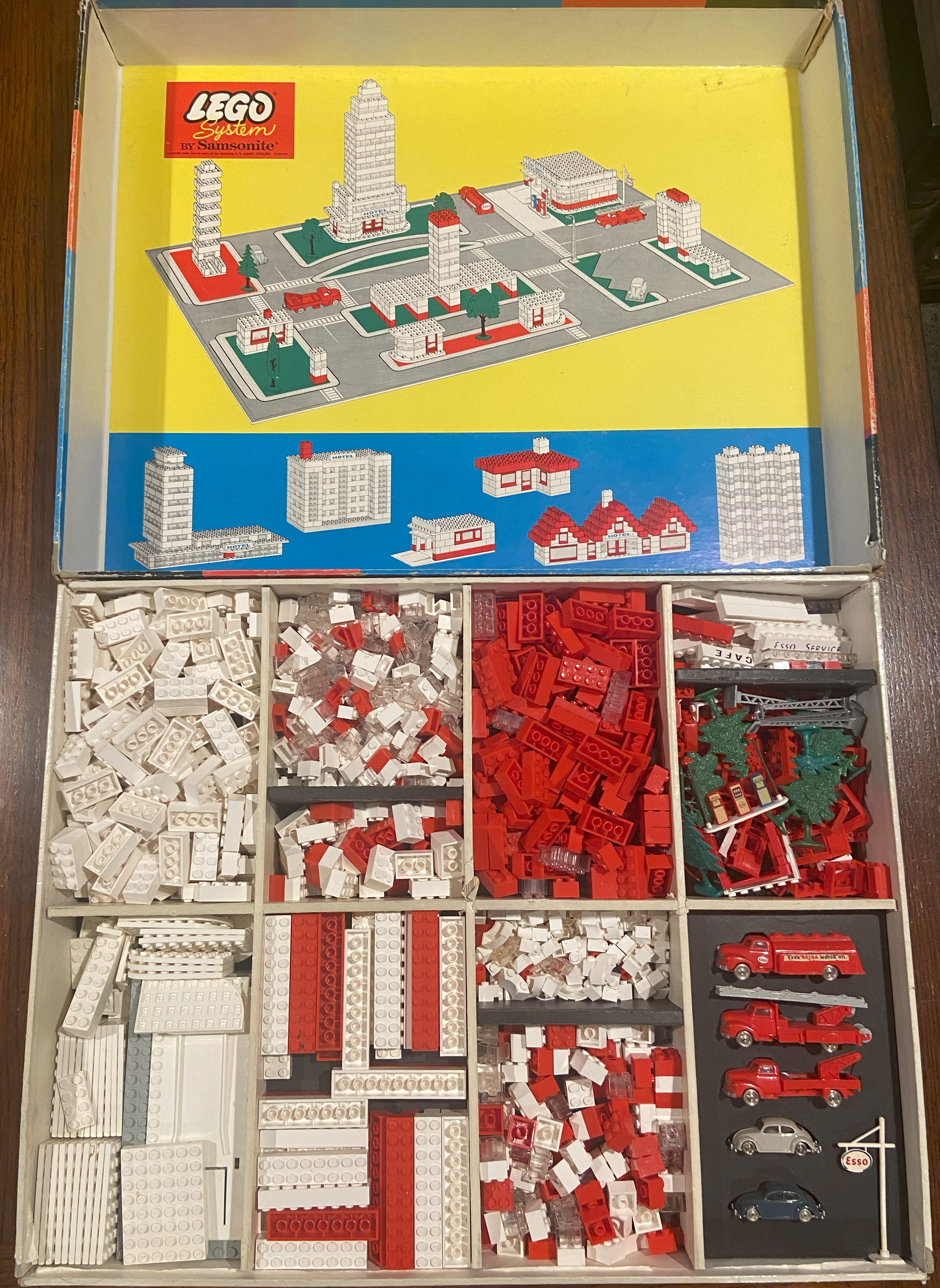
The inserts are the same thin, rigid paper in used in the 705, 708, and 711 Basic Sets and some of these same inserts are reused in the 717 Junior Constructor. Only the very tall insert is exclusive to the 725 Town Plan, one used for the 1:87 vehicles (as in my copy) and the other to hold the trees and gas pumps (or traffic signs/street lamp depending on what was available when you purchased your set). The gas pumps insert on my copy has never been punched, which indicates the pumps were not included and the trees were packaged loose in my box:
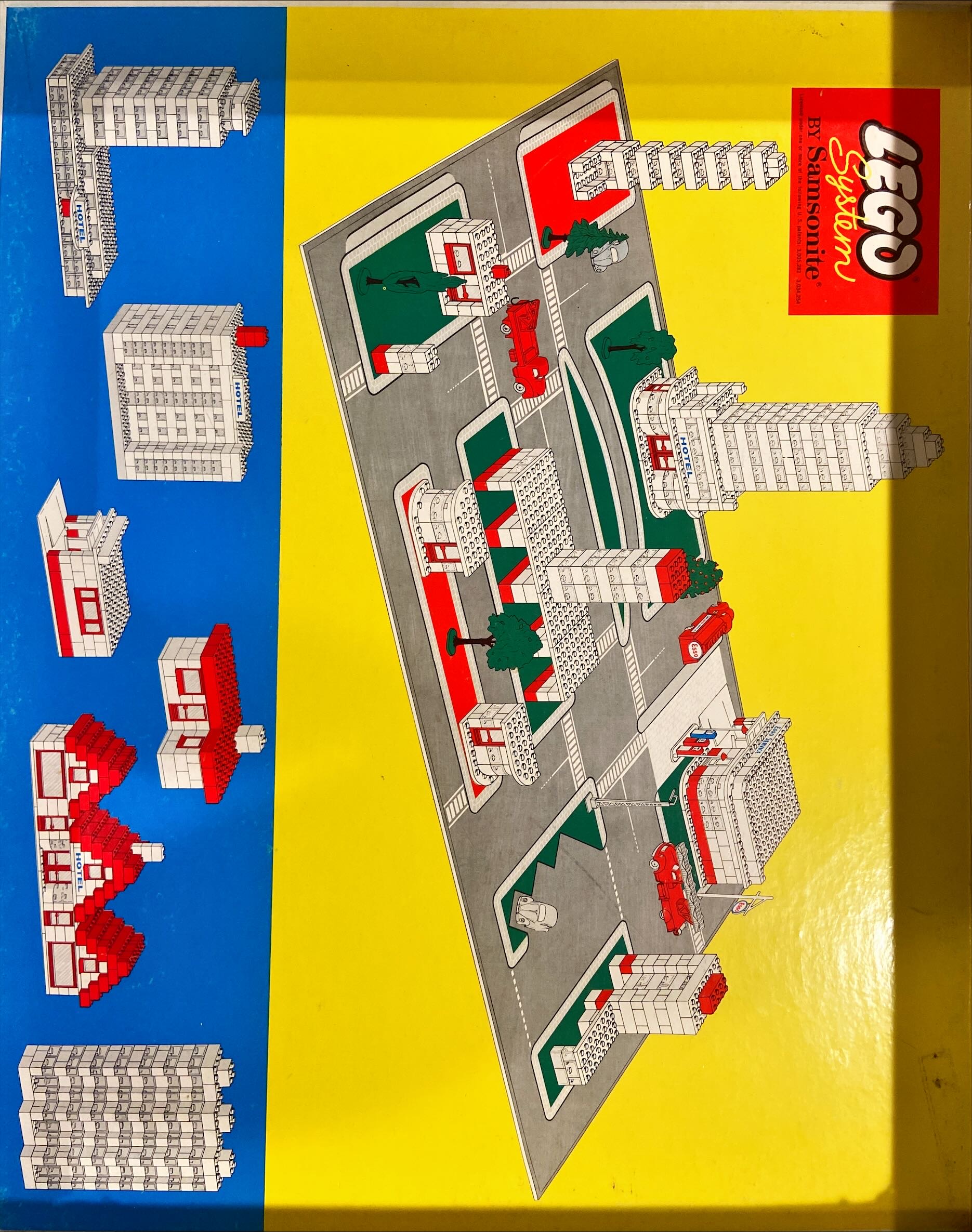
The inside of the box contains the same isometric view seen in newspapers and on the back of the town plan board. It's about the closest thing to instructions included, but we'll talk about that later on. About the only real thing of note here is that the garage door is shown as white on all images of this set, but I've only ever seen North American examples with a red door. It's not likely any came with a white door as pictured:
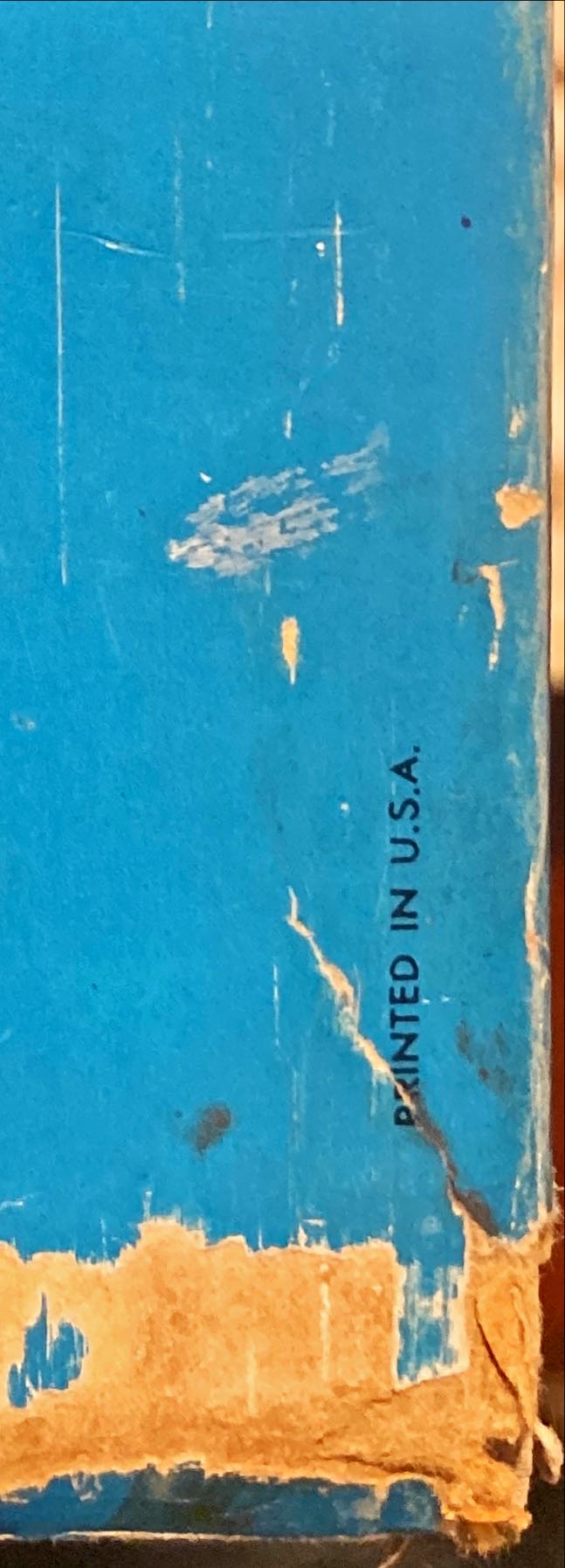
I'll also show the side of the box—it's exactly the same as the 717 Junior Constructor:

After I noticed it on the side of my 708 Basic Set box, I've been checking all my 1961 boxes. My 725 Town Plan has the "Printed in USA" on the side, as we would expect:
Contents
The above wild variations in advertised piece count make any attempt to inventory this set very difficult. Because the specialty pieces(lamposts, gas pumps, 1:87 vehicles, painted trees, etc.) were being imported from Europe and some sets were packed missing some of these elements, along with the +/-30 parts with the advertised counts, it'd be extremely difficult to apply any sort of consistency in that regard. I do, however, strongly believe that the basic elements in the 725 are in fact systematic and could be inventoried, you can read more about that here: Was There a System to Determine a LEGO Set's Inventory? (1961-64).
Regardless, an easy example of the packing variations is that some 725's have been found to contain street signs. It's unknown when they began to be excluded as examples with them are somewhat rare, but I found an image of an open box 725 from late 1962 that clearly shows traffic signs. It may have just been a thing wherein throughout the production runs, if they had town plan elements to spare, they included them. The set isn't even supposed to have them according to the isometric inner and the box top, which is extremely odd. It is entirely possible that they were a later addition to the set's inventory in response to poor supplemental sales, as road signs were only otherwise available through supplements in North America.
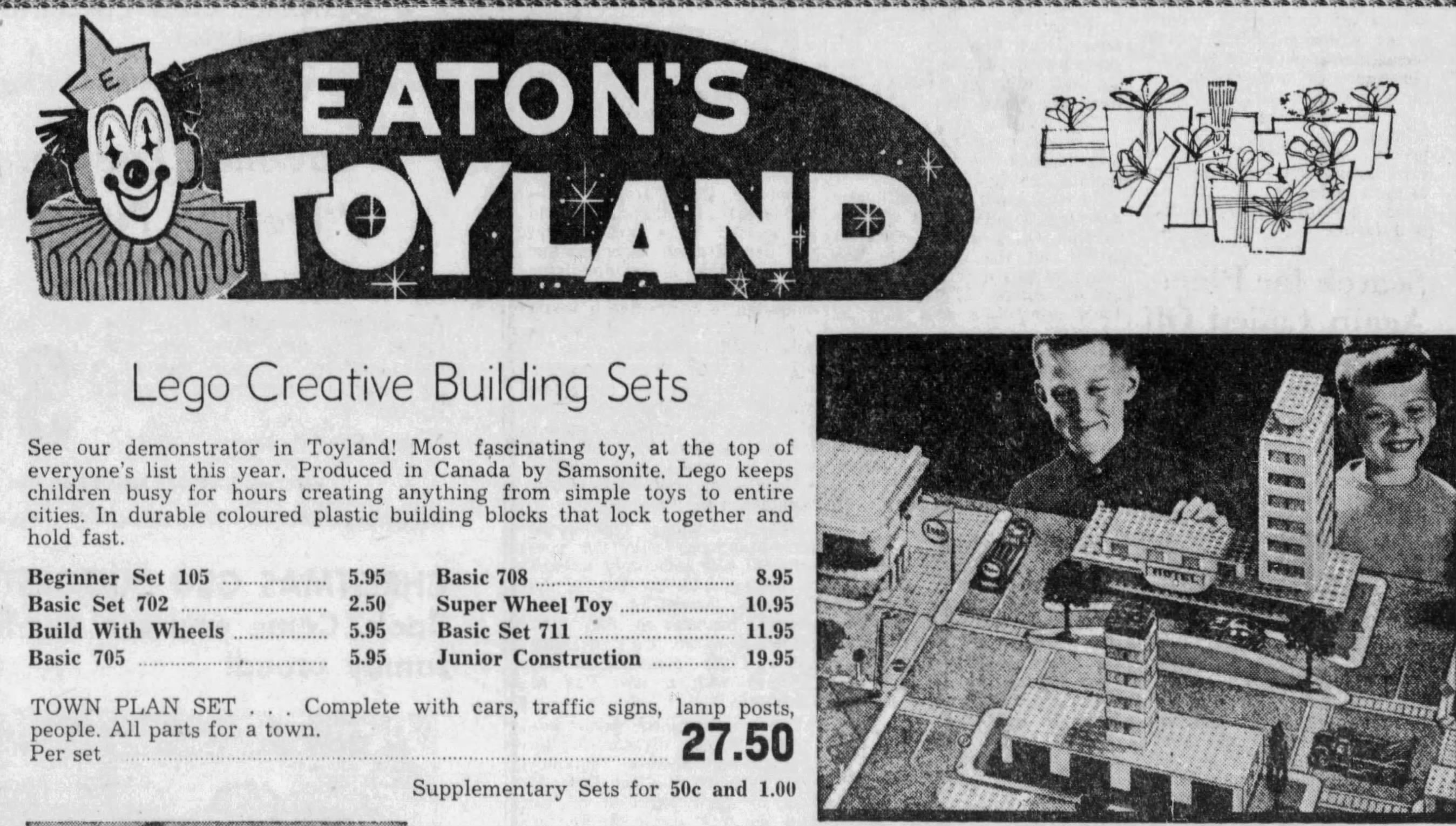
Now, we do have to be careful as sometimes newspaper images being used were not indicative of what was actually on store shelves at the time of publication. This advert from 1964 is a good example. It claims that their 725 contained not only traffic signs but also people. No 725 Town Plan example, whether in historical records or anecdotal accounts, has ever been found to contain people. So it does teach us that we should be careful in taking documents at their word. Newspapers especially.
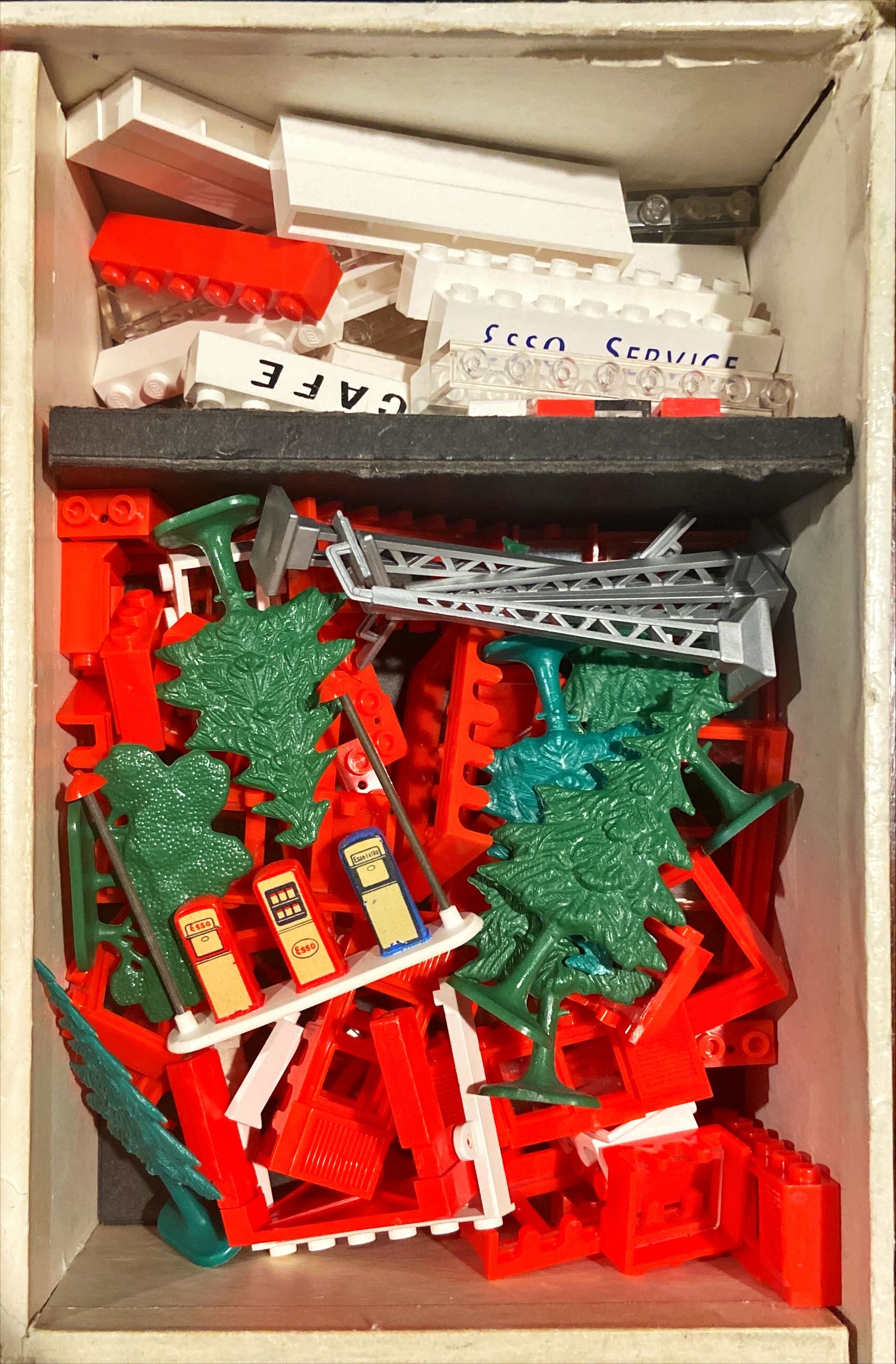
Before we get too far into the weeds, let's take a step back and just look at the contents for my set:
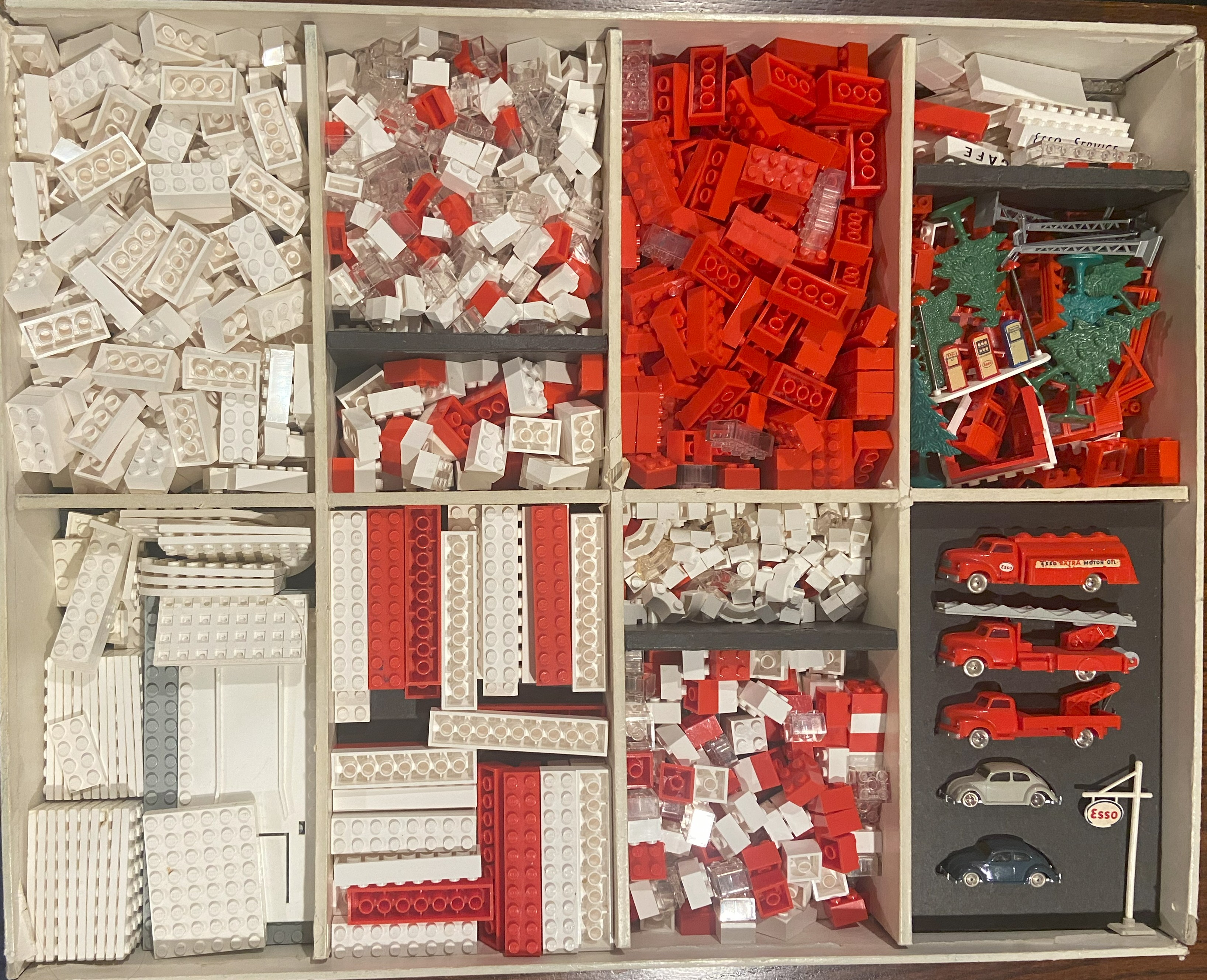
My copy has far too many parts to be original. Instead, as there were several extra pamphlets included, I assume either a basic set or some supplements were added. The hard part is that all its pieces are all very consistent with their logos and are all cellulose acetate, so I'm not sure exactly how to ascertain what did and did not come with my set.
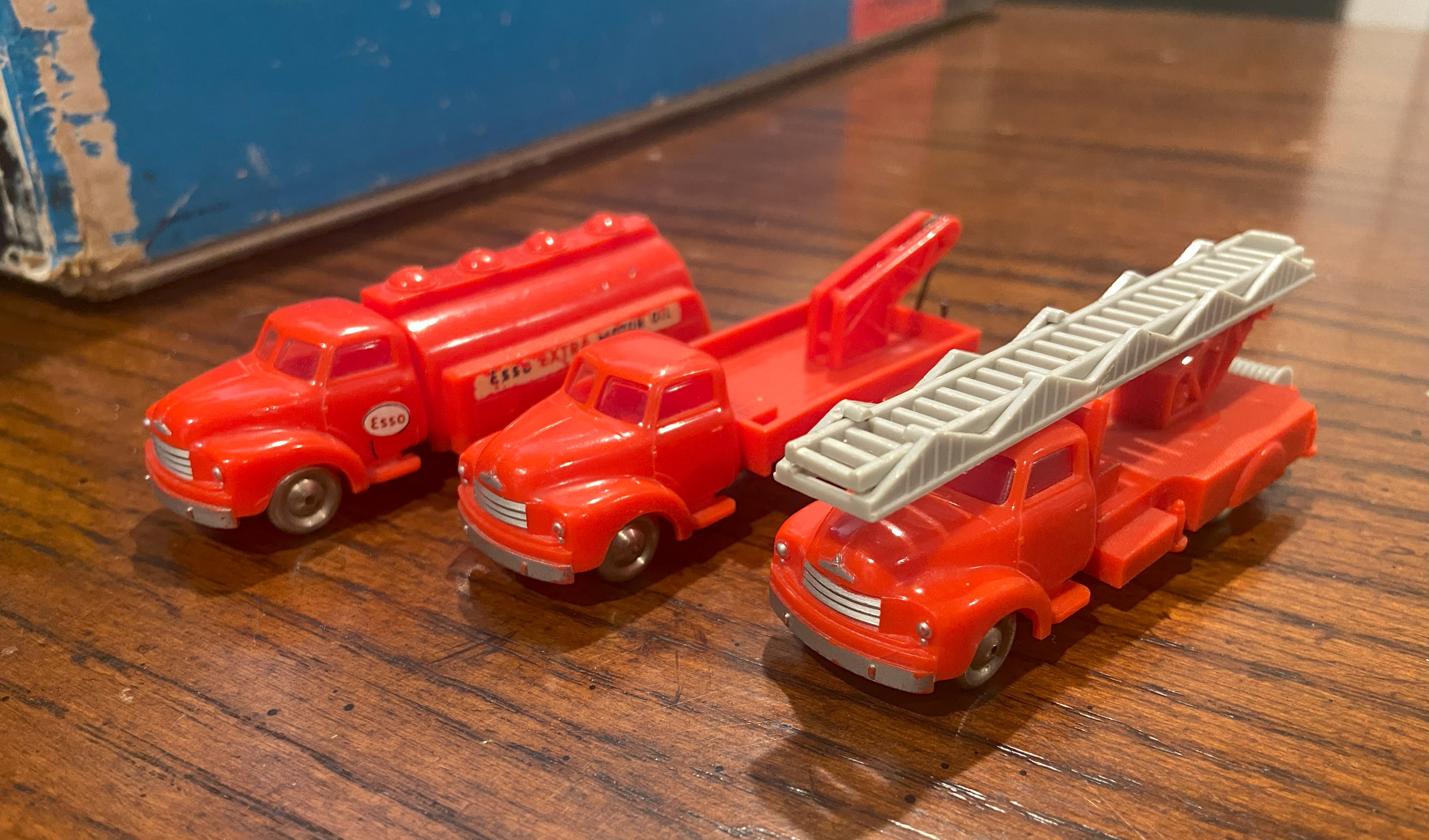
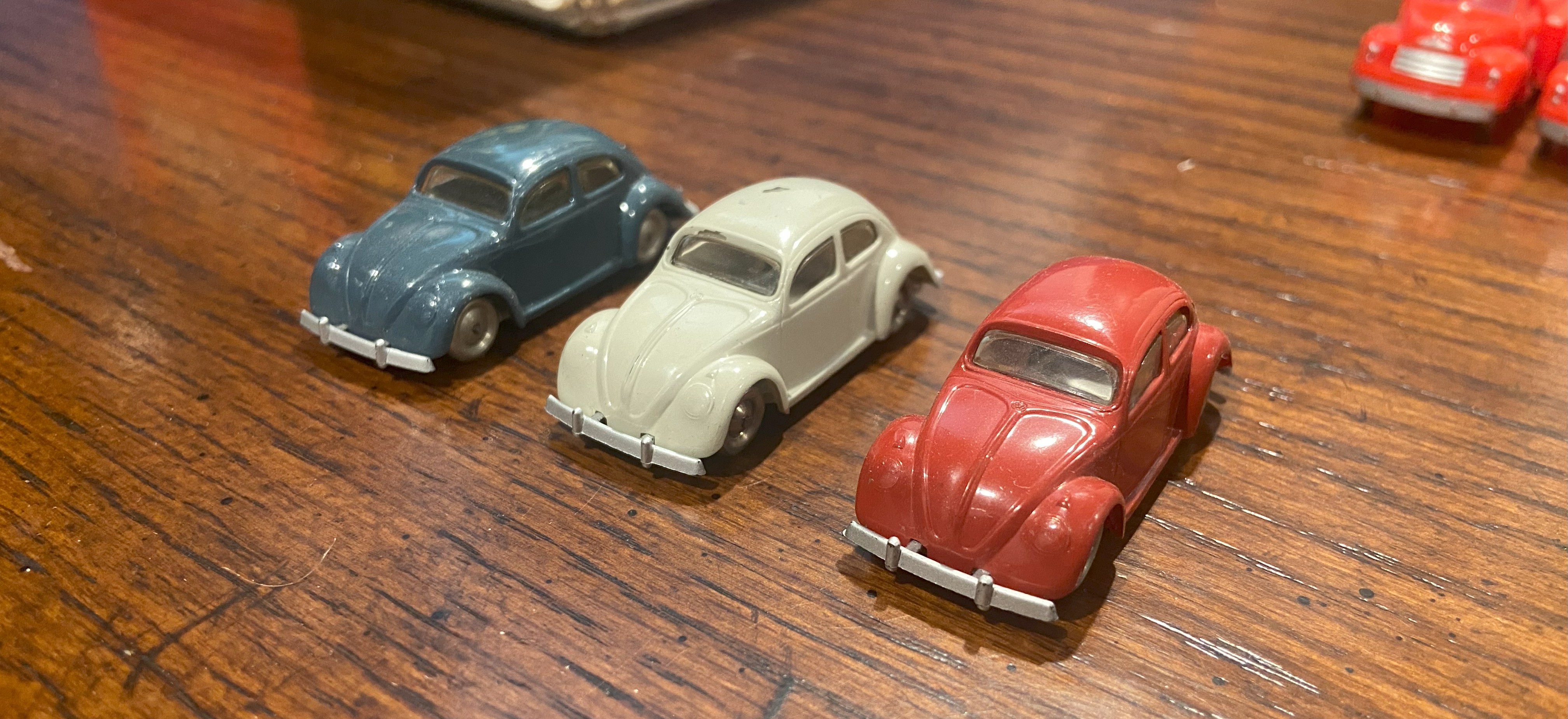
When I originally purchased the set, it only came with the three 1:87 service vehicles, the VW Beetles are my own replacements I sourced. The hose reel for the fire truck was also missing, but I happened upon one in a 605 Wheel Toy I bought and luckily recognized it.
Here's a closer look at the service vehicle trio:
And here's a look at my VWs. These are getting harder and harder to get ahold of, especially ones like these that have unbroken bumpers:
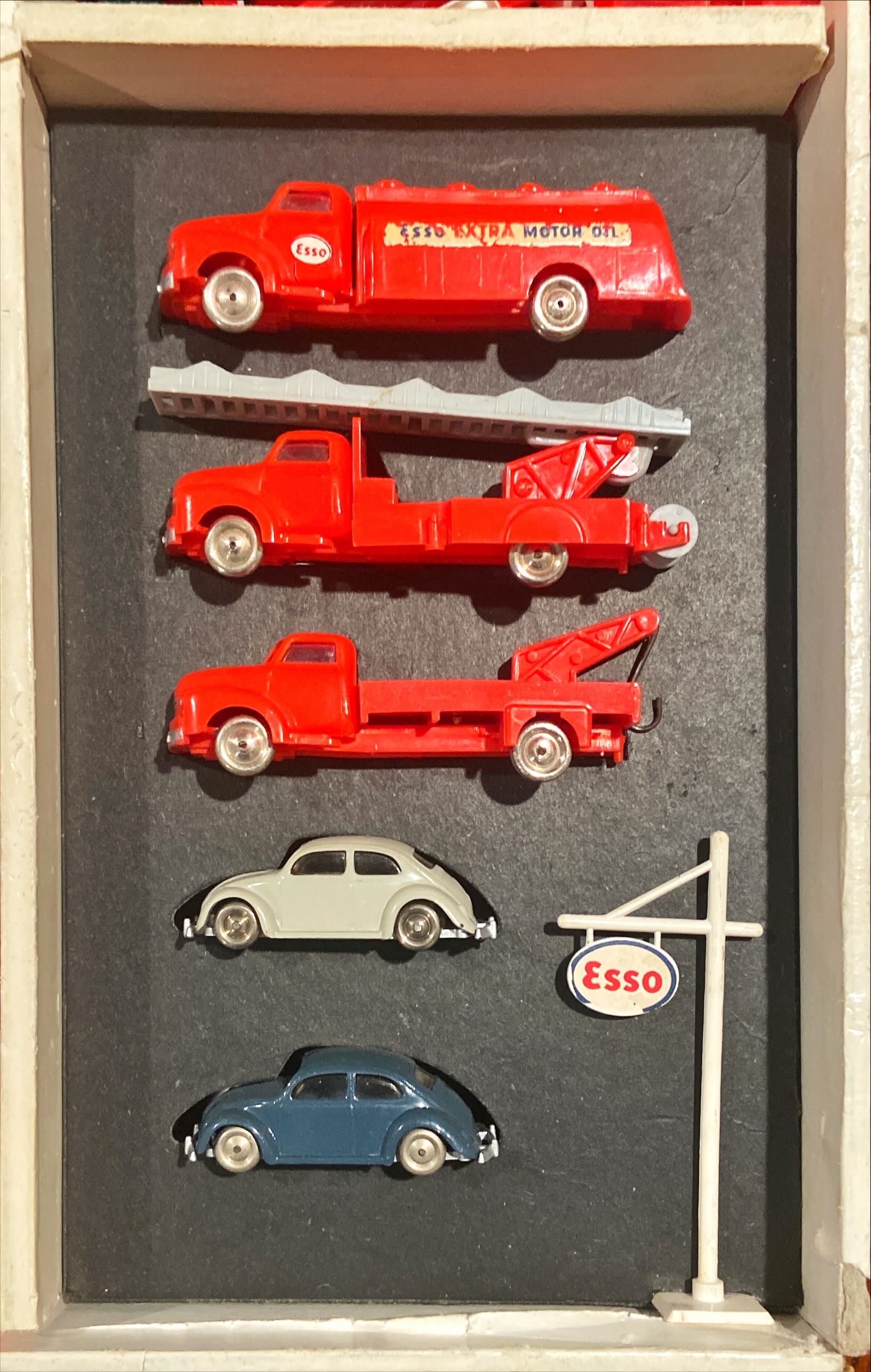
Also kept with the 1:87 vehicles, there is a small hole at the bottom for the Esso signpost to safely go:
While the trees are the ones that came with the set when I purchased it, the lampposts and gas pumps were again added by me. The set would've included only one lamppost, if any at all. The gas pumps shown are a little older than they should be, as they're the only ones I had that weren't broken. I borrowed these from my late 1950s German Town Plan for these pictures:
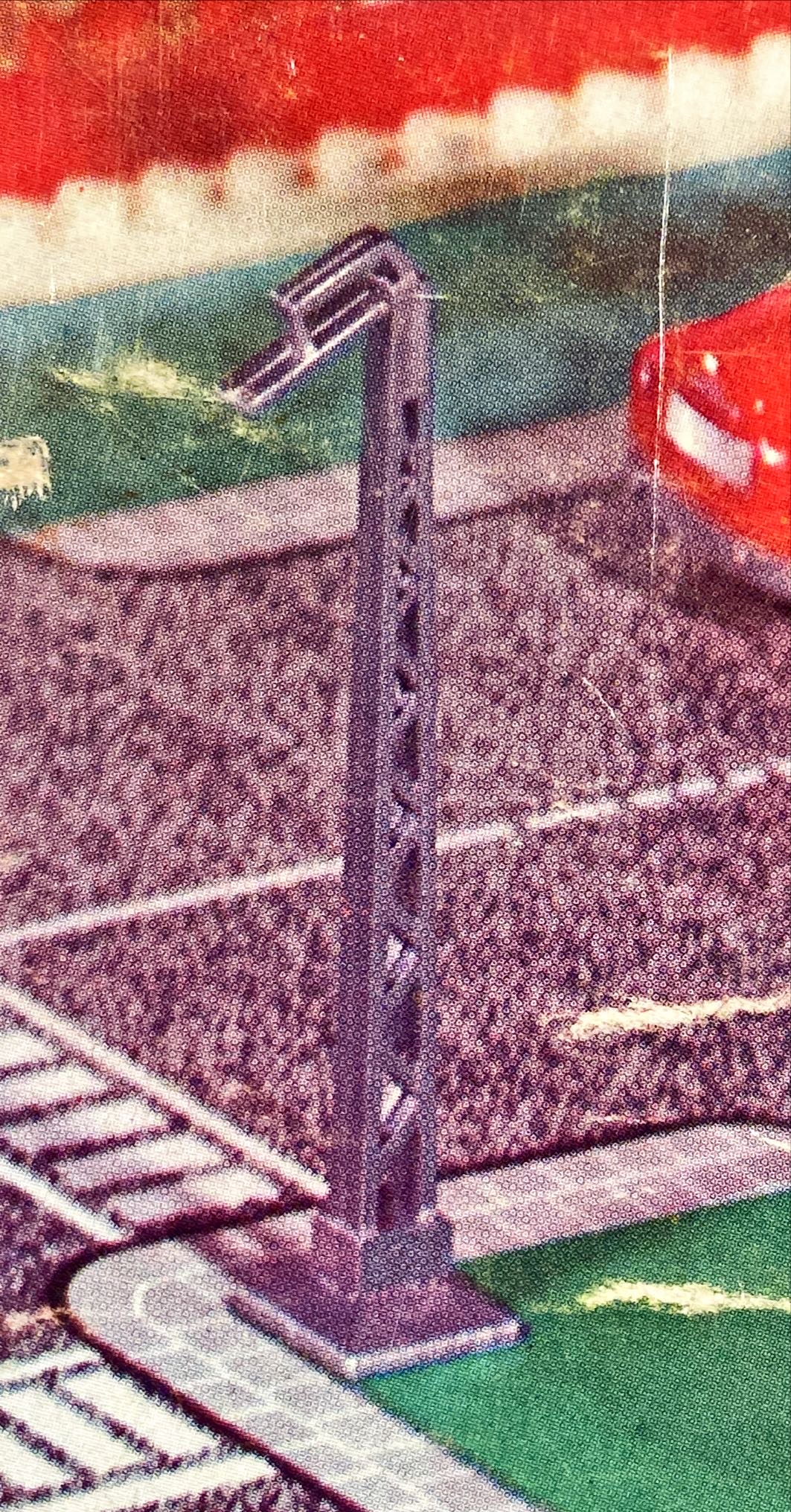
As for the lampposts, I have written up an entire article about them which you can find here. The front of the box features an odd lamppost that is commonly said to be a prototype, but that is not the case and I dissect that in my article. This is the lamppost in question:
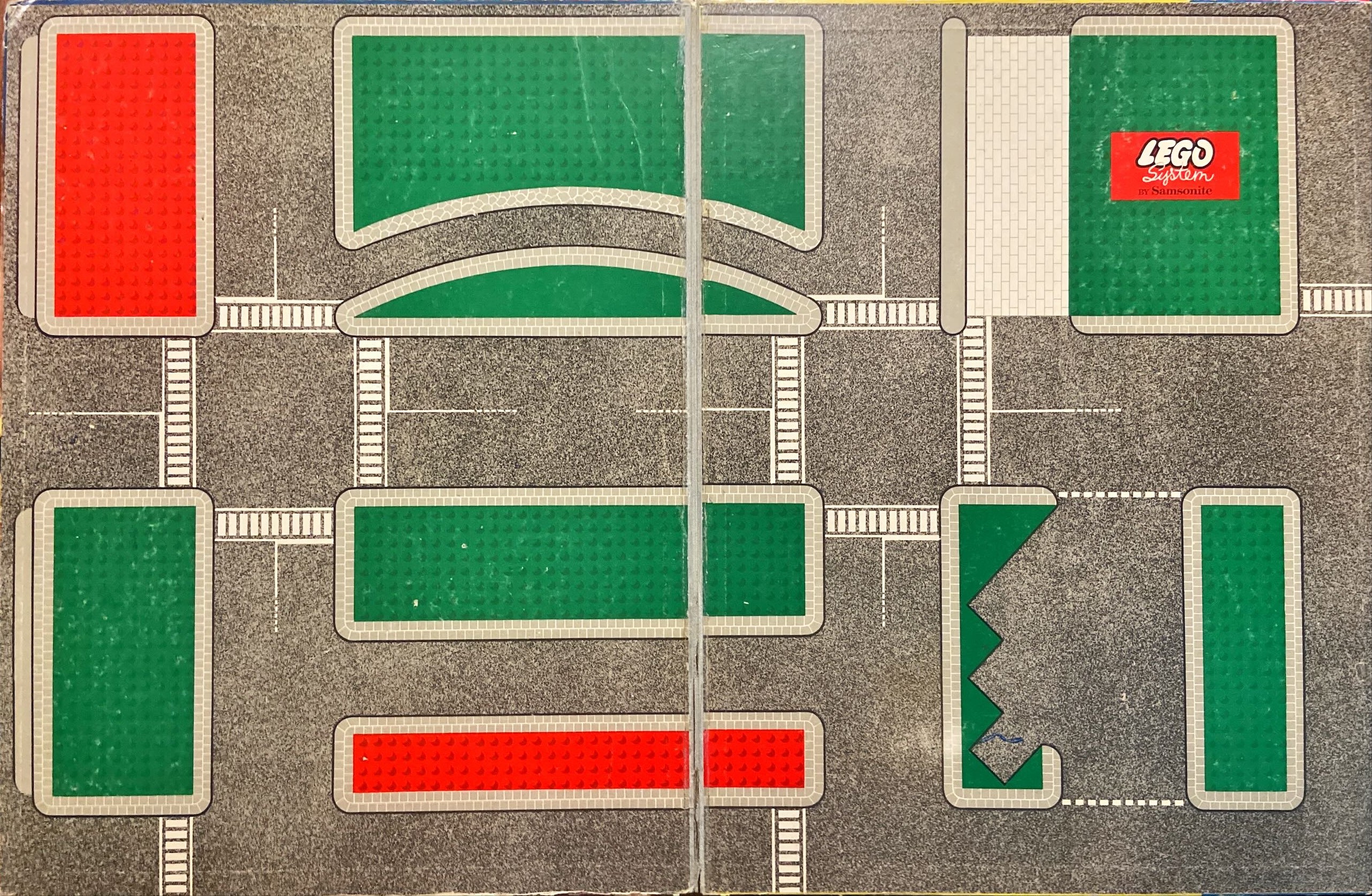
Lastly, I do want to show the town plan board in detail. There are two main variants, though I will go deeper in-depth on a dedicated page. The right one has a cloth hinge and is the original that came with my copy:
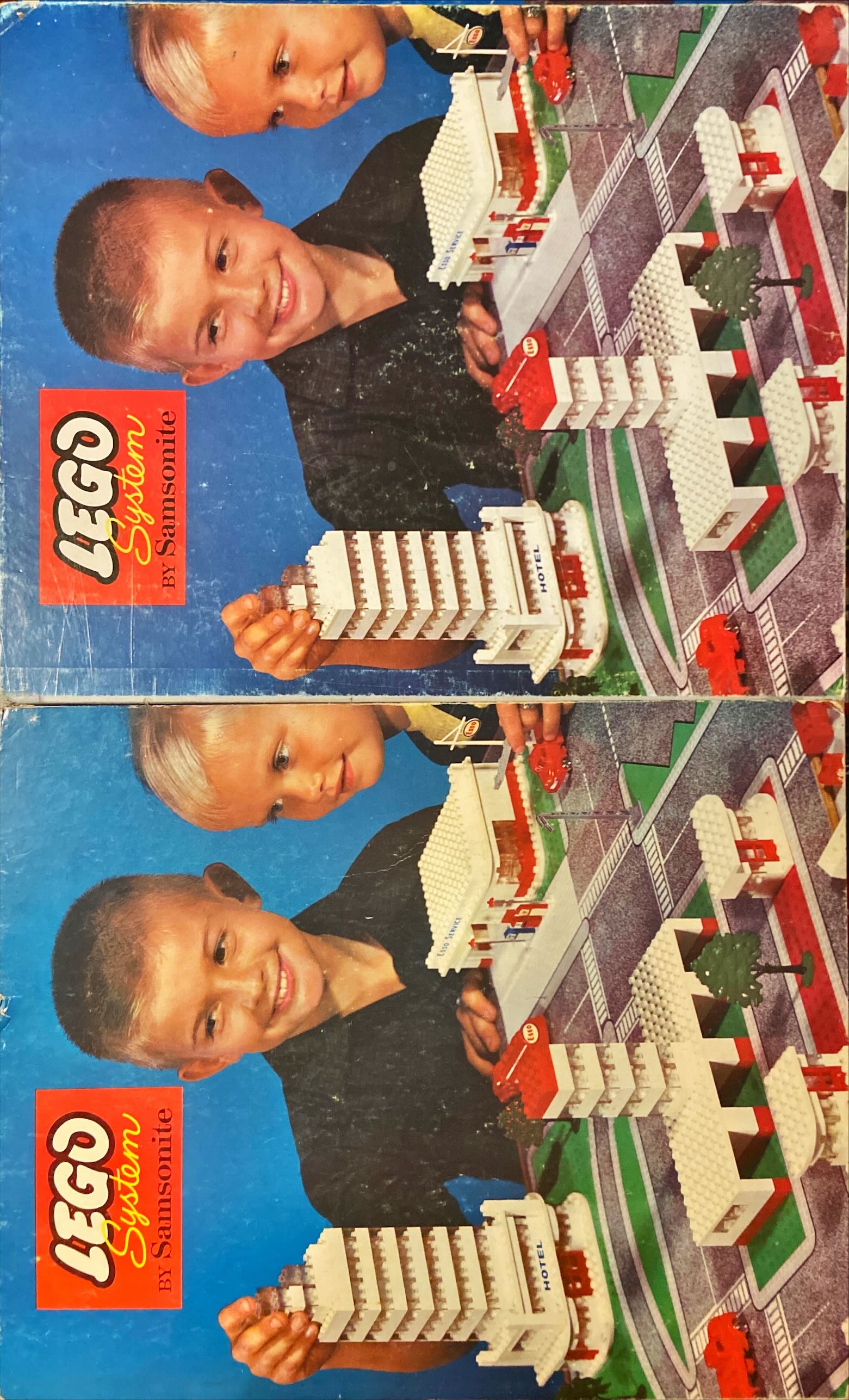
The cloth one is on top of the next image:
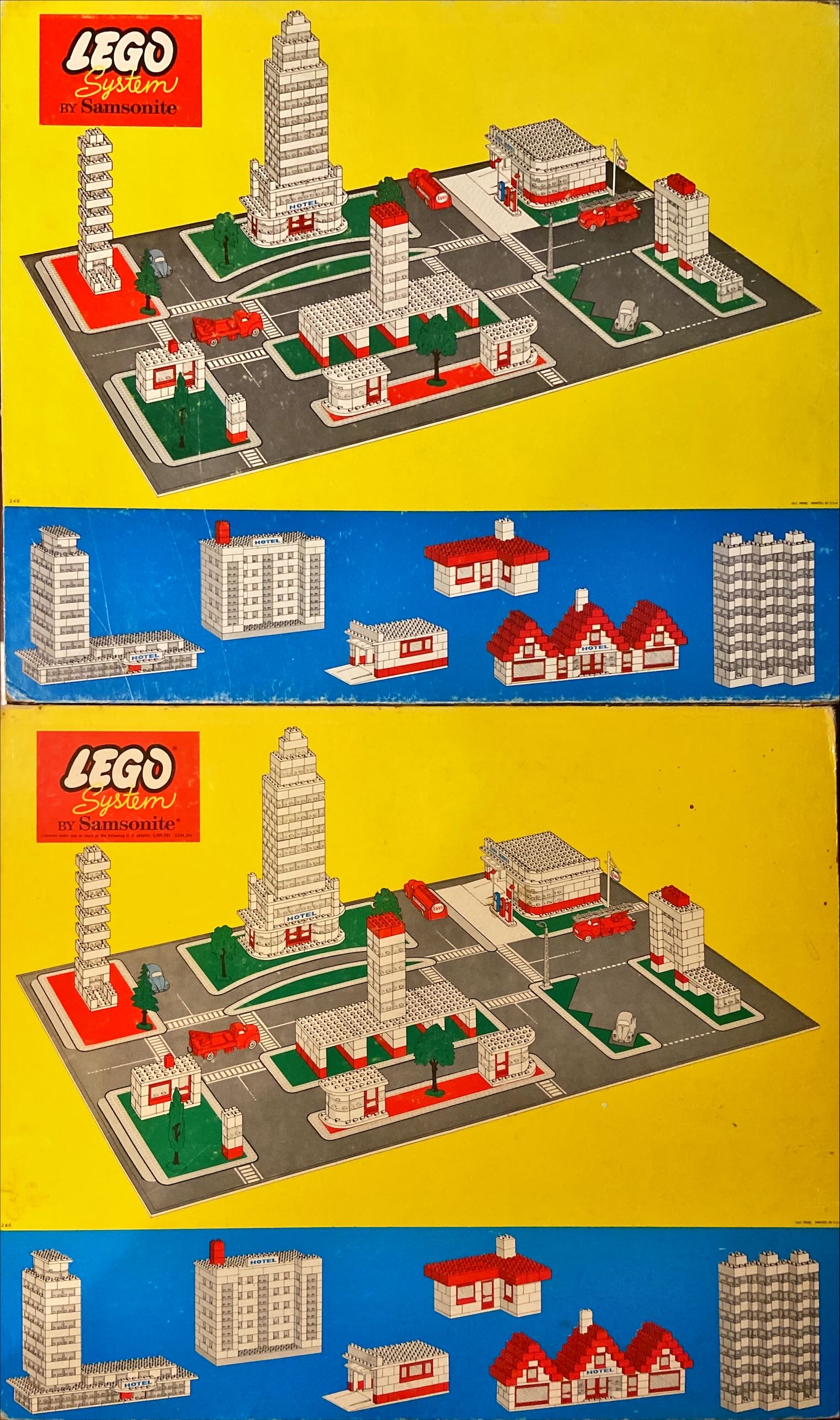
And here is the interior of the cloth one:
I do want to mention also: for some reason my copy came with four 1x1 round bricks in blue. They're the only blue bricks included, and they're nowhere on the box or other suggested models. Why are they here?
I find they are not original inclusions of my copy of the 725, but rather are further evidence of a flat box set being added. Why a flat box set? Well, examples of both the 708 and the 711 both contained 1x1 round blue bricks in quantities of four.
I'd like to identify exactly which set was added at some point in the future, but for now I thought that worthy of note.
Historical Examples
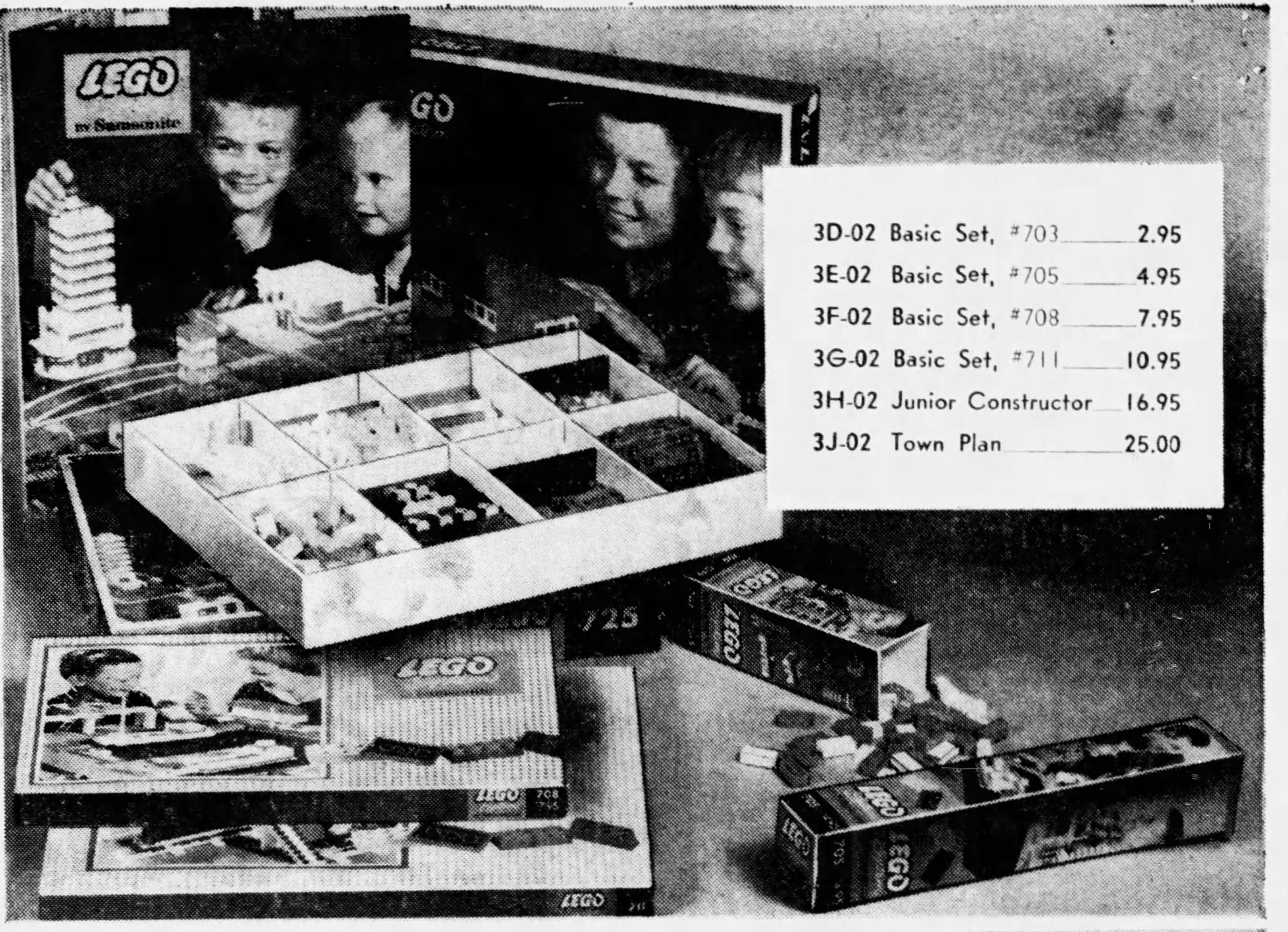
The 725 Town Plan is lucky, as it likely has more historical examples available than any other set in Samsonite's line. Unlucky, however, as usual they raise more questions than answers. This 1962 example with street signs was already linked earlier on this page, but for the record as it is the earliest known picture of an open box:
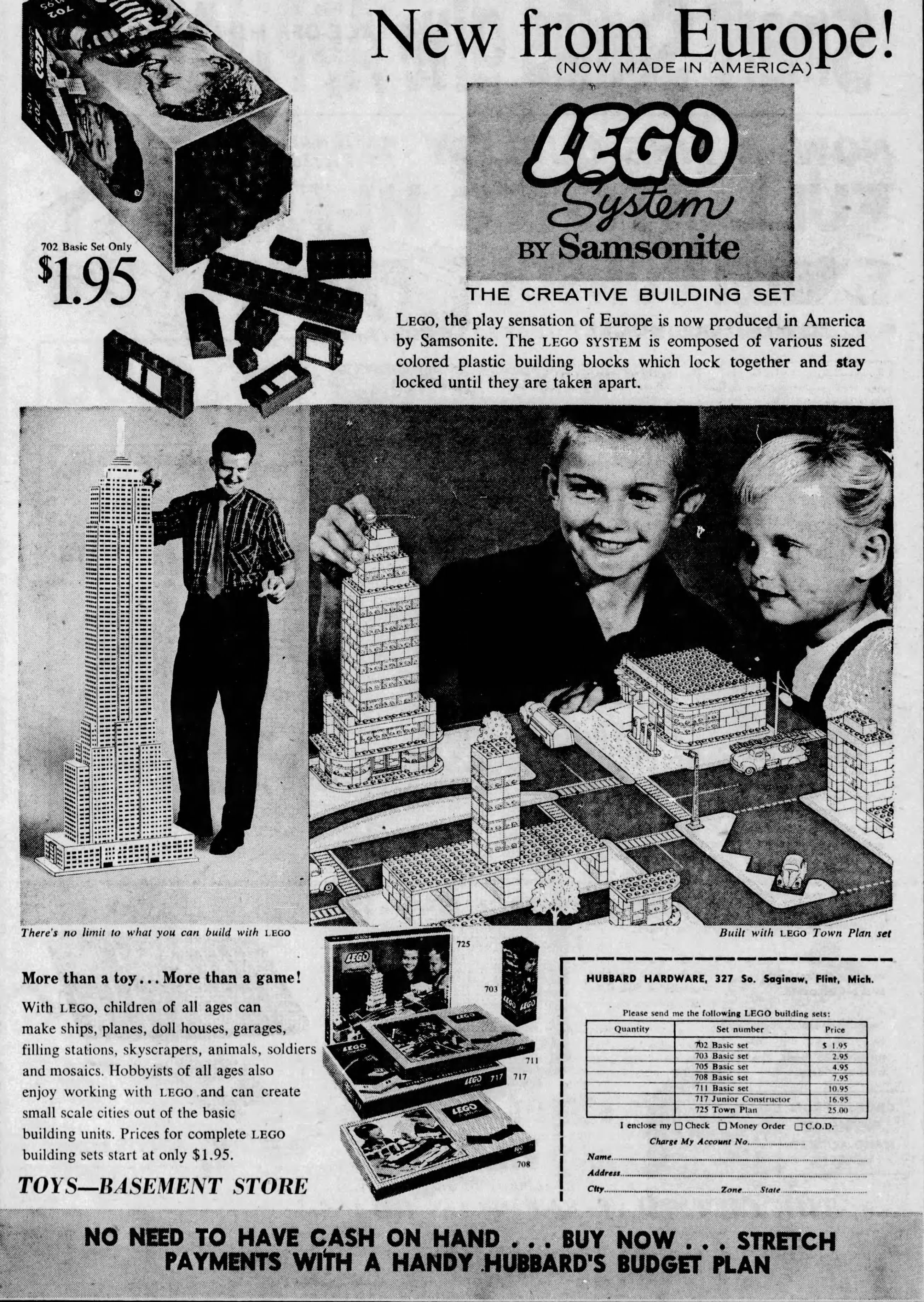
That isn't to say that was the first image of one ever. The town plan featured on several newspapers in November of 1961. Here is one such occurrence:
Also odd, this 1963 Christmas catalog from Wards shows a paper hinge (newer) Town Plan still with imported painted trees. Those are popularly cited to have been replaced with their unpainted variety by 1963:
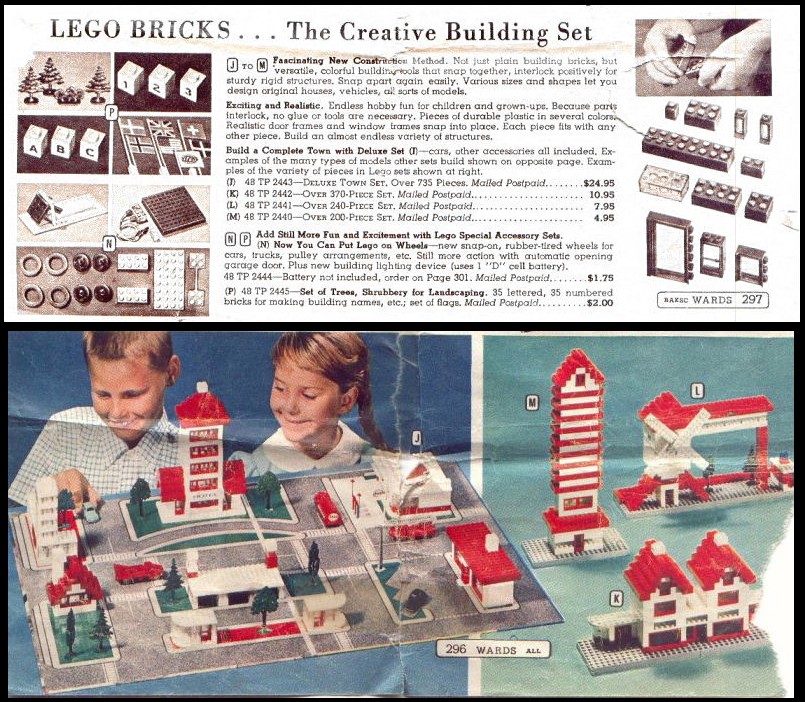
Also still appearing are traffic signs, which makes me think traffic signs had a longer stay than I originally thought. If according to anecdotal memory, they were not included in sets after 1962, why would this late 1963 drawing of an open box 725 include them?
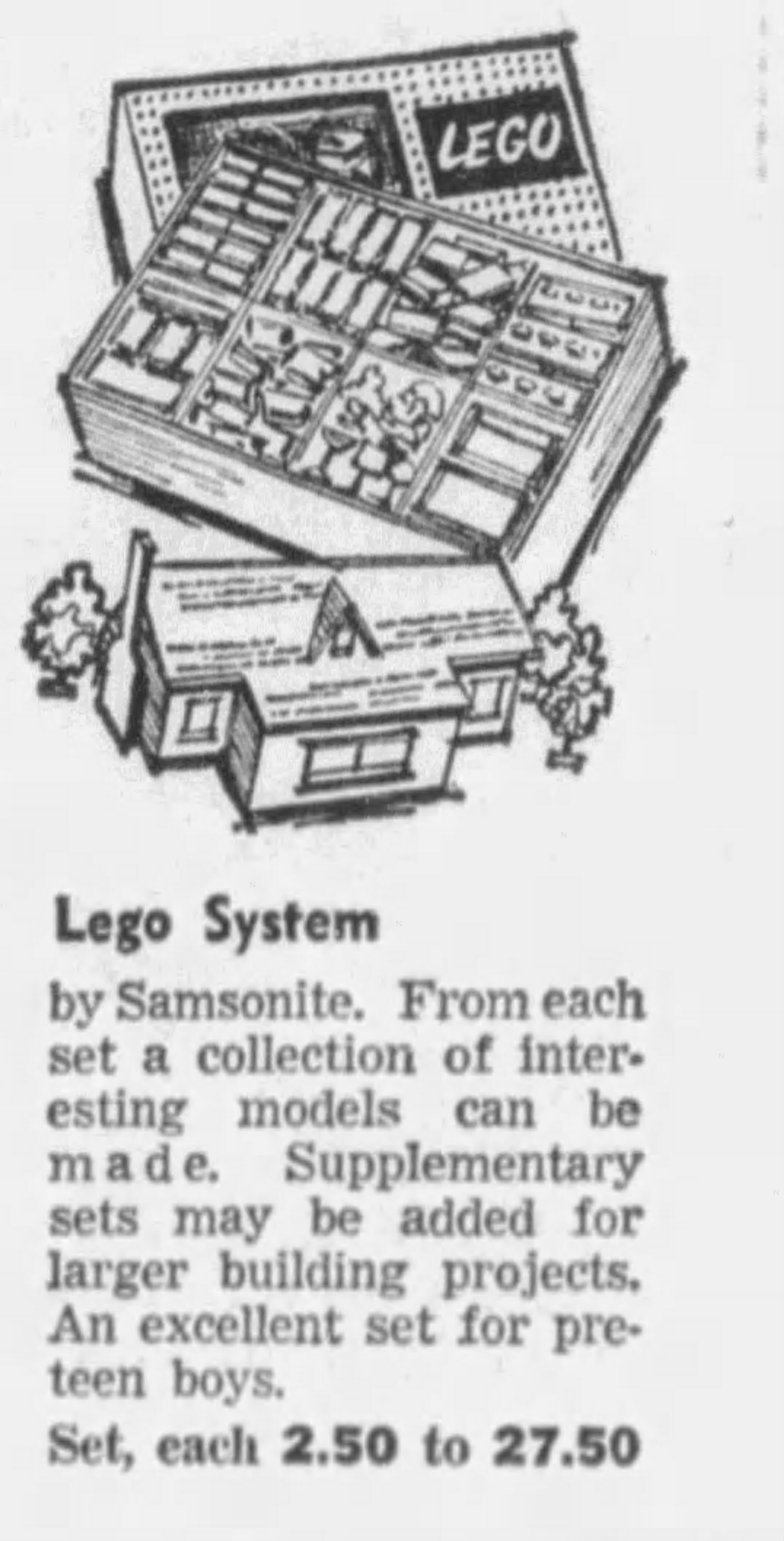
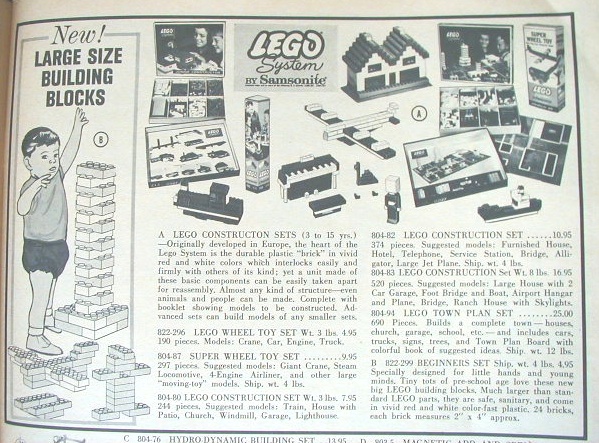
This 1964 F.A.O. Schwarz catalog again shows another unique image of the 725 Town Plan with traffic signs clearly visible:
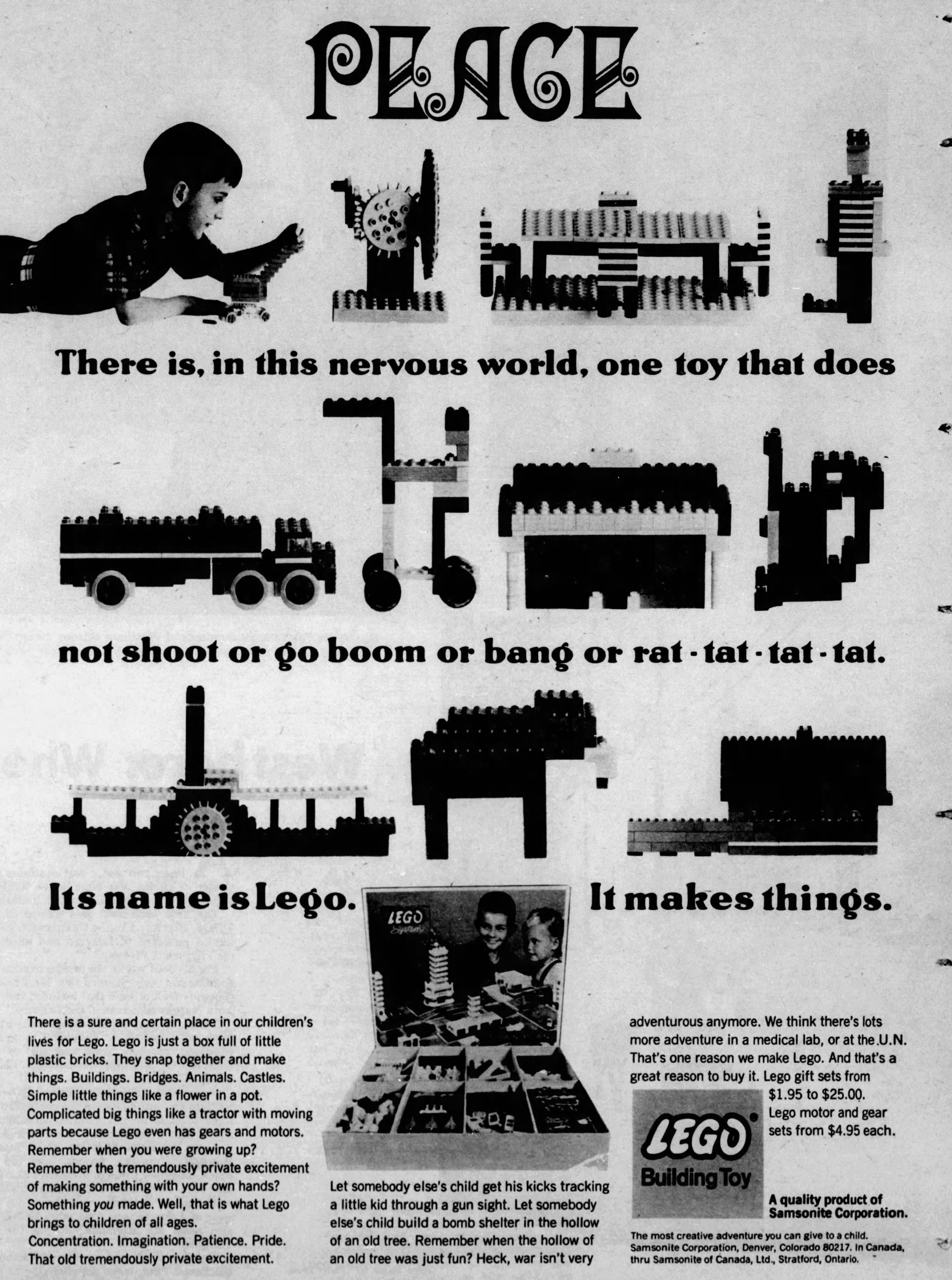
It's not until 1965 that an open box 725 Town Plan is finally shown without traffic signs. From The Boston Globe, December 5th, 1965:
There is also a prototype 725 box shown on an early Samsonite pack-in pamphlet. Prototype is a bit of a loose term, as it was simply a reuse of the European Town Plan's box top with '725' on the side. More of a mockup than anything:
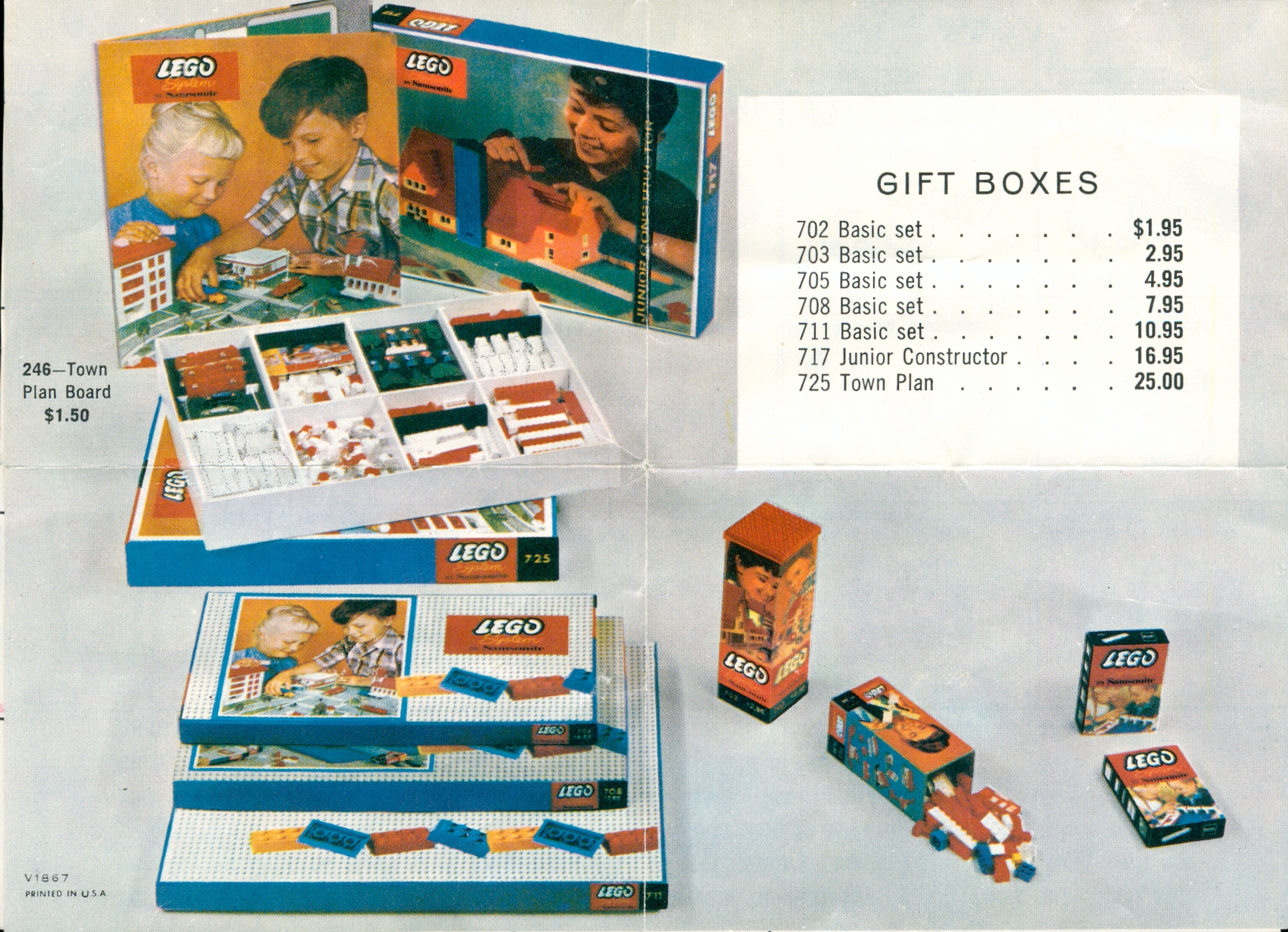
I'm unsure if the contents are also representative of what the set was originally supposed to contain, as there are some weird oddities. For one, what's going on in the top left compartment? What pamphlet did they use in there—wouldn't they have known they were taking the picture for the actual release pamphlet? Why have a pamphlet in there at all, was it an existing European one?
I don't know.
Regardless, I caution the use of the above newspapers/catalogs to prove or disprove the set's inclusion of traffic signs within certain years/productions.
Suggested Model
Despite everything working against this set (having a one step instruction manual is a big one), I quite enjoyed building the town buildings. To be fair, I was very careful, as I wanted to use exactly the pieces I was supposed to, but the isometric drawing does not show exactly how some of the buildings are built.
As all the parts in my kit are cellulose acetate and have warped and lost clutch power overtime, there were some very fragile sections, but you can hardly tell on the completed model:
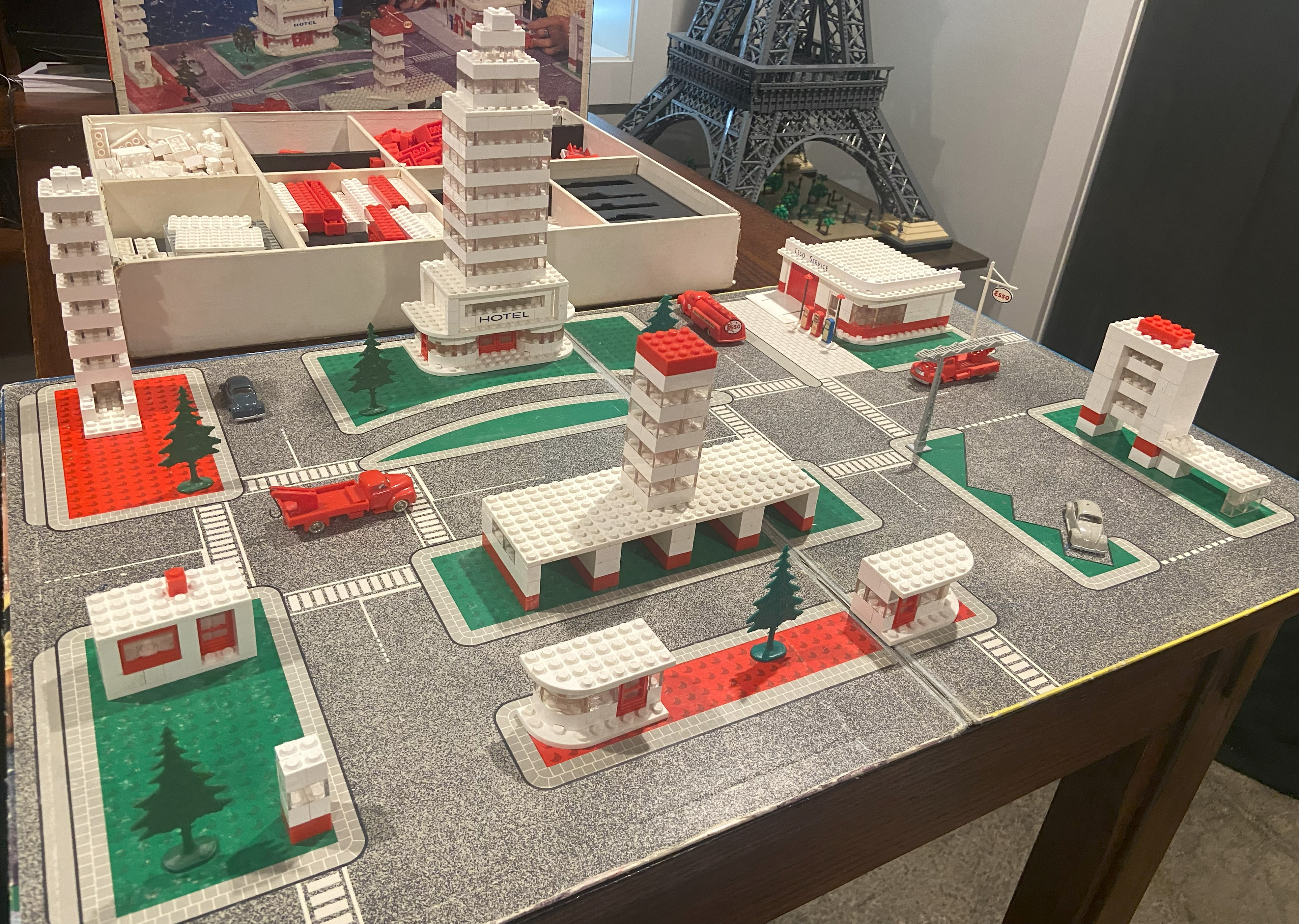
Here's a closer look. Ignore that I stupidly left the tow truck on the wrong side of the road in the middle of the intersection:
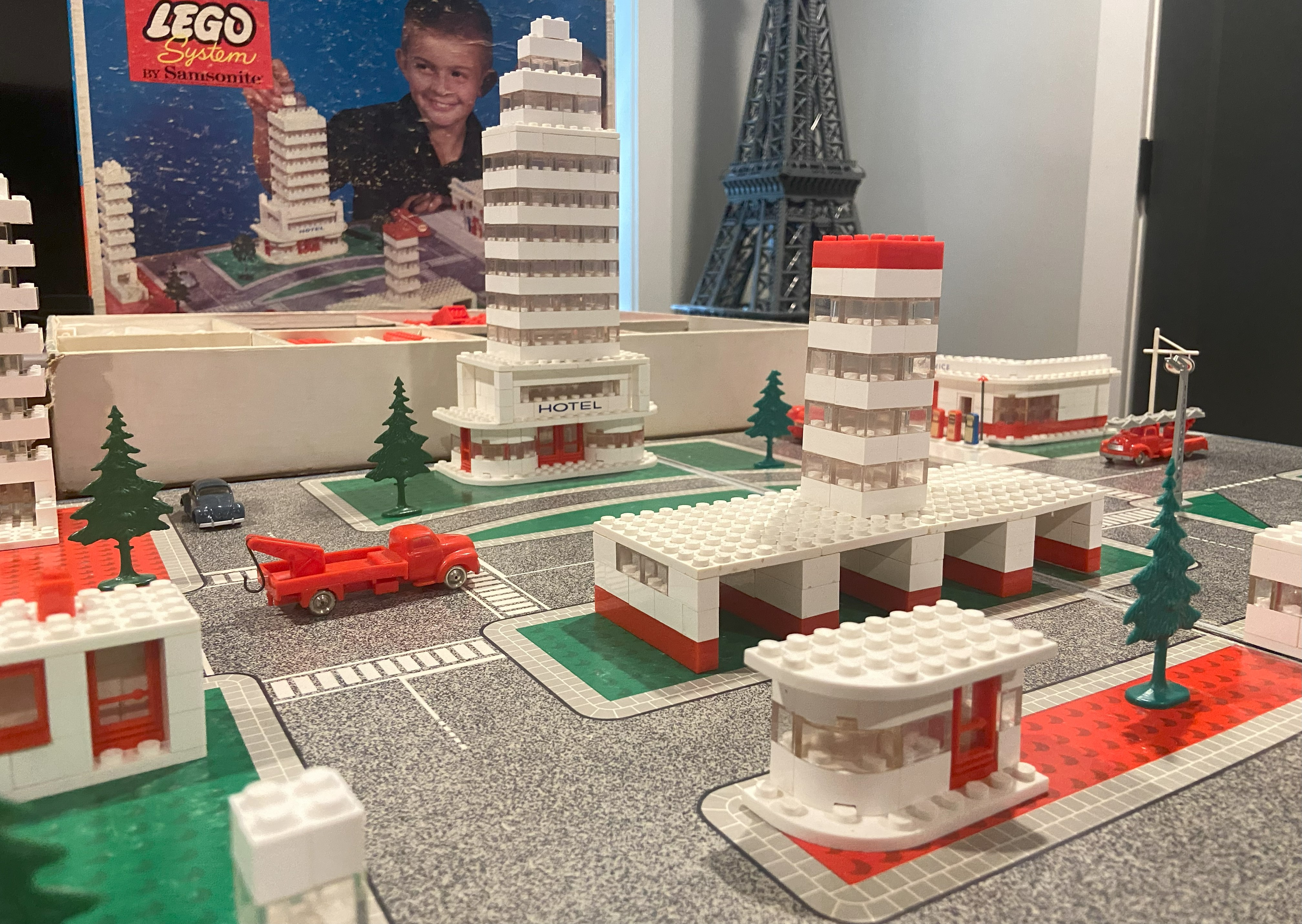
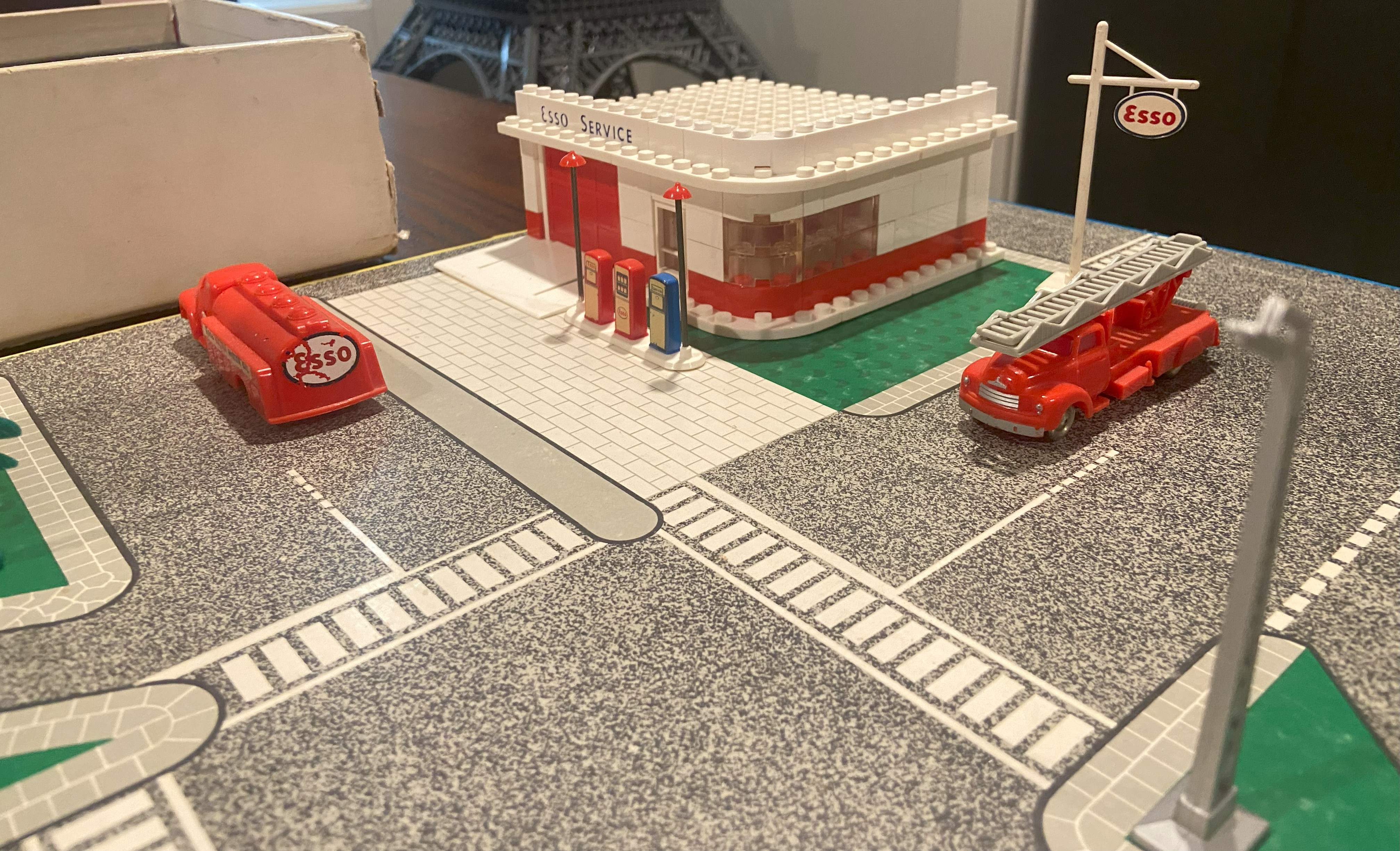
Here is a closeup of the Esso Service Station. I imagine they want you to build it similar to the European model:
These are the leftover parts from when I finished. I imagine I wouldn't have enjoyed building the model as much if I didn't have a ton of spare parts available:
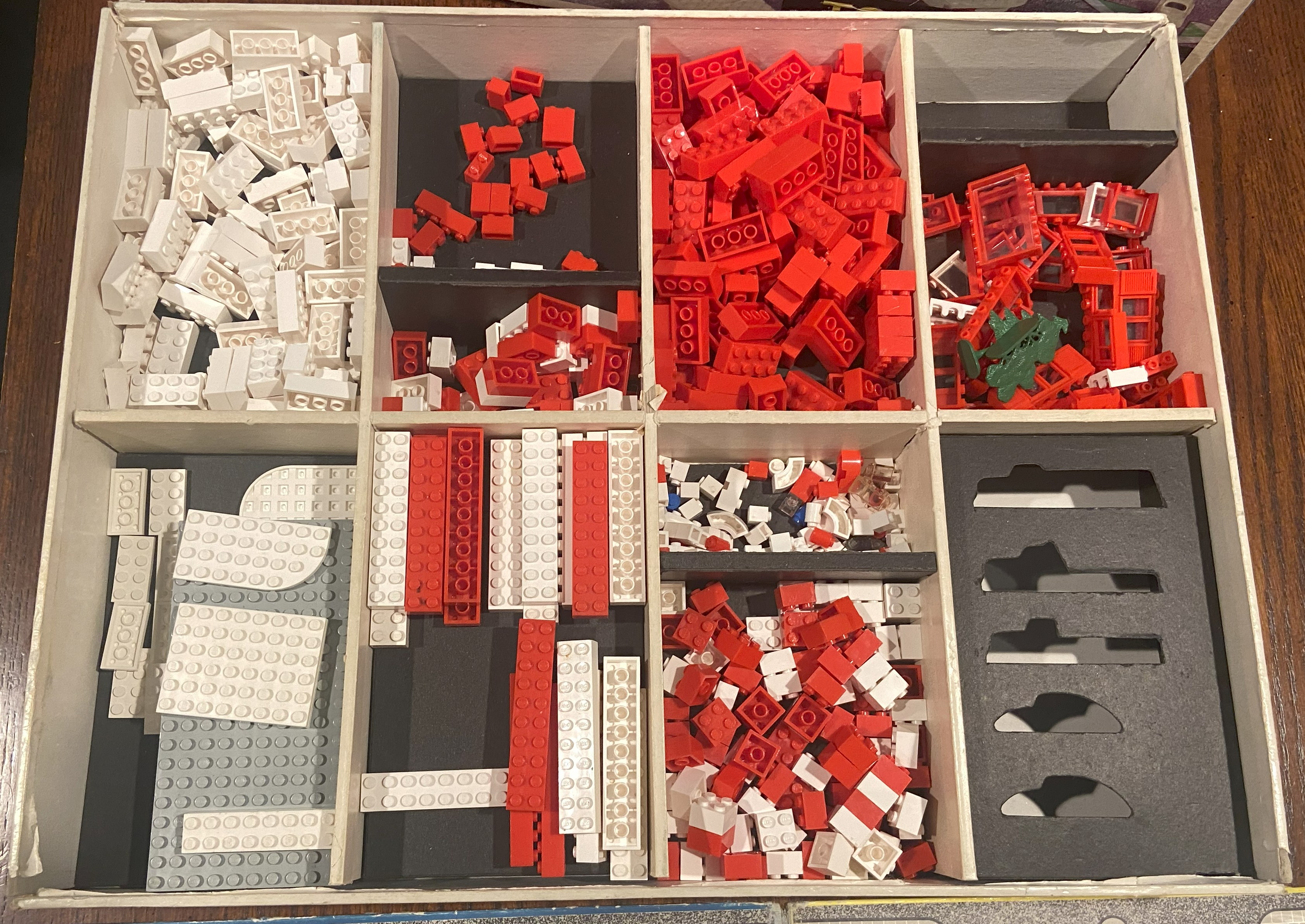
That large assortment of extra parts is the main reason I suspect there were extra pieces added.
Should I collect this set?
In my opinion, if you were to get any set from Samsonite's lineup, this is the one to get.
That doesn't mean you should buy the first one you see, as used examples vary wildly. If you were to only buy one, I'd get one that has all of its 1:87 vehicles in unbroken condition (VWs have undamaged front and back bumpers) as well as complete (service vehicles have their hook, ladder, and reel). I'd also look for one that has all of its inserts and has not had too many 1965+ sets mixed in.
The price for some copies, however, is not for the faint of heart. I paid ~$350 for mine ($300 for the box and contents, which was probably too much, and $50 for a 605 Wheel Toy that luckily contained most the 1:87 supplements and the two VW beetles I was missing). I wouldn't pay $400+ for one, you can usually source a very nice one for under $300 if you're patient enough, with some near complete examples going for just over $100. The majority of the price will be influenced by the 1:87 elements and vehicles.
Obviously it doesn't lend itself to display very well, but I think it best captures the essence of LEGO Samsonite. I can't exactly explain it, but while a lot of Samsonite's sets represent a collector's novelty nowadays, the 725 has a certain allure to it that elevates it. It's become a symbol of sorts; this was Samsonite's best foot forward.
The best comparison I can make is that it's like watching a TV show with a really fascinating idea behind it. Initially excited, you watch it all the way through, but it doesn't end on a very good note. So you go back and rewatch some of the older episodes, and you now finding yourself gravitating towards something you didn't enjoy as much before, seeing it in a new light.
It's a set you could spend hours upon hours pouring over examples of, learning about, obsessing over. I don't mean to sound dramatic either, I'm convinced I could fill an entire book with only the 725 Town Plan's history and examples. There's not another single LEGO set new or old I can think of that I'd be able to do that for.
I get that it sounds like I'm exaggerating, and maybe I am a little, but there is just so much that can be talked about, discussed, compared, etc. It's one of the few 1961-65 sets that has a bit more under the hood in terms of story, even though its right at the beginning. A lot of the later sets get the benefit of context, so they have a lot more to discuss than would be typically expected. The 725, beyond the European 810, builds its own context.
Having even only one copy provides plenty of investigation. Even now, after all of this, I still have plenty of unanswered questions about my own copy that I believe can still be answered with enough rigor. The entrails of a challenge like that do not come around often.
That's how I feel about the 725 Town Plan.